




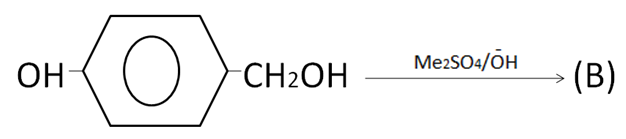
The Product (B) is:
(A)
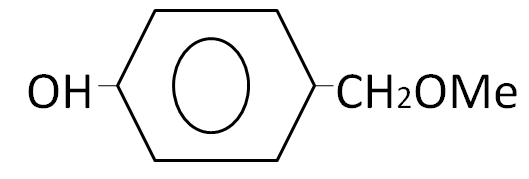
(B)
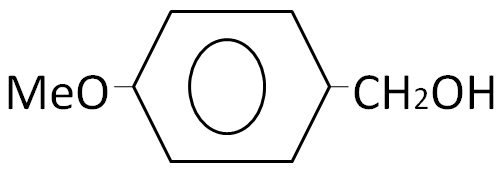
(C)
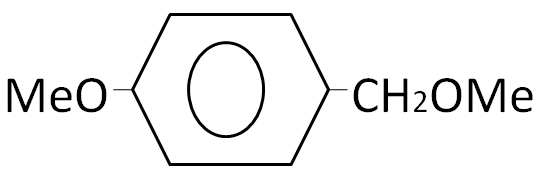
(D) all
Answer
 Verified
576k+ views
Hint :Alcohols are those organic hydrocarbons which are attached with a hydroxyl group like methanol. Phenols are those organic hydrocarbons in which the benzene ring is in direct contact with the hydroxyl group. There are two types of nucleophilic substitution reactions namely substitution nucleophilic bimolecular reactions and substitution nucleophilic unimolecular reactions.
Complete Step By Step Answer:
Alcohol is the organic group in which carbon is in direct contact of the hydroxyl group like Methanol. Whereas the phenol is the organic group in which the benzene ring is in direct contact of the hydroxyl group like 1 Hydroxy benzene or commonly called the Phenol.
For the nucleophilic substitution reactions, we have two types of mechanisms namely substitution nucleophilic bimolecular reactions $ {S_N}2 $ and substitution nucleophilic unimolecular reactions $ {S_N}1 $ .
In $ {S_N}2 $ the attack of the approaching group is from the back side of the alpha-carbon. Thus in the case of $ {S_N}2 $ steric hindrance plays a vital role in the product formation. There is no reversible step in this mechanism, with the formation of the neutral transition state.
In $ {S_N}1 $ the attack of the approaching group is from the front that is head on of the alpha-carbon. Thus the Steric hindrance does not affect the stereochemistry of the product on a large scale. The first step of the reaction is the formation of the carbocation as an intermediate which is reversible in nature and is the slowest step of the reaction. The formation of carbocation intermediate is the rate determining step.
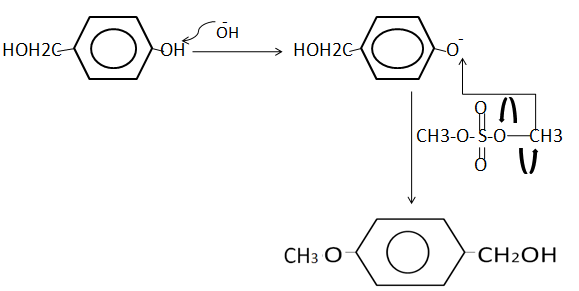
The detailed mechanism of the above reaction asked is given below
Note :
We have several types of reactions, like substitution reaction, elimination reaction, addition reaction, rearrangement reactions. One should be very careful when opting for the mechanisms, as the product of one mechanism may not be in the same stereo arrangement in another reaction mechanism. Further the preconditions like catalyst, temperature, pressure, etc vary in all the reactions.
Complete Step By Step Answer:
Alcohol is the organic group in which carbon is in direct contact of the hydroxyl group like Methanol. Whereas the phenol is the organic group in which the benzene ring is in direct contact of the hydroxyl group like 1 Hydroxy benzene or commonly called the Phenol.
For the nucleophilic substitution reactions, we have two types of mechanisms namely substitution nucleophilic bimolecular reactions $ {S_N}2 $ and substitution nucleophilic unimolecular reactions $ {S_N}1 $ .
In $ {S_N}2 $ the attack of the approaching group is from the back side of the alpha-carbon. Thus in the case of $ {S_N}2 $ steric hindrance plays a vital role in the product formation. There is no reversible step in this mechanism, with the formation of the neutral transition state.
In $ {S_N}1 $ the attack of the approaching group is from the front that is head on of the alpha-carbon. Thus the Steric hindrance does not affect the stereochemistry of the product on a large scale. The first step of the reaction is the formation of the carbocation as an intermediate which is reversible in nature and is the slowest step of the reaction. The formation of carbocation intermediate is the rate determining step.
The detailed mechanism of the above reaction asked is given below
Note :
We have several types of reactions, like substitution reaction, elimination reaction, addition reaction, rearrangement reactions. One should be very careful when opting for the mechanisms, as the product of one mechanism may not be in the same stereo arrangement in another reaction mechanism. Further the preconditions like catalyst, temperature, pressure, etc vary in all the reactions.
Recently Updated Pages
Which of the following graphs shows the variation of class 12 physics CBSE

Draw a labelled diagram of the human male reproductive class 12 biology CBSE
Describe the experiment to compare the emf of two cells class 12 physics CBSE
What is standard hydrogen electrode
What is conventional current and electric current class 12 physics CBSE
2Bromopentane is treated with an alcoholic KOH solution class 12 chemistry CBSE
Trending doubts
Draw a labelled sketch of the human eye class 12 physics CBSE
Which are the Top 10 Largest Countries of the World?
Differentiate between homogeneous and heterogeneous class 12 chemistry CBSE
Draw ray diagrams each showing i myopic eye and ii class 12 physics CBSE
Which is the correct genotypic ratio of mendel dihybrid class 12 biology CBSE
What is the Full Form of PVC, PET, HDPE, LDPE, PP and PS ?