




The principal functional group in aspirin is:
- A. Phenyl
B. -COOH
C. Ester
D. All
- A. Phenyl
Answer
 Verified
643.2k+ views
Hint: Functional groups are the specific atoms bonded with certain arrangement due to which a compound gives certain chemical and physical properties. We know that the highest priority functional group is known as the principal functional group.
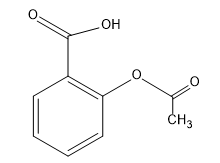
Complete step-by-step answer: From the structure of aspirin it is clear that it contains two functional groups one is
 (carboxylic acid) and another is
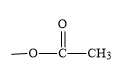 (ester). The common name of aspirin is acetylsalicylic acid and its IUPAC name is 2-Acetoxybenzoic acid. Between ester and carboxylic acid functional groups the highest priority functional group is carboxylic acid. Hence, in aspirin carboxylic acid is the principal functional group. Therefore, the correct option is B, -COOH.
Additional Information: Aspirin is widely used to treat headaches, mild pains and fevers as a prescription medication. Instead, it helps reduce blood clotting, but it may trigger ulcers in the stomach and gastrointestinal tract at higher doses.
A functional group in organic chemistry is a particular group of atoms or bonds within a compound that is responsible for that compound's distinctive chemical reactions. Similarly, a certain functional group can perform similar reactions. In the naming of organic compounds, functional groups often play a significant role; the name of the functional groups combined with the names of the parental alkanes gives a way to differentiate compounds.
Note: A student gets confused between the common names and IUPAC names. In IUPAC nomenclature a compound's systematic naming, combining bonding and fundamental structural relations are given clearly. Hence, in case of Aspirin, as an ester group is joined at the second position of benzene ring with reference to the carboxylic acid group present at the first position, it will act as a substituent and then the whole compound is named accordingly to the rules of IUPAC as 2-Acetoxybenzoic acid.
Complete step-by-step answer: From the structure of aspirin it is clear that it contains two functional groups one is
Additional Information: Aspirin is widely used to treat headaches, mild pains and fevers as a prescription medication. Instead, it helps reduce blood clotting, but it may trigger ulcers in the stomach and gastrointestinal tract at higher doses.
A functional group in organic chemistry is a particular group of atoms or bonds within a compound that is responsible for that compound's distinctive chemical reactions. Similarly, a certain functional group can perform similar reactions. In the naming of organic compounds, functional groups often play a significant role; the name of the functional groups combined with the names of the parental alkanes gives a way to differentiate compounds.
Note: A student gets confused between the common names and IUPAC names. In IUPAC nomenclature a compound's systematic naming, combining bonding and fundamental structural relations are given clearly. Hence, in case of Aspirin, as an ester group is joined at the second position of benzene ring with reference to the carboxylic acid group present at the first position, it will act as a substituent and then the whole compound is named accordingly to the rules of IUPAC as 2-Acetoxybenzoic acid.
Recently Updated Pages
Which will be the least stable resonating structure class 11 chemistry CBSE

How many 5 digit telephone numbers can be construc-class-11-maths-CBSE
How do you find the angle of the resultant vector class 11 physics CBSE
Draw labelled diagram of the following i Gram seed class 11 biology CBSE
1 Quintal is equal to a 110 kg b 10 kg c 100kg d 1000 class 11 physics CBSE
What is the need and importance of classification class 11 biology CBSE
Trending doubts
Difference between physical and chemical change class 11 chemistry CBSE
Draw a diagram of nephron and explain its structur class 11 biology CBSE
Draw a neat labeled diagram of a screw gauge Name its class 11 physics CBSE
Draw a neat diagram of Spirogyra and label the Outermost class 11 biology CBSE
Define cubit handspan armlength and footspan class 11 physics CBSE
Draw a molecular orbital diagram of N2 or O2 with magnetic class 11 chemistry CBSE