




The potential energy of a body at height \[h\] is \[mgh\]. Then its kinetic energy just before hitting the ground is ?
Answer
 Verified
542.1k+ views
Hint:Potential energy is the energy which a body has due to its position or arrangement. The energy is measured relative to a position, we can consider the point to be at zero potential. So for bodies above the surface we take the surfaces as zero potential points, with respect to it we have potential energy as \[mgh\] where \[h\] is the height above the surface.
Complete step by step answer:
As by law of conservation of energy, energy is neither created or destroyed. Energy only changes its form from one to the other forms. In the question, potential energy of the body is given as \[mgh\]. When the body falls to hit the ground its potential energy is converted into kinetic energy to follow the law of conservation of mechanical energy. Thus the kinetic energy of the body just before hitting the ground is \[mgh\], which was initially at a height \[h\] above the surface of earth having potential energy \[mgh\].
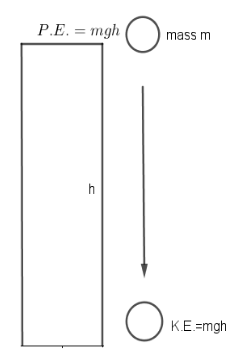
Note: From the law of conservation of energy the total mechanical energy of a body is the sum of potential and kinetic energy. T.E. \[ = P.E. + K.E\] which is defined on each and every point in the particle's trajectory. As on the height h body only possesses potential energy and while reaching ground the energy is converted into kinetic energy.
Complete step by step answer:
As by law of conservation of energy, energy is neither created or destroyed. Energy only changes its form from one to the other forms. In the question, potential energy of the body is given as \[mgh\]. When the body falls to hit the ground its potential energy is converted into kinetic energy to follow the law of conservation of mechanical energy. Thus the kinetic energy of the body just before hitting the ground is \[mgh\], which was initially at a height \[h\] above the surface of earth having potential energy \[mgh\].
Note: From the law of conservation of energy the total mechanical energy of a body is the sum of potential and kinetic energy. T.E. \[ = P.E. + K.E\] which is defined on each and every point in the particle's trajectory. As on the height h body only possesses potential energy and while reaching ground the energy is converted into kinetic energy.
Recently Updated Pages
Master Class 11 Economics: Engaging Questions & Answers for Success

Master Class 11 English: Engaging Questions & Answers for Success
Master Class 11 Maths: Engaging Questions & Answers for Success
Class 11 Question and Answer - Your Ultimate Solutions Guide
Master Class 11 Social Science: Engaging Questions & Answers for Success
Master Class 11 Business Studies: Engaging Questions & Answers for Success
Trending doubts
Differentiate between an exothermic and an endothermic class 11 chemistry CBSE
One Metric ton is equal to kg A 10000 B 1000 C 100 class 11 physics CBSE
There are 720 permutations of the digits 1 2 3 4 5 class 11 maths CBSE
In what year Guru Nanak Dev ji was born A15 April 1469 class 11 social science CBSE
Difference Between Prokaryotic Cells and Eukaryotic Cells
Draw a diagram of a plant cell and label at least eight class 11 biology CBSE