




The outer capsule of drugs is made up of a polymer of:
A) Glycolic acid and lactic acid
B) Glycine and caproic acid
C) Salicylic acid and p-aminobenzoic acid
D) 3-hydroxybutanoic acid and 3-hydroxypentanoic acid
Answer
 Verified
616.2k+ views
Hint:
The monomers that are used to produce the polymer is hydroxyl acid. It contains four and five carbon atoms in each of the monomers.
Complete step by step solution:
The cover of the capsule of drugs is made out of PHBV polymer. It is synthesized using 3 hydroxybutanoic acid and 3 hydroxypentanoic acid. It is a polymer made out of the above two monomers and the correct option is the D.
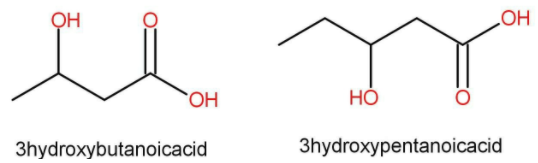
Additional information:
PHBV is the abbreviation for 3-hydroxybutyrate-co-3-hydroxyvalerate. It was first manufactured in 1983. It was manufactured by imperial chemical industries. The properties of PHBV depend on the ratio of the respective monomers used. The properties will change if the ratio varies. It is a very good alternative in comparisons to the other synthetic and non biodegradable.
It is a biodegradable polymer and is obviously not toxic in nature because it is used in the preparation of medicines. It is made up of bio compatible plastic that is naturally produced by bacteria. It is used as an alternative for the plastics and is non biodegradable and upon decomposition they form carbon dioxide and water. It undergoes bacterial degradation. Just as humans use fats as a source of energy PHBV acts as a source of energy for microorganisms.
Note:
In spite of its various advantages it also has some of the disadvantages. No doubt it is biodegradable and renewable but it is very expensive, it is difficult to process PHBV and has low thermal stability. Polymers are macromolecules and are made up joining the monomers.
The monomers that are used to produce the polymer is hydroxyl acid. It contains four and five carbon atoms in each of the monomers.
Complete step by step solution:
The cover of the capsule of drugs is made out of PHBV polymer. It is synthesized using 3 hydroxybutanoic acid and 3 hydroxypentanoic acid. It is a polymer made out of the above two monomers and the correct option is the D.
Additional information:
PHBV is the abbreviation for 3-hydroxybutyrate-co-3-hydroxyvalerate. It was first manufactured in 1983. It was manufactured by imperial chemical industries. The properties of PHBV depend on the ratio of the respective monomers used. The properties will change if the ratio varies. It is a very good alternative in comparisons to the other synthetic and non biodegradable.
It is a biodegradable polymer and is obviously not toxic in nature because it is used in the preparation of medicines. It is made up of bio compatible plastic that is naturally produced by bacteria. It is used as an alternative for the plastics and is non biodegradable and upon decomposition they form carbon dioxide and water. It undergoes bacterial degradation. Just as humans use fats as a source of energy PHBV acts as a source of energy for microorganisms.
Note:
In spite of its various advantages it also has some of the disadvantages. No doubt it is biodegradable and renewable but it is very expensive, it is difficult to process PHBV and has low thermal stability. Polymers are macromolecules and are made up joining the monomers.
Recently Updated Pages
Which of the following graphs shows the variation of class 12 physics CBSE

Draw a labelled diagram of the human male reproductive class 12 biology CBSE
Describe the experiment to compare the emf of two cells class 12 physics CBSE
What is standard hydrogen electrode
What is conventional current and electric current class 12 physics CBSE
2Bromopentane is treated with an alcoholic KOH solution class 12 chemistry CBSE
Trending doubts
Draw a labelled sketch of the human eye class 12 physics CBSE
Which are the Top 10 Largest Countries of the World?
Differentiate between homogeneous and heterogeneous class 12 chemistry CBSE
Draw ray diagrams each showing i myopic eye and ii class 12 physics CBSE
Which is the correct genotypic ratio of mendel dihybrid class 12 biology CBSE
What is the Full Form of PVC, PET, HDPE, LDPE, PP and PS ?