




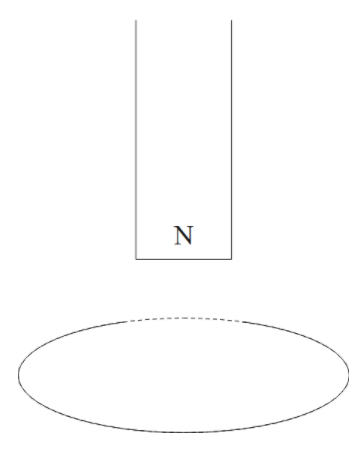
The north pole of a magnet is brought down along the axis of a horizontal circular coil (figure). As a result, the flux through the coil changes from 0.4 Weber to 0.9 Weber in an interval of half of a second. Find the average emf included during this period. Is the induced current clockwise or anticlockwise as you look into the coil from the side of the magnet?
Answer
 Verified
609.9k+ views
Hint: To answer this question we should be familiar with that of the equation of emf. Once we write down the equation, we can easily obtain the emf for this question by putting the values that are already mentioned to us. On the basis of the sign of the emf that we will get we can determine the direction of it.
Complete step by step answer:
We know that induced emf is given as:
$\varepsilon = - \dfrac{{d\phi }}{{dt}}$
So now we have to evaluate the formula by putting the values that are mentioned in the question. So here the expression goes:
$
\varepsilon = - \dfrac{{(0.9 - 0.4)}}{{0.5}} \\
\Rightarrow \varepsilon = - 1V \\
$
Thus we can say that the EMF that is produced is 1 V and it will oppose the motion of the magnet towards the coil. The direction of the current will be in an anticlockwise direction in this case, in the coil and it will behave as the north pole of the magnet.
Note: For the easy understanding of such questions we should be knowing that if a magnet is moved into a coil of wire, then changing the magnetic field and the magnetic flux through the coil, will generate a voltage in the coil. This is known as the Faraday’s Law.
It is also known that the polarity of the induced emf is such that it will produce a current whose magnetic field will oppose the change that is produced.
Complete step by step answer:
We know that induced emf is given as:
$\varepsilon = - \dfrac{{d\phi }}{{dt}}$
So now we have to evaluate the formula by putting the values that are mentioned in the question. So here the expression goes:
$
\varepsilon = - \dfrac{{(0.9 - 0.4)}}{{0.5}} \\
\Rightarrow \varepsilon = - 1V \\
$
Thus we can say that the EMF that is produced is 1 V and it will oppose the motion of the magnet towards the coil. The direction of the current will be in an anticlockwise direction in this case, in the coil and it will behave as the north pole of the magnet.
Note: For the easy understanding of such questions we should be knowing that if a magnet is moved into a coil of wire, then changing the magnetic field and the magnetic flux through the coil, will generate a voltage in the coil. This is known as the Faraday’s Law.
It is also known that the polarity of the induced emf is such that it will produce a current whose magnetic field will oppose the change that is produced.
Recently Updated Pages
Three beakers labelled as A B and C each containing 25 mL of water were taken A small amount of NaOH anhydrous CuSO4 and NaCl were added to the beakers A B and C respectively It was observed that there was an increase in the temperature of the solutions contained in beakers A and B whereas in case of beaker C the temperature of the solution falls Which one of the following statements isarecorrect i In beakers A and B exothermic process has occurred ii In beakers A and B endothermic process has occurred iii In beaker C exothermic process has occurred iv In beaker C endothermic process has occurred

Master Class 12 Social Science: Engaging Questions & Answers for Success
Master Class 12 Physics: Engaging Questions & Answers for Success
Master Class 12 Maths: Engaging Questions & Answers for Success
Master Class 12 Economics: Engaging Questions & Answers for Success
Master Class 12 Chemistry: Engaging Questions & Answers for Success
Three beakers labelled as A B and C each containing 25 mL of water were taken A small amount of NaOH anhydrous CuSO4 and NaCl were added to the beakers A B and C respectively It was observed that there was an increase in the temperature of the solutions contained in beakers A and B whereas in case of beaker C the temperature of the solution falls Which one of the following statements isarecorrect i In beakers A and B exothermic process has occurred ii In beakers A and B endothermic process has occurred iii In beaker C exothermic process has occurred iv In beaker C endothermic process has occurred
Master Class 12 Social Science: Engaging Questions & Answers for Success
Master Class 12 Physics: Engaging Questions & Answers for Success
Trending doubts
Which are the Top 10 Largest Countries of the World?
Draw a labelled sketch of the human eye class 12 physics CBSE
What are the major means of transport Explain each class 12 social science CBSE
Differentiate between homogeneous and heterogeneous class 12 chemistry CBSE
Sulphuric acid is known as the king of acids State class 12 chemistry CBSE
Why should a magnesium ribbon be cleaned before burning class 12 chemistry CBSE