




The life cycle of Funaria is not completed without water. Choose the correct statement.
(a) As Funaria is a bryophyte plant.
(b) As branches will not develop
(c) As fertilization takes place in the presence of water only
(d) As the plant is delicate and will become dry and die without water.
Answer
 Verified
618.3k+ views
Hint: Bryophytes are called amphibians of the plant kingdom as they can live in soil but need water for sexual reproduction. They are further divided into liverworts, hornworts, and mosses. Liverworts include Marchantia, hornworts include Anthoceros and under mosses come Funaria and sphagnum.
Complete answer:
The life cycle of Funaria is not completed without water as fertilization takes place in the presence of water only. Kingdom Plantae includes all multicellular plants of land and water. Major groups of algae, bryophytes, pteridophytes, gymnosperms, and angiosperms belong to this kingdom. Bryophytes are terrestrial, nonvascular plants (absence of xylem and phloem) that still require a moist environment to complete their life cycle. Hence, these are considered amphibians of the plant kingdom. For example, plants like Funaria are dependent on water for their sexual reproduction.
Let's read further to know about Funaria better.
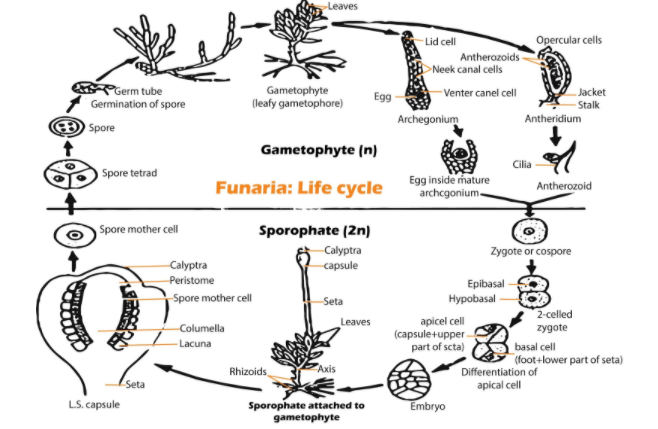
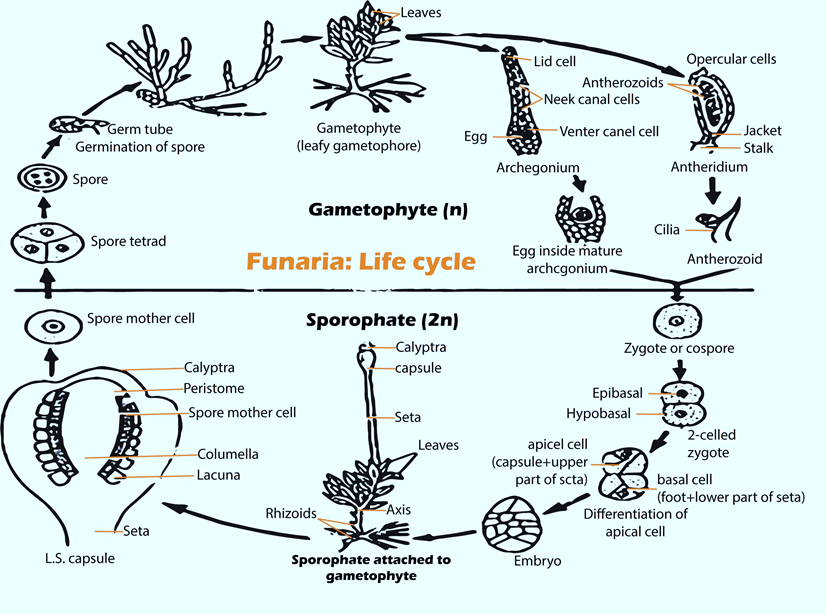
Funaria has a haploid plant body that produces gametes, hence is called a ‘gametophyte’. The male sex organ is called ‘antheridium’ and it produces biflagellate antherozoids. The female sex organ is called ‘archegonium’. The antherozoids as soon as they are released into the water, start moving and come in contact with archegonium. An antherozoid fuses with the egg produced within the archegonium to form a diploid zygote.
So, the correct answer is ‘As fertilization takes place in the presence of water only.’
Note: -The greatest simple problem to overcome in making the transition from water to land is that of desiccation. Any plant not protected in some way, for instance, by a waxy cuticle, may dry out and die very soon.
-The predominant stage of the life cycle of a moss consists of two stages. The first stage is the protonema stage, which develops directly from a spore. It is a green, creeping, branched, and frequently filamentous stage.
Complete answer:
The life cycle of Funaria is not completed without water as fertilization takes place in the presence of water only. Kingdom Plantae includes all multicellular plants of land and water. Major groups of algae, bryophytes, pteridophytes, gymnosperms, and angiosperms belong to this kingdom. Bryophytes are terrestrial, nonvascular plants (absence of xylem and phloem) that still require a moist environment to complete their life cycle. Hence, these are considered amphibians of the plant kingdom. For example, plants like Funaria are dependent on water for their sexual reproduction.
Let's read further to know about Funaria better.
Funaria has a haploid plant body that produces gametes, hence is called a ‘gametophyte’. The male sex organ is called ‘antheridium’ and it produces biflagellate antherozoids. The female sex organ is called ‘archegonium’. The antherozoids as soon as they are released into the water, start moving and come in contact with archegonium. An antherozoid fuses with the egg produced within the archegonium to form a diploid zygote.
So, the correct answer is ‘As fertilization takes place in the presence of water only.’
Note: -The greatest simple problem to overcome in making the transition from water to land is that of desiccation. Any plant not protected in some way, for instance, by a waxy cuticle, may dry out and die very soon.
-The predominant stage of the life cycle of a moss consists of two stages. The first stage is the protonema stage, which develops directly from a spore. It is a green, creeping, branched, and frequently filamentous stage.
Recently Updated Pages
Master Class 11 Social Science: Engaging Questions & Answers for Success

Master Class 11 English: Engaging Questions & Answers for Success
Master Class 11 Maths: Engaging Questions & Answers for Success
Master Class 11 Chemistry: Engaging Questions & Answers for Success
Master Class 11 Biology: Engaging Questions & Answers for Success
Master Class 11 Physics: Engaging Questions & Answers for Success
Trending doubts
One Metric ton is equal to kg A 10000 B 1000 C 100 class 11 physics CBSE
Difference Between Prokaryotic Cells and Eukaryotic Cells
There are 720 permutations of the digits 1 2 3 4 5 class 11 maths CBSE
Draw a diagram of a plant cell and label at least eight class 11 biology CBSE
Two of the body parts which do not appear in MRI are class 11 biology CBSE
Which gas is abundant in air class 11 chemistry CBSE