




The function of mesosome in prokaryotes is
(a) Aerobic respiration
(b) Cell wall formation
(c) Both (a) and (b)
(d) $N_2$ - fixation
Answer
 Verified
629.4k+ views
Hint: Mesosome is a special membranous structure which is formed by the extensions of plasma membrane into the cell. These extensions of the plasma membrane are in the form of vesicles, tubules, and lamellae.
Complete answer:
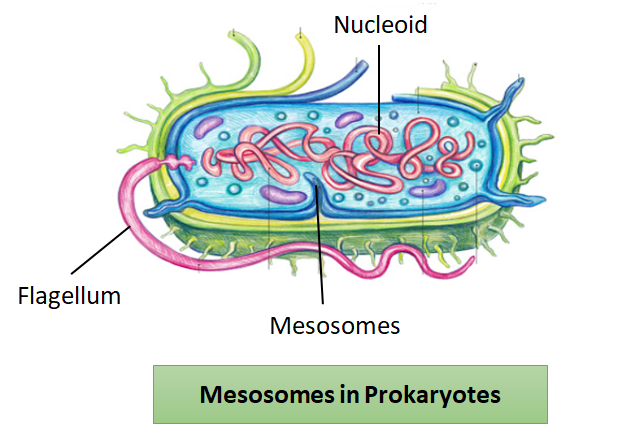
The function of the mesosome in prokaryotes is both aerobic respiration and cell wall formation. Mesosomes are also known as chondroid. The plasma membrane is selectively permeable in nature and interacts with the outside world. This membrane is similar to that of the eukaryotes. Mesosomes perform the following functions:
-They help in cell wall formation.
-They participate in DNA replication.
-They aid in the distribution of DNA to the daughter cells.
-They also help in the respiration process, secretion process, to increase the surface area of the plasma membrane and enzymatic content. Mesosome is found in gram-positive bacteria.
-In some photosynthetic prokaryotes like cyanobacteria and purple bacteria, there are other membranous extensions into the cytoplasm called chromatophores which contain pigments.
Additional information:
-Mesosomes were first observed in 1953 by George B. Chapman and James Hillier. They referred to them as peripheral bodies.
-The term Mesosomes was coined by Fitz-James in 1960.
-These are analogous to cristae in mitochondria in eukaryotic cells, which are finger-like projections and help eukaryotic cells undergo cellular respiration.
Note:
Generally, mesosomes are found in association with the nuclear area or near the site of cell division. They are not found in eukaryotes. Mesosomes are required in formation of the septum at the time of cell division. These are in fact regarded as artifacts coming up during the construction of electron microscopy.
Complete answer:
The function of the mesosome in prokaryotes is both aerobic respiration and cell wall formation. Mesosomes are also known as chondroid. The plasma membrane is selectively permeable in nature and interacts with the outside world. This membrane is similar to that of the eukaryotes. Mesosomes perform the following functions:
-They help in cell wall formation.
-They participate in DNA replication.
-They aid in the distribution of DNA to the daughter cells.
-They also help in the respiration process, secretion process, to increase the surface area of the plasma membrane and enzymatic content. Mesosome is found in gram-positive bacteria.
-In some photosynthetic prokaryotes like cyanobacteria and purple bacteria, there are other membranous extensions into the cytoplasm called chromatophores which contain pigments.
Additional information:
-Mesosomes were first observed in 1953 by George B. Chapman and James Hillier. They referred to them as peripheral bodies.
-The term Mesosomes was coined by Fitz-James in 1960.
-These are analogous to cristae in mitochondria in eukaryotic cells, which are finger-like projections and help eukaryotic cells undergo cellular respiration.
Note:
Generally, mesosomes are found in association with the nuclear area or near the site of cell division. They are not found in eukaryotes. Mesosomes are required in formation of the septum at the time of cell division. These are in fact regarded as artifacts coming up during the construction of electron microscopy.
Recently Updated Pages
Master Class 11 English: Engaging Questions & Answers for Success

Master Class 11 Social Science: Engaging Questions & Answers for Success
Master Class 11 Maths: Engaging Questions & Answers for Success
Master Class 11 Biology: Engaging Questions & Answers for Success
Master Class 11 Physics: Engaging Questions & Answers for Success
Master Class 11 Chemistry: Engaging Questions & Answers for Success
Trending doubts
One Metric ton is equal to kg A 10000 B 1000 C 100 class 11 physics CBSE
Difference Between Prokaryotic Cells and Eukaryotic Cells
Find the value of the expression given below sin 30circ class 11 maths CBSE
1 ton equals to A 100 kg B 1000 kg C 10 kg D 10000 class 11 physics CBSE
Two of the body parts which do not appear in MRI are class 11 biology CBSE
What are hard magnetic materials class 11 physics CBSE