




The first stable product of $C_4$ /HSK photosynthesis is
A) Phosphoglyceric acid
B) Ribulose 1,5 bi-phosphate
C) Malic acid
D) Phosphoglyceraldehyde
Answer
 Verified
590.7k+ views
Hint: The Hatch-Slack Pathway is utilised by the plants which thrive on hot and dry climate. The first stable product is the 4-carbon compound. The $C_4$ plants produce more energy than $C_3$ plants. The HSK pathway takes place in the mesophyll cells.
Complete answer
To answer this question we must know about the Hatch-Slack pathway. The Plants living in the desert follow the HSK pathway rather than Calvin cycle. In these plants, they have special adaptations. In C-4 plants the carbon dioxide is fixed in the mesophyll cells. The 4-Carbon compound called the oxaloacetic acid is the first product.
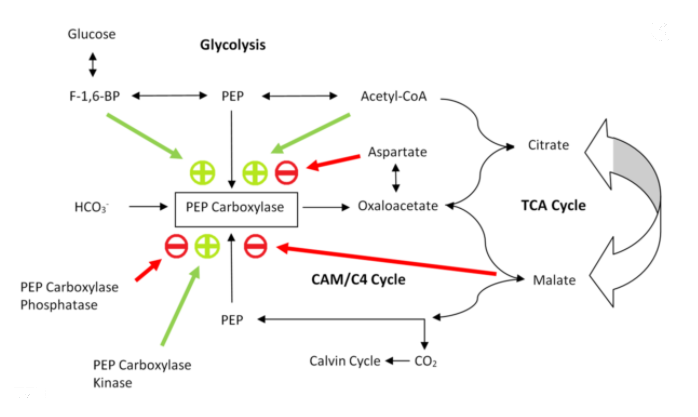
In the HSK pathway the cycle begins with the formation of phosphoenolpyruvate, a 3-carbon compound. This PEP gets converted into a 4-C compound called Oxaloacetic acid. This is converted into malic acid which is stable. This is then transferred from mesophyll to bundle sheath cells.
Phosphoglyceric acid- It is a 3-Carbon compound which is intermediate in between Calvin cycle and glycolysis.
Ribulose 1,5 bisphosphate- It is a 5-C compound involved in Calvin cycle.
Phosphoglyceraldehyde- It is an intermediate in photosynthesis and glycolysis. It is a 3-C compound.
Thus, the correct answer is option ‘C’.
Note: The HSK is the alternative pathway of the Calvin cycle. It takes place during the dark phase of photosynthesis. Corn, shrubs, sugarcane are the plants which follow the HSK pathway. The Calvin pathway is common in both C-3and C-4plants. It takes place in the mesophyll cells of the $C_4$ Plants.
Complete answer
To answer this question we must know about the Hatch-Slack pathway. The Plants living in the desert follow the HSK pathway rather than Calvin cycle. In these plants, they have special adaptations. In C-4 plants the carbon dioxide is fixed in the mesophyll cells. The 4-Carbon compound called the oxaloacetic acid is the first product.
In the HSK pathway the cycle begins with the formation of phosphoenolpyruvate, a 3-carbon compound. This PEP gets converted into a 4-C compound called Oxaloacetic acid. This is converted into malic acid which is stable. This is then transferred from mesophyll to bundle sheath cells.
Phosphoglyceric acid- It is a 3-Carbon compound which is intermediate in between Calvin cycle and glycolysis.
Ribulose 1,5 bisphosphate- It is a 5-C compound involved in Calvin cycle.
Phosphoglyceraldehyde- It is an intermediate in photosynthesis and glycolysis. It is a 3-C compound.
Thus, the correct answer is option ‘C’.
Note: The HSK is the alternative pathway of the Calvin cycle. It takes place during the dark phase of photosynthesis. Corn, shrubs, sugarcane are the plants which follow the HSK pathway. The Calvin pathway is common in both C-3and C-4plants. It takes place in the mesophyll cells of the $C_4$ Plants.
Recently Updated Pages
Master Class 11 English: Engaging Questions & Answers for Success

Master Class 11 Social Science: Engaging Questions & Answers for Success
Master Class 11 Maths: Engaging Questions & Answers for Success
Master Class 11 Biology: Engaging Questions & Answers for Success
Master Class 11 Physics: Engaging Questions & Answers for Success
Master Class 11 Chemistry: Engaging Questions & Answers for Success
Trending doubts
One Metric ton is equal to kg A 10000 B 1000 C 100 class 11 physics CBSE
Difference Between Prokaryotic Cells and Eukaryotic Cells
Two of the body parts which do not appear in MRI are class 11 biology CBSE
Find the value of the expression given below sin 30circ class 11 maths CBSE
Draw a diagram of a plant cell and label at least eight class 11 biology CBSE
10 examples of friction in our daily life