




The extension of the arm is brought about by the muscles shown in the diagram. The movement takes place when
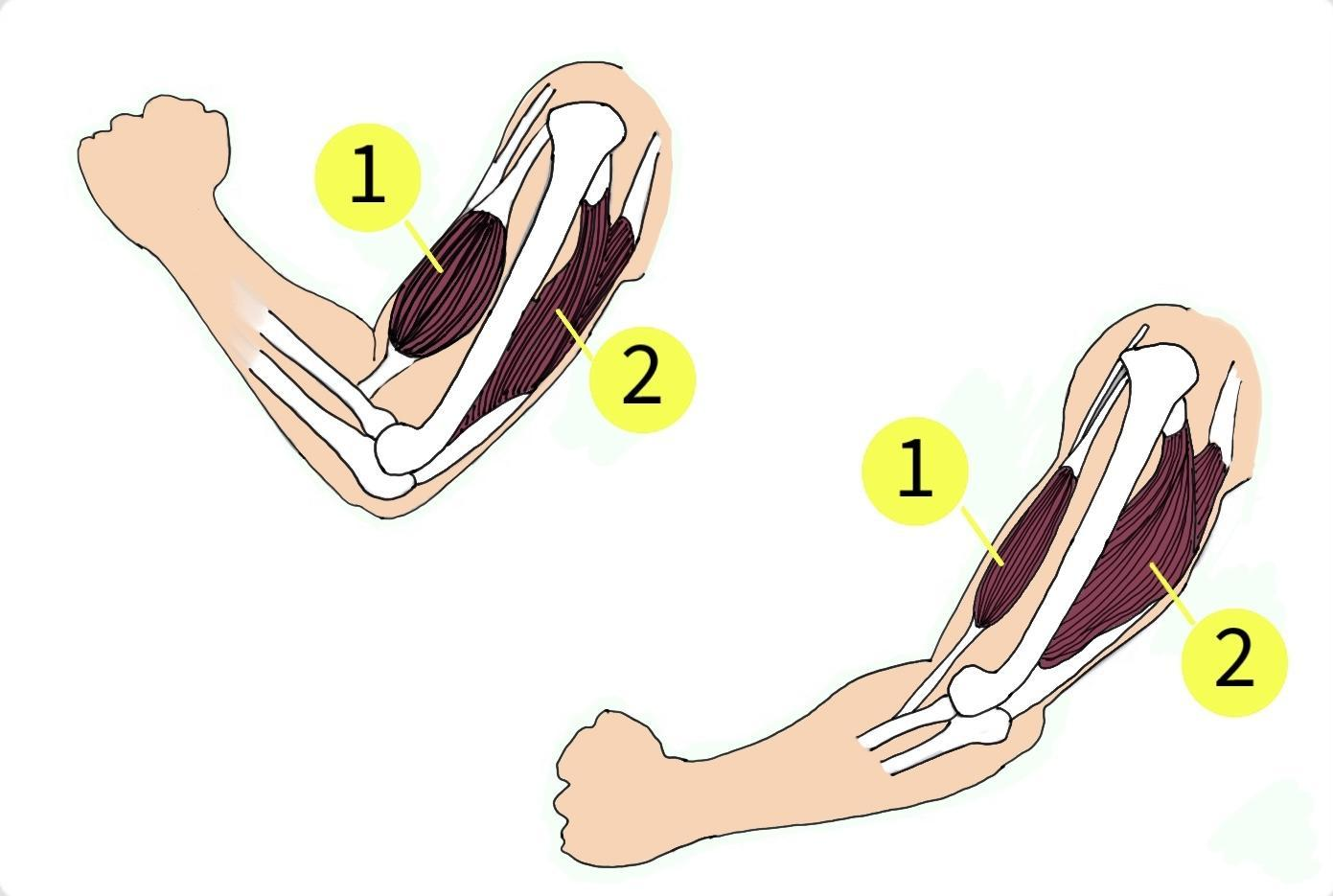
(a) Muscle 1 relaxes while muscle 2 contracts
(b) Muscle 1 contracts while muscle 2 relaxes
(c) Muscle 1 contracts and then both muscles relax
(d) Muscle 1 and muscle 2 both relax at the same time
(e) Muscle 1 and muscle 2 both contract at the same time
Answer
 Verified
604.5k+ views
Hint: Muscles are usually found in antagonistic pairs in the body to carry out movement and locomotion. This means that if one muscle out of the pair contracts, the other one does the opposite to be able to produce any movement.
Complete Answer:
The muscles that are shown in the given figure as 1 and 2 are biceps brachii and triceps brachii respectively. These two muscles are an antagonistic pair and work opposite to each other. In order to move the forearm as the way shown in the diagram, muscle 1 i.e. bicep muscles relax, and muscle 2 i.e. tricep muscles contracts. The relaxation of the biceps allows the forearm to relax and the contraction of the triceps allows the arm to be extended out in the front like that.
Additional information: Let us look at the structure of a muscle.
- A muscle is made up of a number of muscle bundles or fascicles.
- These fascicles are further made up of muscle cells known as muscle fibers.
- Each muscle fiber has a large number of parallelly arranged fibrils known as myofibrils.
- These myofibrils have alternate light and dark bands on it due to the distribution pattern of two proteins known as actin and myosin.
- The interaction between actin and myosin leads to muscle contraction.
So, the correct option is ‘(a) Muscle 1 relaxes while muscle 2 contracts’.
Note:
- A muscle fiber is a syncytium i.e. it contains many nuclei in it.
- The contraction of a muscle takes place by the formation of a cross- bridge between actin and myosin filaments.
- Calcium ions which are very important for the contraction of muscles are stored in the sarcoplasmic reticulum which is similar to the structure of the endoplasmic reticulum.
Complete Answer:
The muscles that are shown in the given figure as 1 and 2 are biceps brachii and triceps brachii respectively. These two muscles are an antagonistic pair and work opposite to each other. In order to move the forearm as the way shown in the diagram, muscle 1 i.e. bicep muscles relax, and muscle 2 i.e. tricep muscles contracts. The relaxation of the biceps allows the forearm to relax and the contraction of the triceps allows the arm to be extended out in the front like that.
Additional information: Let us look at the structure of a muscle.
- A muscle is made up of a number of muscle bundles or fascicles.
- These fascicles are further made up of muscle cells known as muscle fibers.
- Each muscle fiber has a large number of parallelly arranged fibrils known as myofibrils.
- These myofibrils have alternate light and dark bands on it due to the distribution pattern of two proteins known as actin and myosin.
- The interaction between actin and myosin leads to muscle contraction.
So, the correct option is ‘(a) Muscle 1 relaxes while muscle 2 contracts’.
Note:
- A muscle fiber is a syncytium i.e. it contains many nuclei in it.
- The contraction of a muscle takes place by the formation of a cross- bridge between actin and myosin filaments.
- Calcium ions which are very important for the contraction of muscles are stored in the sarcoplasmic reticulum which is similar to the structure of the endoplasmic reticulum.
Recently Updated Pages
Master Class 12 Economics: Engaging Questions & Answers for Success

Master Class 12 English: Engaging Questions & Answers for Success
Master Class 12 Social Science: Engaging Questions & Answers for Success
Master Class 12 Maths: Engaging Questions & Answers for Success
Master Class 12 Physics: Engaging Questions & Answers for Success
Master Class 9 General Knowledge: Engaging Questions & Answers for Success
Trending doubts
One Metric ton is equal to kg A 10000 B 1000 C 100 class 11 physics CBSE
Difference Between Prokaryotic Cells and Eukaryotic Cells
Two of the body parts which do not appear in MRI are class 11 biology CBSE
1 ton equals to A 100 kg B 1000 kg C 10 kg D 10000 class 11 physics CBSE
Draw a diagram of nephron and explain its structur class 11 biology CBSE
10 examples of friction in our daily life