




The earth is acted upon by gravitation of the sun, even though it does not fall into the sun why?
Answer
 Verified
614.1k+ views
Hint: The earth revolves around the sun, due to the gravitational force act on the earth by the sun. By the gravitational force the earth keeps the orbit of the revolution. The earth rotates themselves, and then it rotates the earth. But the earth is not attracted by the sun because of the centripetal force acting on the earth.
Complete step by step solution:
We already know that the earth revolves the sun by the gravitational force acting on the earth by the sun. And the earth revolves the sun by keeping the orbit. For example, take one stick, stone and thread. One end of the thread is tied on the rope and the other end is tied on the stone. Now assume that the stone is the earth and the stick is the sun and the thread acts like the gravitational force. Let the stone revolve around the stick by giving rotational force to the stone. The stone keeps the constant circular orbit, the stone does not fall and does not change the orbit. This is the simple example for the given condition in the question.
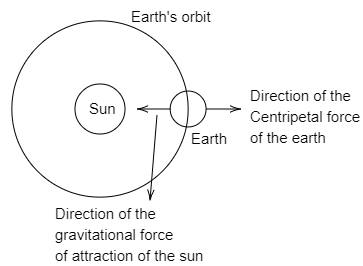
The centripetal force acts on the earth pushes the earth outwards to increase the radius of the orbit, but the gravitational force of the sun pulls the earth to revolve. When the gravitational force and the centripetal forces are equal, the earth revolves in the constant radius of the circular orbit and does not fall.
Note: If the centripetal force of the earth goes maximum to the gravitational force of attraction of the sun, the earth orbit radius gets increased or the earth leaves from the orbit. If the gravitational force of attraction of the sun is maximum to the centripetal force, the earth orbit radius gets decreased.
Complete step by step solution:
We already know that the earth revolves the sun by the gravitational force acting on the earth by the sun. And the earth revolves the sun by keeping the orbit. For example, take one stick, stone and thread. One end of the thread is tied on the rope and the other end is tied on the stone. Now assume that the stone is the earth and the stick is the sun and the thread acts like the gravitational force. Let the stone revolve around the stick by giving rotational force to the stone. The stone keeps the constant circular orbit, the stone does not fall and does not change the orbit. This is the simple example for the given condition in the question.
The centripetal force acts on the earth pushes the earth outwards to increase the radius of the orbit, but the gravitational force of the sun pulls the earth to revolve. When the gravitational force and the centripetal forces are equal, the earth revolves in the constant radius of the circular orbit and does not fall.
Note: If the centripetal force of the earth goes maximum to the gravitational force of attraction of the sun, the earth orbit radius gets increased or the earth leaves from the orbit. If the gravitational force of attraction of the sun is maximum to the centripetal force, the earth orbit radius gets decreased.
Recently Updated Pages
Master Class 12 Economics: Engaging Questions & Answers for Success

Master Class 12 English: Engaging Questions & Answers for Success
Master Class 12 Social Science: Engaging Questions & Answers for Success
Master Class 12 Maths: Engaging Questions & Answers for Success
Master Class 12 Physics: Engaging Questions & Answers for Success
Master Class 9 General Knowledge: Engaging Questions & Answers for Success
Trending doubts
One Metric ton is equal to kg A 10000 B 1000 C 100 class 11 physics CBSE
Difference Between Prokaryotic Cells and Eukaryotic Cells
Two of the body parts which do not appear in MRI are class 11 biology CBSE
1 ton equals to A 100 kg B 1000 kg C 10 kg D 10000 class 11 physics CBSE
Draw a diagram of nephron and explain its structur class 11 biology CBSE
10 examples of friction in our daily life