




The complex formed by a pair of synapsed homologous chromosomes is called as
A. Equatorial plate.
B. Kinetochore.
C. Bivalent.
D. Axoneme.
Answer
 Verified
606k+ views
Hint: The human karyotype represents the total set of chromosomes. There are a total of 46 chromosomes that are present in pairs of 23. Each of the pairs is homologous chromosomes. In the meiosis first stage during the zygotene phase, the homologous chromosomes come close and pair up. This forms a synapsed pair or synaptonemal complex.
Complete answer: The chromosomes are the genetic material present inside the nucleus of the cells. There are a total of 23 pairs of chromosomes and each pair represents the homologous pair of chromosomes.
-During cell division, the chromosomes condense and undergo various cell division processes. The division is a reductional type division that results in daughter cells having half the number of chromosomes as the parents. This type of division involves the process of meiosis. The meiosis involves division in two phases. Meiosis consists of four main stages named leptotene, zygotene, pachytene, and diplotene.
-During the zygotene stage, the two homologous chromosomes attach to each other laterally. This attachment process is called synapsis. The synapsis results in the formation of a complex called synaptonemal complex or the Bivalent. The number of bivalents formed is half the number of total chromosomes.
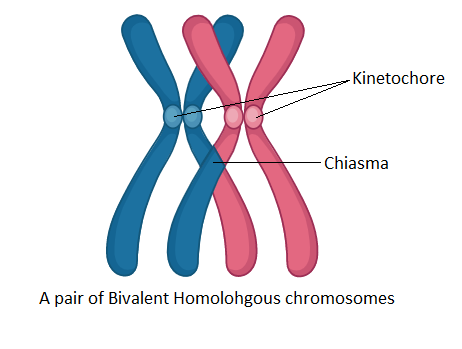
-The equatorial plane is the plane or place that is formed between the poles of a dividing cell in the middle. It is formed because of the movement of the chromosomes at the center of the spindle.
-The kinetochore is the complex of proteins situated at the centromere of the chromosomes. It is the point to which the microtubules of the spindle attach or join.
The axoneme is the cytoskeleton structure that is in the forms of microtubules. They form the core or the base of the cilium or flagellum.
Thus, the right answer is bivalent, option C.
Note: The cell division is a complex mechanism involving cell multiplication. It is the process of the formation of new cells. Mitosis and meiosis are the two types of cell division that takes place in the cells. There is also another type of simplest cell division called amitosis.
Complete answer: The chromosomes are the genetic material present inside the nucleus of the cells. There are a total of 23 pairs of chromosomes and each pair represents the homologous pair of chromosomes.
-During cell division, the chromosomes condense and undergo various cell division processes. The division is a reductional type division that results in daughter cells having half the number of chromosomes as the parents. This type of division involves the process of meiosis. The meiosis involves division in two phases. Meiosis consists of four main stages named leptotene, zygotene, pachytene, and diplotene.
-During the zygotene stage, the two homologous chromosomes attach to each other laterally. This attachment process is called synapsis. The synapsis results in the formation of a complex called synaptonemal complex or the Bivalent. The number of bivalents formed is half the number of total chromosomes.
-The equatorial plane is the plane or place that is formed between the poles of a dividing cell in the middle. It is formed because of the movement of the chromosomes at the center of the spindle.
-The kinetochore is the complex of proteins situated at the centromere of the chromosomes. It is the point to which the microtubules of the spindle attach or join.
The axoneme is the cytoskeleton structure that is in the forms of microtubules. They form the core or the base of the cilium or flagellum.
Thus, the right answer is bivalent, option C.
Note: The cell division is a complex mechanism involving cell multiplication. It is the process of the formation of new cells. Mitosis and meiosis are the two types of cell division that takes place in the cells. There is also another type of simplest cell division called amitosis.
Recently Updated Pages
Master Class 12 Economics: Engaging Questions & Answers for Success

Master Class 12 English: Engaging Questions & Answers for Success
Master Class 12 Social Science: Engaging Questions & Answers for Success
Master Class 12 Maths: Engaging Questions & Answers for Success
Master Class 12 Physics: Engaging Questions & Answers for Success
Master Class 11 Social Science: Engaging Questions & Answers for Success
Trending doubts
One Metric ton is equal to kg A 10000 B 1000 C 100 class 11 physics CBSE
Difference Between Prokaryotic Cells and Eukaryotic Cells
Two of the body parts which do not appear in MRI are class 11 biology CBSE
1 ton equals to A 100 kg B 1000 kg C 10 kg D 10000 class 11 physics CBSE
Draw a diagram of nephron and explain its structur class 11 biology CBSE
10 examples of friction in our daily life