




The chemical differences between DNA and RNA are
A. DNA has deoxyribose sugar and RNA has ribose sugar
B. DNA is double stranded and RNA is single stranded
C. Nitrogenous bases are only present in DNA
D. Both A and B
Answer
 Verified
634.2k+ views
Hint: DNA carries heredity characters within the chromosomes whereas RNA is the messenger of DNA. They are both linear polymers consisting of sugars, phosphates and nitrogen bases with slight key differences between them.
Complete answer:
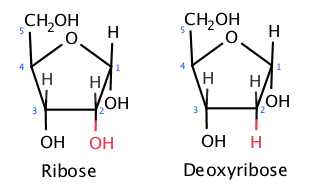
DNA contains the sugar deoxyribose whereas RNA contains the sugar ribose. DNA contains one less oxygen than ribose.
DNA is double-stranded whereas RNA is usually single-stranded.
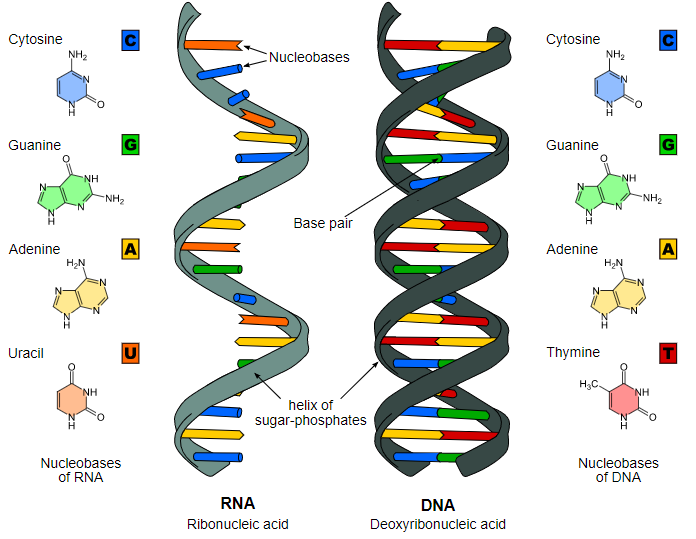
Nitrogenous bases are both present in DNA and RNA. DNA consists of four nitrogen bases - thymine, cytosine, adenine and guanine. RNA contains four nitrogen bases - uracil, cytosine, adenine and guanine. Hence, ‘option C’ is incorrect.
Hence, the correct answer is option (D).
Additional information:
-The full form of DNA is Deoxyribonucleic acid whereas the full form RNA is Ribonucleic acid.
-DNA is present in the nucleus and in mitochondria, a small amount of DNA is present. RNA is formed in the nucleolus and depending on the type of RNA, they are present in different regions of the cytoplasm.
-As DNA is double-stranded in nature, the geometry of the helix is β-form. As RNA is single-stranded in nature the geometry of the helix is α-form.
-For every species, the number of DNA remains the same whereas RNA numbers vary from cell to cell.
-DNA is more stable than RNA.
-DNA is more susceptible to UV light than RNA.
-DNA is generally self-replicating in nature whereas RNA is synthesised according to DNA’s need.
Note: DNA carries genetic information in specific genes and transfers them to the next generation. RNA helps to move the genetic code to produce proteins from the nucleus to the ribosomes. RNA can be divided into three main types – messenger RNA (mRNA), transfer RNA (tRNA) and ribosomal RNA (rRNA). The process of making an RNA copy of a gene sequence is known as transcription whereas the process of creating proteins from an mRNA template is known as translation.
Complete answer:
DNA contains the sugar deoxyribose whereas RNA contains the sugar ribose. DNA contains one less oxygen than ribose.
DNA is double-stranded whereas RNA is usually single-stranded.
Nitrogenous bases are both present in DNA and RNA. DNA consists of four nitrogen bases - thymine, cytosine, adenine and guanine. RNA contains four nitrogen bases - uracil, cytosine, adenine and guanine. Hence, ‘option C’ is incorrect.
Hence, the correct answer is option (D).
Additional information:
-The full form of DNA is Deoxyribonucleic acid whereas the full form RNA is Ribonucleic acid.
-DNA is present in the nucleus and in mitochondria, a small amount of DNA is present. RNA is formed in the nucleolus and depending on the type of RNA, they are present in different regions of the cytoplasm.
-As DNA is double-stranded in nature, the geometry of the helix is β-form. As RNA is single-stranded in nature the geometry of the helix is α-form.
-For every species, the number of DNA remains the same whereas RNA numbers vary from cell to cell.
-DNA is more stable than RNA.
-DNA is more susceptible to UV light than RNA.
-DNA is generally self-replicating in nature whereas RNA is synthesised according to DNA’s need.
Note: DNA carries genetic information in specific genes and transfers them to the next generation. RNA helps to move the genetic code to produce proteins from the nucleus to the ribosomes. RNA can be divided into three main types – messenger RNA (mRNA), transfer RNA (tRNA) and ribosomal RNA (rRNA). The process of making an RNA copy of a gene sequence is known as transcription whereas the process of creating proteins from an mRNA template is known as translation.
Recently Updated Pages
Which of the following graphs shows the variation of class 12 physics CBSE

Draw a labelled diagram of the human male reproductive class 12 biology CBSE
Describe the experiment to compare the emf of two cells class 12 physics CBSE
What is standard hydrogen electrode
What is conventional current and electric current class 12 physics CBSE
2Bromopentane is treated with an alcoholic KOH solution class 12 chemistry CBSE
Trending doubts
Draw a labelled sketch of the human eye class 12 physics CBSE
Which are the Top 10 Largest Countries of the World?
Differentiate between homogeneous and heterogeneous class 12 chemistry CBSE
Draw ray diagrams each showing i myopic eye and ii class 12 physics CBSE
Which is the correct genotypic ratio of mendel dihybrid class 12 biology CBSE
What is the Full Form of PVC, PET, HDPE, LDPE, PP and PS ?