




The calm area, which is the centre of cyclone, is called _______________
A) Eye of Cyclone.
B) Heart of Cyclone.
C) Ear of Cyclone.
D) The mouth of Cyclone.
Answer
 Verified
650.4k+ views
Hint:A cyclone is a system of winds which are rotating counterclockwise or clockwise around a low-pressure centre. The air rotating at high speed rises and cools, creating clouds and moisture. Firstly, we have to look at a picture of a cyclone from the top view. This can give us a better insight with regards to this question.
Step by step solution:
A cyclone is a system of winds which are rotating counterclockwise or clockwise around a low-pressure centre. The air rotating at high speed rises and cools, creating clouds and moisture.
The cyclones have three main parts
The Eye: The eye of the storm is the centre. It’s a relatively calm space. When the eye passes over an area, the wind slows down drastically and the weather feels like the storm has cleared up. But in reality, this is the origin of the proverb ‘calm before the storm’. The part before the eye usually does the most damage, as this is the most destructive of the storm.
The Eyewall: This is the most effective part of the cyclone. The eyewall is where the most high-speed wind and destructive power of the cyclone resides. This is the part that causes the most damage to both lives and property. It is the ring of the thunderstorms, and this changes inside the eye. The eyewall affects the intensity of the cyclone and thus controls its destructive power.
Rainbands: The outermost part of the cyclone is known as the rainbands. This is the part where sudden rain happens. There rainbands have some gaps between them where there are no rain or wind.
Thus, the answer to the question is (A) Eye of the cyclone.
Note:An easy and quick solution to this question is to look at the picture of a cyclone. If we look at this picture of a cyclone, the centre or the hole type section is called the eye of the cyclone.
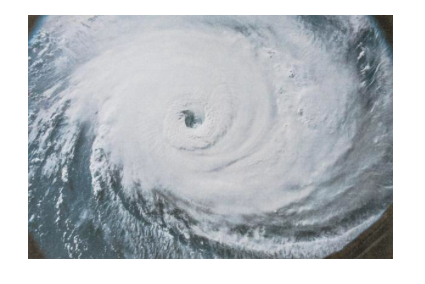
Step by step solution:
A cyclone is a system of winds which are rotating counterclockwise or clockwise around a low-pressure centre. The air rotating at high speed rises and cools, creating clouds and moisture.
The cyclones have three main parts
The Eye: The eye of the storm is the centre. It’s a relatively calm space. When the eye passes over an area, the wind slows down drastically and the weather feels like the storm has cleared up. But in reality, this is the origin of the proverb ‘calm before the storm’. The part before the eye usually does the most damage, as this is the most destructive of the storm.
The Eyewall: This is the most effective part of the cyclone. The eyewall is where the most high-speed wind and destructive power of the cyclone resides. This is the part that causes the most damage to both lives and property. It is the ring of the thunderstorms, and this changes inside the eye. The eyewall affects the intensity of the cyclone and thus controls its destructive power.
Rainbands: The outermost part of the cyclone is known as the rainbands. This is the part where sudden rain happens. There rainbands have some gaps between them where there are no rain or wind.
Thus, the answer to the question is (A) Eye of the cyclone.
Note:An easy and quick solution to this question is to look at the picture of a cyclone. If we look at this picture of a cyclone, the centre or the hole type section is called the eye of the cyclone.
Recently Updated Pages
Which of the following graphs shows the variation of class 12 physics CBSE

Draw a labelled diagram of the human male reproductive class 12 biology CBSE
Describe the experiment to compare the emf of two cells class 12 physics CBSE
What is standard hydrogen electrode
What is conventional current and electric current class 12 physics CBSE
2Bromopentane is treated with an alcoholic KOH solution class 12 chemistry CBSE
Trending doubts
Draw a labelled sketch of the human eye class 12 physics CBSE
Which are the Top 10 Largest Countries of the World?
Differentiate between homogeneous and heterogeneous class 12 chemistry CBSE
Draw ray diagrams each showing i myopic eye and ii class 12 physics CBSE
Which is the correct genotypic ratio of mendel dihybrid class 12 biology CBSE
What is the Full Form of PVC, PET, HDPE, LDPE, PP and PS ?