




The blind sac body plan is applicable to
(a)Porifera
(b)Annelida and Arthropoda
(c)Cnidaria and Platyhelminthes
(d)None of the above
Answer
 Verified
633k+ views
Hint: The blind sac body plan is an incomplete digestive system which is applicable to lower animals. In these sets of animals, the gaseous exchange usually occurs by diffusion through body surfaces.
Complete answer:
In a blind sac body plan, an animal has a single pore which serves the dual function of ingestion as well egestion. That means food enters through an opening into a single cavity and after digestion, the undigested food is passed out from the same opening. It is exhibited in Cnidarians (Coelenterates) and Platyhelminthes(flatworms).
Additional Information:
The incomplete digestive system is present in both Cnidaria and Platyhelminthes. Cnidarians have a central gastrovascular cavity known as coelenteron with an opening behaving both as a mouth as well as an anus. Flatworms are mostly parasites and thus they are devoid of the alimentary canal. They usually absorb the digested food of their host through their general body surface. E.g. Taenia solium.
Porifera or Sponges are primitive multicellular animals with a cellular grade of an organization. A complex canal system in Spongilla maintains continuous water current flowing into the spongocoel. The canal system helps in nutrition, excretion, reproduction, and respiration.
Arthropods are the largest phylum of kingdom Animalia. Their body is segmented and their characteristic feature is the presence of chitin exoskeleton and jointed appendages. Their digestive system is complete with foregut(stomodeum), midgut(mesenteron) and hindgut(proctodaeum).
Annelids are metamerically segmented animals living in freshwater, seawater, or moist soil. Their digestive tract is also complete. Their characteristic feature is the external segmentation of their body into ring-like grooves called annuli.
So, the correct answer is ‘Cnidaria and Platyhelminthes’.
Note: Digestion is the breakdown of complex food molecules into simpler molecules that can be easily absorbed and used by the cells to fulfill their nutritional requirements. Digestion is particularly of two types based on the location where hydrolysis or breakdown of food takes place- extracellular or intracellular digestion. Usually, in lower animals, digestion occurs inside the cells where digestive enzymes are poured into food vacuoles, termed as intracellular digestion. While in higher animals, the digestion occurs in a cavity outside individual cells where digestive enzymes are poured. This termed extracellular digestion.
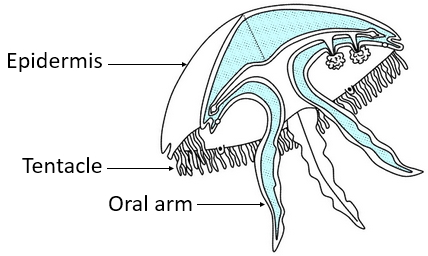
Fig : Cnidaria
Complete answer:
In a blind sac body plan, an animal has a single pore which serves the dual function of ingestion as well egestion. That means food enters through an opening into a single cavity and after digestion, the undigested food is passed out from the same opening. It is exhibited in Cnidarians (Coelenterates) and Platyhelminthes(flatworms).
Additional Information:
The incomplete digestive system is present in both Cnidaria and Platyhelminthes. Cnidarians have a central gastrovascular cavity known as coelenteron with an opening behaving both as a mouth as well as an anus. Flatworms are mostly parasites and thus they are devoid of the alimentary canal. They usually absorb the digested food of their host through their general body surface. E.g. Taenia solium.
Porifera or Sponges are primitive multicellular animals with a cellular grade of an organization. A complex canal system in Spongilla maintains continuous water current flowing into the spongocoel. The canal system helps in nutrition, excretion, reproduction, and respiration.
Arthropods are the largest phylum of kingdom Animalia. Their body is segmented and their characteristic feature is the presence of chitin exoskeleton and jointed appendages. Their digestive system is complete with foregut(stomodeum), midgut(mesenteron) and hindgut(proctodaeum).
Annelids are metamerically segmented animals living in freshwater, seawater, or moist soil. Their digestive tract is also complete. Their characteristic feature is the external segmentation of their body into ring-like grooves called annuli.
So, the correct answer is ‘Cnidaria and Platyhelminthes’.
Note: Digestion is the breakdown of complex food molecules into simpler molecules that can be easily absorbed and used by the cells to fulfill their nutritional requirements. Digestion is particularly of two types based on the location where hydrolysis or breakdown of food takes place- extracellular or intracellular digestion. Usually, in lower animals, digestion occurs inside the cells where digestive enzymes are poured into food vacuoles, termed as intracellular digestion. While in higher animals, the digestion occurs in a cavity outside individual cells where digestive enzymes are poured. This termed extracellular digestion.
Fig : Cnidaria
Recently Updated Pages
Master Class 11 English: Engaging Questions & Answers for Success

Master Class 11 Social Science: Engaging Questions & Answers for Success
Master Class 11 Maths: Engaging Questions & Answers for Success
Master Class 11 Biology: Engaging Questions & Answers for Success
Master Class 11 Physics: Engaging Questions & Answers for Success
Master Class 11 Chemistry: Engaging Questions & Answers for Success
Trending doubts
One Metric ton is equal to kg A 10000 B 1000 C 100 class 11 physics CBSE
Difference Between Prokaryotic Cells and Eukaryotic Cells
Difference between physical and chemical change class 11 chemistry CBSE
Find the value of the expression given below sin 30circ class 11 maths CBSE
Two of the body parts which do not appear in MRI are class 11 biology CBSE
Draw a diagram of a plant cell and label at least eight class 11 biology CBSE