




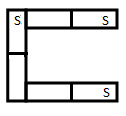
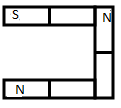
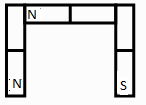
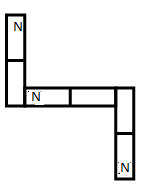
Study the arrangements of three bar magnets as shown in the figure. Which arrangement is possible?
$A.$
$B.$
$C.$
$D.$
Answer
 Verified
642.3k+ views
Hint: We have to solve the given problem which is related to the arrangements of bar magnets. We should keep in mind the basic law of magnetic poles which states that like poles repel each other while unlike poles attract each other. The bar magnet is a rectangular piece of magnet. A bar magnet consists of two equal and opposite magnetic poles separated by a small distance.
Complete step-by-step solution
From the arrangements given above only arrangement $(C)$ is possible because it is only this option which is following the basic law of magnetic poles that like poles repel each other while unlike poles attract each other.
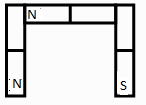
Hence, option $(C)$ is correct.
Additional Information:
We should know the basic properties of a bar magnet also. Some basic properties are listed below:-
$(i)$Poles are not the real geometric ends of a bar magnet. The shortest distance between two poles is called effective length and is always less than its geometric length.
$(ii)$A bar magnet attracts small pieces of iron, cobalt, nickel, etc. and other magnetic substances.
$(iii)$Isolated magnetic poles do not exist. If we break a magnet into two pieces, we get two smaller magnets of similar kinds.
$(iv)$Like magnetic poles repel, and unlike magnetic poles attract each other this law is known as the law of magnetic poles.
Note: In solving the problems of bar magnet which include arrangements of many magnets we should always consider only the law of magnetic poles. Another thing which should be kept in mind is the fact that isolated magnetic poles do not exist. It means that if we break a magnet into two pieces, we get two smaller similar magnets.
Complete step-by-step solution
From the arrangements given above only arrangement $(C)$ is possible because it is only this option which is following the basic law of magnetic poles that like poles repel each other while unlike poles attract each other.
Hence, option $(C)$ is correct.
Additional Information:
We should know the basic properties of a bar magnet also. Some basic properties are listed below:-
$(i)$Poles are not the real geometric ends of a bar magnet. The shortest distance between two poles is called effective length and is always less than its geometric length.
$(ii)$A bar magnet attracts small pieces of iron, cobalt, nickel, etc. and other magnetic substances.
$(iii)$Isolated magnetic poles do not exist. If we break a magnet into two pieces, we get two smaller magnets of similar kinds.
$(iv)$Like magnetic poles repel, and unlike magnetic poles attract each other this law is known as the law of magnetic poles.
Note: In solving the problems of bar magnet which include arrangements of many magnets we should always consider only the law of magnetic poles. Another thing which should be kept in mind is the fact that isolated magnetic poles do not exist. It means that if we break a magnet into two pieces, we get two smaller similar magnets.
Recently Updated Pages
Which of the following graphs shows the variation of class 12 physics CBSE

Draw a labelled diagram of the human male reproductive class 12 biology CBSE
Describe the experiment to compare the emf of two cells class 12 physics CBSE
What is standard hydrogen electrode
What is conventional current and electric current class 12 physics CBSE
2Bromopentane is treated with an alcoholic KOH solution class 12 chemistry CBSE
Trending doubts
Draw a labelled sketch of the human eye class 12 physics CBSE
Which are the Top 10 Largest Countries of the World?
Differentiate between homogeneous and heterogeneous class 12 chemistry CBSE
Draw ray diagrams each showing i myopic eye and ii class 12 physics CBSE
Which is the correct genotypic ratio of mendel dihybrid class 12 biology CBSE
What is the Full Form of PVC, PET, HDPE, LDPE, PP and PS ?