




Statement (A): Work done by a man in lifting a bucket out of, by means of a rope tied to the bucket, is positive.
Statement (B): In the above case, work done by the gravitational force is negative.
A) Both A and B are true.
B) Both A and B are false.
C) A is true and B is false.
D) A is false and B is true.
Answer
 Verified
600k+ views
Hint: We know that the work done on a body is a scalar quantity. It has a magnitude and also a sign which depends on the force applied on the body and the displacement caused by this force. We can assign the sign according to the direction of force and the displacement.
Complete answer:
We know that for an object to do some work against another force, the object should be applied to a force that causes a displacement against this force. Similarly, for an object to do negative work, the direction of the force applied and the displacement should be in opposite directions. The relation between the work done, the force applied and the displacement is given as –
\[\begin{align}
& W=FS\cos \theta \\
& \text{where, }\theta \text{ is the angle between the force and the displacement} \\
\end{align}\]
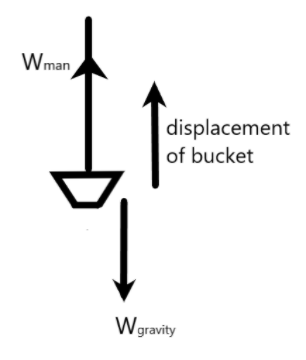
We are given a situation in which a bucket is pulled up from a well by means of a rope tied directly to the bucket. The force applied on the bucket is in the upward direction and the displacement is also in the upward direction. This means that the work done by the man on the bucket is positive. i.e., \[\theta \text{=}{{\text{0}}^{0}}\].
Now, let us consider the work done by the gravitational force on the bucket being pulled up. We know that the gravitational force is acting in the downwards directions, but the displacement is in the upward direction. This means the force and displacement are in the opposite direction, i.e., \[\theta \text{=18}{{\text{0}}^{0}}\], which gives negative work done by the gravitational force.
From the above two arguments, we understand that the work done by the man on the bucket is positive and the work done by the gravitational force is negative.
The correct answer is option A.
Note:
The bucket can be pulled upwards from a well using a pulley system and a rope also. In that case, the force applied on the rope is acting in the downward direction, unlike our situation, so the work done on the bucket by the man will be negative.
Complete answer:
We know that for an object to do some work against another force, the object should be applied to a force that causes a displacement against this force. Similarly, for an object to do negative work, the direction of the force applied and the displacement should be in opposite directions. The relation between the work done, the force applied and the displacement is given as –
\[\begin{align}
& W=FS\cos \theta \\
& \text{where, }\theta \text{ is the angle between the force and the displacement} \\
\end{align}\]
We are given a situation in which a bucket is pulled up from a well by means of a rope tied directly to the bucket. The force applied on the bucket is in the upward direction and the displacement is also in the upward direction. This means that the work done by the man on the bucket is positive. i.e., \[\theta \text{=}{{\text{0}}^{0}}\].
Now, let us consider the work done by the gravitational force on the bucket being pulled up. We know that the gravitational force is acting in the downwards directions, but the displacement is in the upward direction. This means the force and displacement are in the opposite direction, i.e., \[\theta \text{=18}{{\text{0}}^{0}}\], which gives negative work done by the gravitational force.
From the above two arguments, we understand that the work done by the man on the bucket is positive and the work done by the gravitational force is negative.
The correct answer is option A.
Note:
The bucket can be pulled upwards from a well using a pulley system and a rope also. In that case, the force applied on the rope is acting in the downward direction, unlike our situation, so the work done on the bucket by the man will be negative.
Recently Updated Pages
Master Class 11 Social Science: Engaging Questions & Answers for Success

Master Class 11 English: Engaging Questions & Answers for Success
Master Class 11 Maths: Engaging Questions & Answers for Success
Master Class 11 Chemistry: Engaging Questions & Answers for Success
Master Class 11 Biology: Engaging Questions & Answers for Success
Master Class 11 Physics: Engaging Questions & Answers for Success
Trending doubts
One Metric ton is equal to kg A 10000 B 1000 C 100 class 11 physics CBSE
Difference Between Prokaryotic Cells and Eukaryotic Cells
How many of the following diseases can be studied with class 11 biology CBSE
Which of the following enzymes is used for carboxylation class 11 biology CBSE
Draw a diagram of a plant cell and label at least eight class 11 biology CBSE
Two of the body parts which do not appear in MRI are class 11 biology CBSE