




State two important properties of photons which are used to write Einstein’s photoelectric equation. Define (i) Stopping potential and (ii) threshold frequency, using Einstein’s equation and drawing necessary plots between relevant quantities.
Answer
 Verified
663.6k+ views
Hint: Photon is neither a particle nor a wave. In most phenomena like interference, diffraction and polarization it behaves like a wave. Whereas, in phenomena like emission, absorption and interaction it behaves like a particle. It has a dual nature.
Complete step by step answer:
According to Einstein, the photons are emitted as the result of interaction between the photon, the radiation that was incident and an electron in the metal. So, when a photon of energy ℎν is incident on a surface its energy is used in two ways:
(1) One part of the energy is used to extract the electrons from the metal surface as the electrons on the metal surface are bound to the nucleus. The energy spent in extracting the photoelectron is known as the photoelectric work function of the metal. It is denoted as ‘W’ and is defined as the minimum amount of energy required to liberate an electron from the metal surface.
(2) The remaining part of energy is used to impart kinetic energy into the liberated electron. If the electron does not lose energy by collisions, the entire energy will be shown as kinetic energy of the electron. Einstein’s photoelectric equation is given as,
$h\nu =W+\dfrac { 1 }{ 2 } m{ { v }_{ max } }^{ 2 }$
(i) Stopping potential is defined as the minimum negative potential given to anode for which the photoelectric current becomes zero. It is also known as cut-off potential.
(ii) Threshold frequency is defined as the minimum frequency of incident radiation below which the photoelectric emission is not possible completely. Its value is different for different metals.
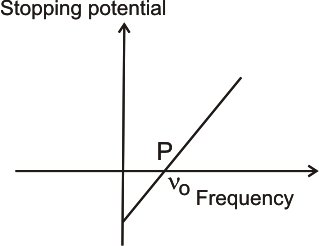
Note: For a given photosensitive material, the photoelectric current is directly proportional to the intensity of the incident radiation, provided the frequency is greater than the threshold frequency.
Complete step by step answer:
According to Einstein, the photons are emitted as the result of interaction between the photon, the radiation that was incident and an electron in the metal. So, when a photon of energy ℎν is incident on a surface its energy is used in two ways:
(1) One part of the energy is used to extract the electrons from the metal surface as the electrons on the metal surface are bound to the nucleus. The energy spent in extracting the photoelectron is known as the photoelectric work function of the metal. It is denoted as ‘W’ and is defined as the minimum amount of energy required to liberate an electron from the metal surface.
(2) The remaining part of energy is used to impart kinetic energy into the liberated electron. If the electron does not lose energy by collisions, the entire energy will be shown as kinetic energy of the electron. Einstein’s photoelectric equation is given as,
$h\nu =W+\dfrac { 1 }{ 2 } m{ { v }_{ max } }^{ 2 }$
(i) Stopping potential is defined as the minimum negative potential given to anode for which the photoelectric current becomes zero. It is also known as cut-off potential.
(ii) Threshold frequency is defined as the minimum frequency of incident radiation below which the photoelectric emission is not possible completely. Its value is different for different metals.
Note: For a given photosensitive material, the photoelectric current is directly proportional to the intensity of the incident radiation, provided the frequency is greater than the threshold frequency.
Recently Updated Pages
Which of the following graphs shows the variation of class 12 physics CBSE

Draw a labelled diagram of the human male reproductive class 12 biology CBSE
Describe the experiment to compare the emf of two cells class 12 physics CBSE
What is standard hydrogen electrode
What is conventional current and electric current class 12 physics CBSE
2Bromopentane is treated with an alcoholic KOH solution class 12 chemistry CBSE
Trending doubts
Draw a labelled sketch of the human eye class 12 physics CBSE
Which are the Top 10 Largest Countries of the World?
Differentiate between homogeneous and heterogeneous class 12 chemistry CBSE
Draw ray diagrams each showing i myopic eye and ii class 12 physics CBSE
Which is the correct genotypic ratio of mendel dihybrid class 12 biology CBSE
What is the Full Form of PVC, PET, HDPE, LDPE, PP and PS ?