




Starting from the centre of the earth having radius R, the variation of g (acceleration due to gravity) is shown by which of the following options?
A)
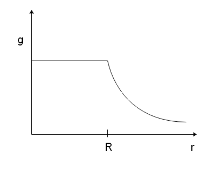
B)
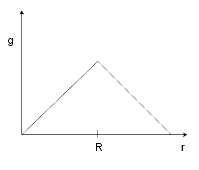
C)
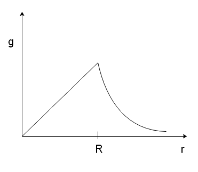
D)
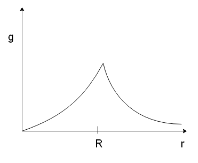
Answer
 Verified
589.8k+ views
Hint The gravitational acceleration inside the surface of the Earth is linearly proportional to the radius while outside the surface of the Earth it falls off with the inverse square of the distance. Use the formula of gravitational acceleration to determine the graph of gravity inside and outside the surface of the Earth.
Formula used Gravity inside the surface of Earth: $g = \dfrac{{GMr}}{{{R^3}}}$ where $G$ is the gravitational constant, $M$ is the mass of the Earth, $r$ is the distance from the centre of the Earth and $R$ is the radius of Earth.
Gravity outside the surface of Earth: $g = \dfrac{{GM}}{{{R^2}}}$
Complete step by step answer
To determine the graph of the gravitational acceleration below and outside the surface of the Earth, we know the gravity inside the surface of the Earth is calculated A:
$\Rightarrow g = \dfrac{{GMr}}{{{R^3}}}$
This equation is of the form
$\Rightarrow g = Ar$ where $A = GM/{R^3}$ which is the equation of a line. So the gravitational acceleration inside the surface of the Earth increases linearly with $r$ so the possible choices are (B) and (C).
Now outside the surface of the Earth, the gravitational acceleration is calculated as:
$\Rightarrow g = \dfrac{{GM}}{{{R^2}}}$
Since outside the surface of the Earth, the distance from the centre of the Earth is $R$, the gravity falls off with the inverse square of the distance which is shown in option (C) from option (B) and (C).
Note
The trick in this question is to know the gravitational acceleration on Earth as a function of the distance from the centre of the Earth. While option (A) seems tempting, the gravitational acceleration inside the Earth increases with increasing distance since there is more mass as we move towards the surface of the Earth.
Formula used Gravity inside the surface of Earth: $g = \dfrac{{GMr}}{{{R^3}}}$ where $G$ is the gravitational constant, $M$ is the mass of the Earth, $r$ is the distance from the centre of the Earth and $R$ is the radius of Earth.
Gravity outside the surface of Earth: $g = \dfrac{{GM}}{{{R^2}}}$
Complete step by step answer
To determine the graph of the gravitational acceleration below and outside the surface of the Earth, we know the gravity inside the surface of the Earth is calculated A:
$\Rightarrow g = \dfrac{{GMr}}{{{R^3}}}$
This equation is of the form
$\Rightarrow g = Ar$ where $A = GM/{R^3}$ which is the equation of a line. So the gravitational acceleration inside the surface of the Earth increases linearly with $r$ so the possible choices are (B) and (C).
Now outside the surface of the Earth, the gravitational acceleration is calculated as:
$\Rightarrow g = \dfrac{{GM}}{{{R^2}}}$
Since outside the surface of the Earth, the distance from the centre of the Earth is $R$, the gravity falls off with the inverse square of the distance which is shown in option (C) from option (B) and (C).
Note
The trick in this question is to know the gravitational acceleration on Earth as a function of the distance from the centre of the Earth. While option (A) seems tempting, the gravitational acceleration inside the Earth increases with increasing distance since there is more mass as we move towards the surface of the Earth.
Recently Updated Pages
Master Class 11 Social Science: Engaging Questions & Answers for Success

Master Class 11 Physics: Engaging Questions & Answers for Success
Master Class 11 Maths: Engaging Questions & Answers for Success
Master Class 11 Economics: Engaging Questions & Answers for Success
Master Class 11 Computer Science: Engaging Questions & Answers for Success
Master Class 11 Chemistry: Engaging Questions & Answers for Success
Trending doubts
One Metric ton is equal to kg A 10000 B 1000 C 100 class 11 physics CBSE
There are 720 permutations of the digits 1 2 3 4 5 class 11 maths CBSE
1 Quintal is equal to a 110 kg b 10 kg c 100kg d 1000 class 11 physics CBSE
State and prove Bernoullis theorem class 11 physics CBSE
Difference Between Prokaryotic Cells and Eukaryotic Cells
Discuss the various forms of bacteria class 11 biology CBSE