




How do solve $\cos 2x=2\cos x-1$ in the interval $\left[ 0,2\pi \right]$ ?
Answer
 Verified
576.6k+ views
Hint: At first, we apply the formula $\cos 2x=2{{\cos }^{2}}x-1$ . We get a quadratic in $\cos x$ . We then apply the Sridhar Acharya formula to get the roots of $\cos x$ in the interval $\left[ 0,2\pi \right]$ .
Complete step by step solution:
The given equation is
$\cos 2x=2\cos x-1$
If we carefully observe the above equation, we can see that if we can express $\cos 2x$ in terms of $\cos x$ , then the equation becomes an equation of $\cos x$ . Luckily, we have a formula between $\cos 2x$ and $\cos x$ which is,
$\cos 2x=2{{\cos }^{2}}x-1$
Putting this value of $\cos 2x$ in the given equation, the equation thus becomes,
$\Rightarrow 2{{\cos }^{2}}x-1=2\cos x-1$
Now, we subtract $2\cos x$ from both sides of the above equation and get,
$\Rightarrow 2{{\cos }^{2}}x-2\cos x-1=-1$
Now, we cancel $1$ from both sides of the above equation and get,
$\Rightarrow 2{{\cos }^{2}}x-2\cos x=0$
We now divide the entire equation by $2$ and get,
$\Rightarrow {{\cos }^{2}}x-\cos x=0$
This is nothing but a quadratic equation in $\cos x$ . Let us take $\cos x=z$ . We then rewrite the entire equation as,
$\Rightarrow {{z}^{2}}-z=0$
Thus, the quadratic equation has transformed into a quadratic equation in $z$ . So, we now need to solve for $z$ by solving this quadratic. We apply the Sridhar Acharya formula which is
$z=\dfrac{-b\pm \sqrt{{{b}^{2}}-4ac}}{2a}$
In our problem, $a=1,b=-1,c=0$ . So, putting these values in the formula, we get,
$\begin{align}
& \Rightarrow z=\dfrac{-\left( -1 \right)\pm \sqrt{{{\left( -1 \right)}^{2}}-4\left( 0 \right)}}{2} \\
& \Rightarrow z=\dfrac{1\pm 1}{2} \\
& \Rightarrow z=\dfrac{1}{2}\pm \dfrac{1}{2} \\
\end{align}$
So, we get two roots of $z$ which are $\dfrac{1}{2}+\dfrac{1}{2}=1$ and $\dfrac{1}{2}-\dfrac{1}{2}=0$ . But, $z=\cos x$ . This means, $\cos x$ has two roots,
$\begin{align}
& \cos x=1...\left( 1 \right) \\
& \cos x=0...\left( 2 \right) \\
\end{align}$
$\left( 1 \right)$ gives $x={{\cos }^{-1}}1$ which gives the values $0,2\pi $ within $\left[ 0,2\pi \right]$ .
$\left( 2 \right)$ gives $x={{\cos }^{-1}}0$ which gives the values $\dfrac{\pi }{2},\dfrac{3\pi }{2}$ within $\left[ 0,2\pi \right]$ .
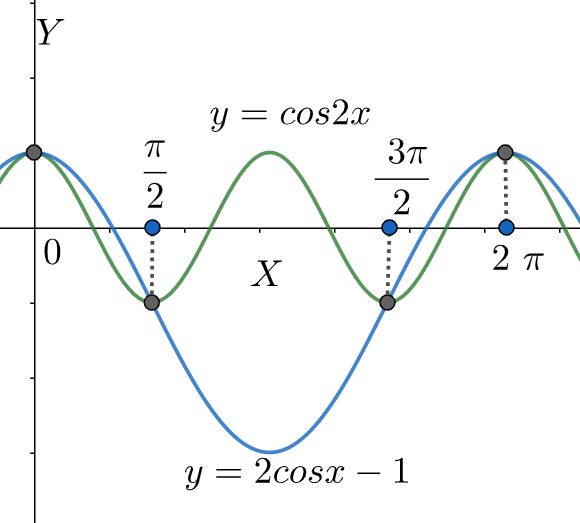
Therefore, we can conclude that the values of $x$ in $\left[ 0,2\pi \right]$ which satisfy the given equation are $0,\dfrac{\pi }{2},\dfrac{3\pi }{2},2\pi $.
Note: We should be careful while solving the quadratic equation in $\cos x$ and should apply the Sridhar Acharya formula correctly. This equation can also be solved by taking two equations $y=\cos 2x$ and $y=2\cos x-1$ . The points where two curves intersect in $\left[ 0,2\pi \right]$ will be the required answers.
Complete step by step solution:
The given equation is
$\cos 2x=2\cos x-1$
If we carefully observe the above equation, we can see that if we can express $\cos 2x$ in terms of $\cos x$ , then the equation becomes an equation of $\cos x$ . Luckily, we have a formula between $\cos 2x$ and $\cos x$ which is,
$\cos 2x=2{{\cos }^{2}}x-1$
Putting this value of $\cos 2x$ in the given equation, the equation thus becomes,
$\Rightarrow 2{{\cos }^{2}}x-1=2\cos x-1$
Now, we subtract $2\cos x$ from both sides of the above equation and get,
$\Rightarrow 2{{\cos }^{2}}x-2\cos x-1=-1$
Now, we cancel $1$ from both sides of the above equation and get,
$\Rightarrow 2{{\cos }^{2}}x-2\cos x=0$
We now divide the entire equation by $2$ and get,
$\Rightarrow {{\cos }^{2}}x-\cos x=0$
This is nothing but a quadratic equation in $\cos x$ . Let us take $\cos x=z$ . We then rewrite the entire equation as,
$\Rightarrow {{z}^{2}}-z=0$
Thus, the quadratic equation has transformed into a quadratic equation in $z$ . So, we now need to solve for $z$ by solving this quadratic. We apply the Sridhar Acharya formula which is
$z=\dfrac{-b\pm \sqrt{{{b}^{2}}-4ac}}{2a}$
In our problem, $a=1,b=-1,c=0$ . So, putting these values in the formula, we get,
$\begin{align}
& \Rightarrow z=\dfrac{-\left( -1 \right)\pm \sqrt{{{\left( -1 \right)}^{2}}-4\left( 0 \right)}}{2} \\
& \Rightarrow z=\dfrac{1\pm 1}{2} \\
& \Rightarrow z=\dfrac{1}{2}\pm \dfrac{1}{2} \\
\end{align}$
So, we get two roots of $z$ which are $\dfrac{1}{2}+\dfrac{1}{2}=1$ and $\dfrac{1}{2}-\dfrac{1}{2}=0$ . But, $z=\cos x$ . This means, $\cos x$ has two roots,
$\begin{align}
& \cos x=1...\left( 1 \right) \\
& \cos x=0...\left( 2 \right) \\
\end{align}$
$\left( 1 \right)$ gives $x={{\cos }^{-1}}1$ which gives the values $0,2\pi $ within $\left[ 0,2\pi \right]$ .
$\left( 2 \right)$ gives $x={{\cos }^{-1}}0$ which gives the values $\dfrac{\pi }{2},\dfrac{3\pi }{2}$ within $\left[ 0,2\pi \right]$ .
Therefore, we can conclude that the values of $x$ in $\left[ 0,2\pi \right]$ which satisfy the given equation are $0,\dfrac{\pi }{2},\dfrac{3\pi }{2},2\pi $.
Note: We should be careful while solving the quadratic equation in $\cos x$ and should apply the Sridhar Acharya formula correctly. This equation can also be solved by taking two equations $y=\cos 2x$ and $y=2\cos x-1$ . The points where two curves intersect in $\left[ 0,2\pi \right]$ will be the required answers.
Recently Updated Pages
Master Class 11 English: Engaging Questions & Answers for Success

Master Class 11 Maths: Engaging Questions & Answers for Success
Class 11 Question and Answer - Your Ultimate Solutions Guide
Master Class 11 Biology: Engaging Questions & Answers for Success
Master Class 11 Physics: Engaging Questions & Answers for Success
Master Class 11 Accountancy: Engaging Questions & Answers for Success
Trending doubts
Differentiate between an exothermic and an endothermic class 11 chemistry CBSE
One Metric ton is equal to kg A 10000 B 1000 C 100 class 11 physics CBSE
In what year Guru Nanak Dev ji was born A15 April 1469 class 11 social science CBSE
Difference Between Prokaryotic Cells and Eukaryotic Cells
There are 720 permutations of the digits 1 2 3 4 5 class 11 maths CBSE
Draw a diagram of a plant cell and label at least eight class 11 biology CBSE