




Silver nitrate solution is used to study
A) Endoplasmic reticulum
B) Golgi apparatus
C) Nucleus
Mitochondria
Answer
 Verified
631.5k+ views
Hint: Camillo Golgi discovered a reticular structure in the cytoplasm of nerve cells in 1898 by using a silver staining method.
Complete Answer:
In 1873, Camillo Golgi developed a staining technique known as “black reaction” technique to study neurons. In this technique he used potassium dichromate to harden the tissue, and, after hardening the tissue he submerged the tissue in silver nitrate solution. The silver nitrate solution reacted with potassium dichromate and formed fragments of silver chromate on the cell membrane. The fragments stained were black therefore this technique became popular as “black reaction”.
By using the same silver staining method, Camillo Golgi discovered Golgi apparatus in 1898. Since the refractive index of Golgi apparatus is similar to that of cytosol, it was difficult to observe this organelle in the living cell with the light microscope. The use of black reaction method or silver staining method made it possible.
Golgi apparatus got its name from its discoverer. It is an organelle found in eukaryotic cells. Structurally it is differentiated into three membranous components –
(i) flattened sacs or cisternae.
(ii) small tubules.
(iii) vesicles.
- The cisternae or lamellae are the most constant elements of the Golgi apparatus.
- The Golgi complex is polarised, having a forming face towards the outer side where the cisternae are formed and, a maturing face towards the opposite side where the cisternae bud off secretory vesicles.
- Silver nitrate staining method or black reaction method was used in the discovery and further study of Golgi apparatus, and not in the study of endoplasmic reticulum, nucleus or mitochondria.
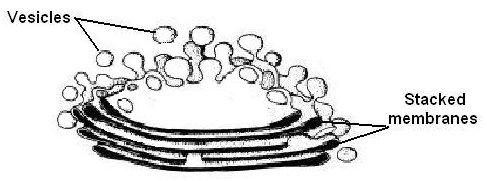
Thus, the correct answer is B, i.e., Golgi apparatus.
Note: The important functions of Golgi complex are – synthesis, packaging and secretion.
Complete Answer:
In 1873, Camillo Golgi developed a staining technique known as “black reaction” technique to study neurons. In this technique he used potassium dichromate to harden the tissue, and, after hardening the tissue he submerged the tissue in silver nitrate solution. The silver nitrate solution reacted with potassium dichromate and formed fragments of silver chromate on the cell membrane. The fragments stained were black therefore this technique became popular as “black reaction”.
By using the same silver staining method, Camillo Golgi discovered Golgi apparatus in 1898. Since the refractive index of Golgi apparatus is similar to that of cytosol, it was difficult to observe this organelle in the living cell with the light microscope. The use of black reaction method or silver staining method made it possible.
Golgi apparatus got its name from its discoverer. It is an organelle found in eukaryotic cells. Structurally it is differentiated into three membranous components –
(i) flattened sacs or cisternae.
(ii) small tubules.
(iii) vesicles.
- The cisternae or lamellae are the most constant elements of the Golgi apparatus.
- The Golgi complex is polarised, having a forming face towards the outer side where the cisternae are formed and, a maturing face towards the opposite side where the cisternae bud off secretory vesicles.
- Silver nitrate staining method or black reaction method was used in the discovery and further study of Golgi apparatus, and not in the study of endoplasmic reticulum, nucleus or mitochondria.
Thus, the correct answer is B, i.e., Golgi apparatus.
Note: The important functions of Golgi complex are – synthesis, packaging and secretion.
Recently Updated Pages
Master Class 11 English: Engaging Questions & Answers for Success

Master Class 11 Social Science: Engaging Questions & Answers for Success
Master Class 11 Maths: Engaging Questions & Answers for Success
Master Class 11 Biology: Engaging Questions & Answers for Success
Master Class 11 Physics: Engaging Questions & Answers for Success
Master Class 11 Chemistry: Engaging Questions & Answers for Success
Trending doubts
One Metric ton is equal to kg A 10000 B 1000 C 100 class 11 physics CBSE
Difference Between Prokaryotic Cells and Eukaryotic Cells
1 ton equals to A 100 kg B 1000 kg C 10 kg D 10000 class 11 physics CBSE
Find the value of the expression given below sin 30circ class 11 maths CBSE
Two of the body parts which do not appear in MRI are class 11 biology CBSE
Draw a diagram of a plant cell and label at least eight class 11 biology CBSE