




Show how could you accomplish the following synthesis?
Cyclohexyl amine $\longrightarrow$ N- cyclohexyl acetamide
Answer
 Verified
655.2k+ views
Hint: Cyclohexylamine is a cyclic, aromatic structure with 6 carbon and an amine group attached to it. For the conversion of amine to the amide group, the hydrogen is removed from the amine and carbonyl group (\[\text{C=O}\]) attaches in place of hydrogen and forms acetamide group i.e. \[\text{N}{{\text{H}}_{3}}\text{-CO-N}{{\text{H}}_{3}}\text{ }\] .
Complete answer:
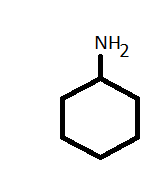
-To convert the cyclohexylamine let's draw the structure first.
-As it has 6- membered cyclic ring with an amine group so the structure is:
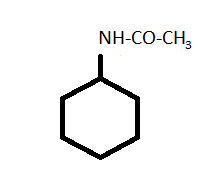
-Now, in N - cyclohexyl acetamide has a similar structure to cyclohexylamine except the presence of acetamide group in place of the amine group.
-For the synthesis of N - cyclohexyl acetamide from cyclohexylamine, pyridine is used as a catalyst to increase the rate or speed of the reaction.
-Along with the pyridine, acetyl chloride is used which has a molecular formula of $\text{C}{{\text{H}}_{3}}\text{-CO-Cl}$.
-From this, the oxidation of cyclohexylamine takes place due to which hydrogen atom releases from $\text{-N}{{\text{H}}_{2}}$ the group.
-Meanwhile, from acetyl chloride chlorine is released.
-So, the \[\text{C}{{\text{H}}_{3}}\text{ - CO-}\] group attaches with the amine group of the cyclohexylamine and it forms cyclohexyl acetamide.
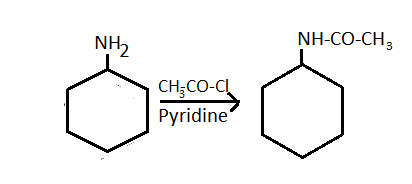
Cyclohexylamine N - cyclohexyl acetamide
-Along with it, hydrochloric acid is also formed.
-So, by using acetyl chloride we can synthesize N - cyclohexyl acetamide.
Note: It is observed that when N - cyclohexyl acetamide is reduced by $\text{LiAl}{{\text{H}}_{4}}$ which is a strong reducing agent, then the oxygen is lost from the acetamide and it can form N - ethyl cyclohexylamine, which has extra alkyl group than cyclohexylamine.
.
Complete answer:
-To convert the cyclohexylamine let's draw the structure first.
-As it has 6- membered cyclic ring with an amine group so the structure is:
-Now, in N - cyclohexyl acetamide has a similar structure to cyclohexylamine except the presence of acetamide group in place of the amine group.
-For the synthesis of N - cyclohexyl acetamide from cyclohexylamine, pyridine is used as a catalyst to increase the rate or speed of the reaction.
-Along with the pyridine, acetyl chloride is used which has a molecular formula of $\text{C}{{\text{H}}_{3}}\text{-CO-Cl}$.
-From this, the oxidation of cyclohexylamine takes place due to which hydrogen atom releases from $\text{-N}{{\text{H}}_{2}}$ the group.
-Meanwhile, from acetyl chloride chlorine is released.
-So, the \[\text{C}{{\text{H}}_{3}}\text{ - CO-}\] group attaches with the amine group of the cyclohexylamine and it forms cyclohexyl acetamide.
Cyclohexylamine N - cyclohexyl acetamide
-Along with it, hydrochloric acid is also formed.
-So, by using acetyl chloride we can synthesize N - cyclohexyl acetamide.
Note: It is observed that when N - cyclohexyl acetamide is reduced by $\text{LiAl}{{\text{H}}_{4}}$ which is a strong reducing agent, then the oxygen is lost from the acetamide and it can form N - ethyl cyclohexylamine, which has extra alkyl group than cyclohexylamine.
.
Recently Updated Pages
Master Class 12 Physics: Engaging Questions & Answers for Success

Master Class 12 Social Science: Engaging Questions & Answers for Success
Master Class 12 English: Engaging Questions & Answers for Success
Master Class 12 Maths: Engaging Questions & Answers for Success
Master Class 12 Business Studies: Engaging Questions & Answers for Success
Master Class 12 Chemistry: Engaging Questions & Answers for Success
Trending doubts
Draw a labelled sketch of the human eye class 12 physics CBSE
Which are the Top 10 Largest Countries of the World?
Draw ray diagrams each showing i myopic eye and ii class 12 physics CBSE
Which is the correct genotypic ratio of mendel dihybrid class 12 biology CBSE
Differentiate between homogeneous and heterogeneous class 12 chemistry CBSE
Give 10 examples of unisexual and bisexual flowers