




Refractive index:
A) Is the actual property of the substance.
B) Depends on the wavelength of the light used to measure
C) Sensitive to the eye
D) None of these
Answer
 Verified
603.6k+ views
Hint
Refractive index, measure of the bending of a ray of light when passing from one medium into another. The ratio of velocity of light in air with the velocity of light in vacuum is called the refractive index of air More generally the ratio of the speed of light in a vacuum to its speed in a specific medium. Try to think how velocity of light depends on the medium.
Complete step by step solution
The ratio between the speed of light in medium to speed in a vacuum is the refractive index. When light travels in a medium other than the vacuum, the atoms of that medium continually absorb and re-emit the particles of light, slowing down the speed of light.
The refractive index is dimensionless. It is a number that indicates the number of times slower than a light wave would be in the material than it is in a vacuum. The refractive index, represented by the symbol $\mu $ , is the velocity of light in vacuum divided by the velocity of light in a medium.
The formula of the refractive index is as follows:
$\mu = \dfrac{c}{v}$
Where:
$c$ is the velocity of light in a vacuum i.e. $3{\text{ }} \times {\text{ }}{10^8}\;m/s$,
$v$ is the velocity of light in a substance.
And we also know that:
$v = \lambda f$
$\lambda $ is the wavelength of the light
Hence refractive index depends on wavelength and option B is correct.
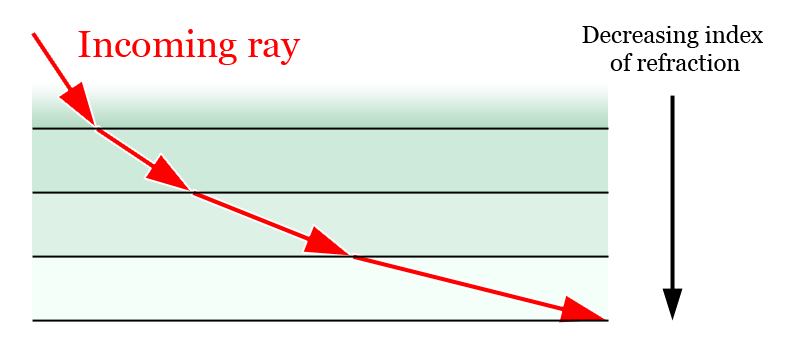
As the refractive index increases, light will bend away from the normal. This can be seen as follow:
Note
The refractive index changes with wavelength; this causes white light to split into constituent (different) colors when refracted. This is called dispersion. It can be observed in prisms and rainbows. The concept of refractive index also applies within the full electromagnetic spectrum, from X-rays to radio waves.
Refractive index, measure of the bending of a ray of light when passing from one medium into another. The ratio of velocity of light in air with the velocity of light in vacuum is called the refractive index of air More generally the ratio of the speed of light in a vacuum to its speed in a specific medium. Try to think how velocity of light depends on the medium.
Complete step by step solution
The ratio between the speed of light in medium to speed in a vacuum is the refractive index. When light travels in a medium other than the vacuum, the atoms of that medium continually absorb and re-emit the particles of light, slowing down the speed of light.
The refractive index is dimensionless. It is a number that indicates the number of times slower than a light wave would be in the material than it is in a vacuum. The refractive index, represented by the symbol $\mu $ , is the velocity of light in vacuum divided by the velocity of light in a medium.
The formula of the refractive index is as follows:
$\mu = \dfrac{c}{v}$
Where:
$c$ is the velocity of light in a vacuum i.e. $3{\text{ }} \times {\text{ }}{10^8}\;m/s$,
$v$ is the velocity of light in a substance.
And we also know that:
$v = \lambda f$
$\lambda $ is the wavelength of the light
Hence refractive index depends on wavelength and option B is correct.
As the refractive index increases, light will bend away from the normal. This can be seen as follow:
Note
The refractive index changes with wavelength; this causes white light to split into constituent (different) colors when refracted. This is called dispersion. It can be observed in prisms and rainbows. The concept of refractive index also applies within the full electromagnetic spectrum, from X-rays to radio waves.
Recently Updated Pages
Master Class 12 Business Studies: Engaging Questions & Answers for Success

Master Class 12 Biology: Engaging Questions & Answers for Success
Master Class 12 Chemistry: Engaging Questions & Answers for Success
Class 12 Question and Answer - Your Ultimate Solutions Guide
Master Class 11 Social Science: Engaging Questions & Answers for Success
Master Class 11 English: Engaging Questions & Answers for Success
Trending doubts
Which is more stable and why class 12 chemistry CBSE
Which are the Top 10 Largest Countries of the World?
Draw a labelled sketch of the human eye class 12 physics CBSE
Differentiate between homogeneous and heterogeneous class 12 chemistry CBSE
What are the major means of transport Explain each class 12 social science CBSE
Sulphuric acid is known as the king of acids State class 12 chemistry CBSE