




Who proposed the chromosomal theory?
A) Bateson and Punnett
B) Mendel
C) Morgan
D) Sutton and Boveri
Answer
 Verified
592.5k+ views
Hint: The chromosomal theory of inheritance was proposed by the scientists who were working on Sea Urchins and Grasshoppers in the period between 1902 and 1903 based on the Mendel’s laws of inheritance.
Complete answer
The chromosomal theory of inheritance is credited to the names of two scientists – Walter Sutton and Theodre Bouveri in the year 1902 and 1903. Their combined study was based on the Mendel’s laws of I heritance and they successfully demonstrated that chromosomes are hereditary in nature. Hence, option D is the correct answer.
Gregor Johann Mendel gave the Inheritance theory in the year 1865 based on his studies of the Garden Pea (Pisum sativum). The chromosome theory was popularised after Mendel’s theory had been accepted, so option B is incorrect.
Thomas Hunt Morgan is credited with the Morgan theory in the decade of the 1890s. The Morgan theory states that the genes are located on the chromosomes, in the same manner as beads are on the necklace. This paved the further research work for the Chromosomal Theory which came in the years 1902 – 1903. So, option C is also incorrect.
William Bateson was the chief propagator of the Theory of Genetics and he was the main person behind the acceptance of the laws of inheritance of Gregor johann Mendel. He also co-founded the Journal of Genetics in the early 20th century and he was awarded the Royal Medal for his contribution in the year 1920. So, option A is incorrect.
Hence, option D is the correct answer.
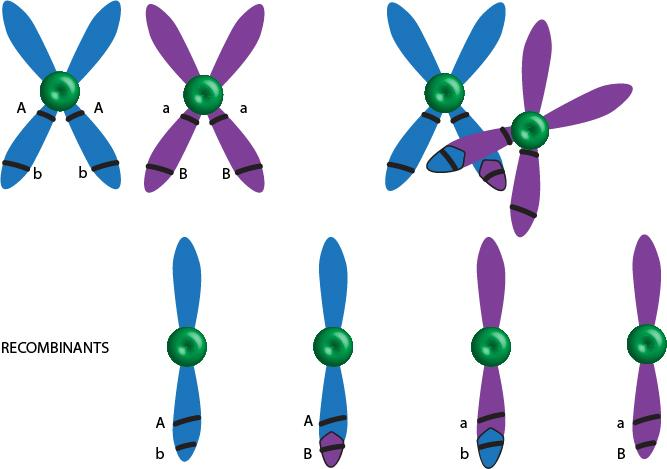
Note:
The genes of a human make up only about three percent of the total DNA fibres but contain almost 99.99 percent of the information of the individual. The DNA fibres are so long that they can be stretched from the Earth and the Sun multiple times, but they are microscopic particles.
Complete answer
The chromosomal theory of inheritance is credited to the names of two scientists – Walter Sutton and Theodre Bouveri in the year 1902 and 1903. Their combined study was based on the Mendel’s laws of I heritance and they successfully demonstrated that chromosomes are hereditary in nature. Hence, option D is the correct answer.
Gregor Johann Mendel gave the Inheritance theory in the year 1865 based on his studies of the Garden Pea (Pisum sativum). The chromosome theory was popularised after Mendel’s theory had been accepted, so option B is incorrect.
Thomas Hunt Morgan is credited with the Morgan theory in the decade of the 1890s. The Morgan theory states that the genes are located on the chromosomes, in the same manner as beads are on the necklace. This paved the further research work for the Chromosomal Theory which came in the years 1902 – 1903. So, option C is also incorrect.
William Bateson was the chief propagator of the Theory of Genetics and he was the main person behind the acceptance of the laws of inheritance of Gregor johann Mendel. He also co-founded the Journal of Genetics in the early 20th century and he was awarded the Royal Medal for his contribution in the year 1920. So, option A is incorrect.
Hence, option D is the correct answer.
Note:
The genes of a human make up only about three percent of the total DNA fibres but contain almost 99.99 percent of the information of the individual. The DNA fibres are so long that they can be stretched from the Earth and the Sun multiple times, but they are microscopic particles.
Recently Updated Pages
Which of the following graphs shows the variation of class 12 physics CBSE

Draw a labelled diagram of the human male reproductive class 12 biology CBSE
Describe the experiment to compare the emf of two cells class 12 physics CBSE
What is standard hydrogen electrode
What is conventional current and electric current class 12 physics CBSE
2Bromopentane is treated with an alcoholic KOH solution class 12 chemistry CBSE
Trending doubts
Draw a labelled sketch of the human eye class 12 physics CBSE
Which are the Top 10 Largest Countries of the World?
Differentiate between homogeneous and heterogeneous class 12 chemistry CBSE
Draw ray diagrams each showing i myopic eye and ii class 12 physics CBSE
Which is the correct genotypic ratio of mendel dihybrid class 12 biology CBSE
What is the Full Form of PVC, PET, HDPE, LDPE, PP and PS ?