




Primary host of Malaria parasite:
(a) Male culex
(b) Male Anopheles
(c) Female culex
(d) Female Anopheles
Answer
 Verified
608.4k+ views
Hint: Malaria is a common disease that is caused by the protozoa which requires two hosts to complete its life cycle. One is human and another is a blood-sucking insect also known as a vector of the disease. The females are responsible for its transmission.
Complete answer:
The primary host of malaria parasites is the Female Anopheles mosquito. It is also the vector or the transmitting agent. The protozoa, in an infectious form, is present in the salivary glands of the mosquito and when it bites the human target, the protozoa enters the body and reaches the liver through the bloodstream.
-The malarial infection starts when an infected female anopheles mosquito bites a healthy human. Thus, injects the plasmodium parasites into the bloodstream in the form of sporozoites.
-These sporozoites then reach the human liver via the bloodstream which undergoes division after 7 to 10 days and at this stage no symptoms are found.
-The sporozoites after multiplication then forms merozoites and are released from the liver and then carried through the heart to settle in the lung capillaries.
-The disintegration of the vesicles allows merozoites to enter the blood phase of their development.
-The merozoites enter the red blood cells in the bloodstream and there they multiply until the cell bursts. Then they start to enter more red blood cells. Each time the red blood cells burst then it will result in fever. The bursting of RBCs will result in the release of a substance called hemozoin which is toxic in nature.
-These blood cells after causing the infection will leave the asexual multiplication cycle and will form gametocytes from merozoites through the sexual multiplication cycle.
-When again the mosquito bites an infected person the gametocytes enter into the mosquito body, where they further develop into mature sex cells called gametes.
-The ookinetes are the female gametes that remain in the midgut wall of the mosquito where oocysts are formed.
-Inside the oocyst, many active sporozoites are present. When the oocyst breaks down, a large number of sporozoites are released into the body cavity and they travel to the mosquito's salivary gland.
-This led to the cycle of human infection that starts again when the mosquito bites another person.
-Thus, the mosquito is the primary host while the human is the secondary host.
So, the correct answer is 'Female Anopheles mosquito is the primary host of Malaria'.
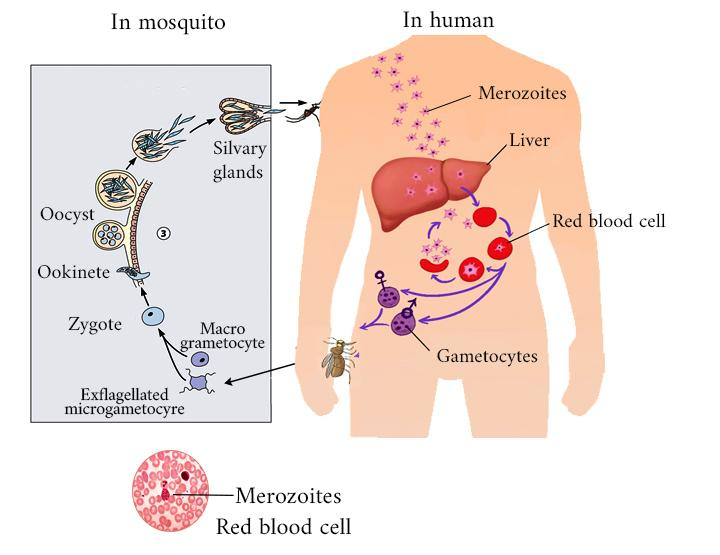
Life Cycle of Plasmodium
Notes:
-Malaria requires two hosts - Mosquitoes and Humans.
-Malignant malaria caused by Plasmodium falciparum is the most serious one and can be fatal.
-Hemozoin, a toxic substance is responsible for the recurring chills and fever during Malaria.
Complete answer:
The primary host of malaria parasites is the Female Anopheles mosquito. It is also the vector or the transmitting agent. The protozoa, in an infectious form, is present in the salivary glands of the mosquito and when it bites the human target, the protozoa enters the body and reaches the liver through the bloodstream.
-The malarial infection starts when an infected female anopheles mosquito bites a healthy human. Thus, injects the plasmodium parasites into the bloodstream in the form of sporozoites.
-These sporozoites then reach the human liver via the bloodstream which undergoes division after 7 to 10 days and at this stage no symptoms are found.
-The sporozoites after multiplication then forms merozoites and are released from the liver and then carried through the heart to settle in the lung capillaries.
-The disintegration of the vesicles allows merozoites to enter the blood phase of their development.
-The merozoites enter the red blood cells in the bloodstream and there they multiply until the cell bursts. Then they start to enter more red blood cells. Each time the red blood cells burst then it will result in fever. The bursting of RBCs will result in the release of a substance called hemozoin which is toxic in nature.
-These blood cells after causing the infection will leave the asexual multiplication cycle and will form gametocytes from merozoites through the sexual multiplication cycle.
-When again the mosquito bites an infected person the gametocytes enter into the mosquito body, where they further develop into mature sex cells called gametes.
-The ookinetes are the female gametes that remain in the midgut wall of the mosquito where oocysts are formed.
-Inside the oocyst, many active sporozoites are present. When the oocyst breaks down, a large number of sporozoites are released into the body cavity and they travel to the mosquito's salivary gland.
-This led to the cycle of human infection that starts again when the mosquito bites another person.
-Thus, the mosquito is the primary host while the human is the secondary host.
So, the correct answer is 'Female Anopheles mosquito is the primary host of Malaria'.
Life Cycle of Plasmodium
Notes:
-Malaria requires two hosts - Mosquitoes and Humans.
-Malignant malaria caused by Plasmodium falciparum is the most serious one and can be fatal.
-Hemozoin, a toxic substance is responsible for the recurring chills and fever during Malaria.
Recently Updated Pages
Which of the following graphs shows the variation of class 12 physics CBSE

Draw a labelled diagram of the human male reproductive class 12 biology CBSE
Describe the experiment to compare the emf of two cells class 12 physics CBSE
What is standard hydrogen electrode
What is conventional current and electric current class 12 physics CBSE
2Bromopentane is treated with an alcoholic KOH solution class 12 chemistry CBSE
Trending doubts
Draw a labelled sketch of the human eye class 12 physics CBSE
Which are the Top 10 Largest Countries of the World?
Differentiate between homogeneous and heterogeneous class 12 chemistry CBSE
Draw ray diagrams each showing i myopic eye and ii class 12 physics CBSE
Which is the correct genotypic ratio of mendel dihybrid class 12 biology CBSE
What is the Full Form of PVC, PET, HDPE, LDPE, PP and PS ?