




Potentiometer measures voltage more accurately because:
A. It measures potential in an open circuit.
B. It uses a sensitive galvanometer for null deflection.
C. It uses high resistance potential wire.
D. It measures potential in a closed circuit.
Answer
 Verified
661.2k+ views
Hint: A potentiometer is a passive circuit element that is used to measure the voltage in a circuit with high accuracy. It can also measure the internal resistance of a cell or battery. Moreover, it is used to compare the e.m.f of the two cells. It has a wire made up of constantan, which is a high resistance metal.
Complete step-by-step answer:
A potentiometer is a passive electronic component. It contains the following circuit elements:
Rheostat
Constantan wire
Meter stick
Copper plates
Ammeter
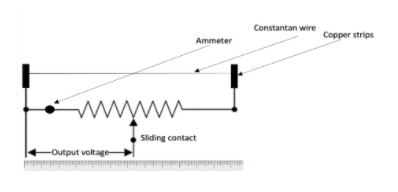
These all elements are mounted on a huge wooden board. It works on the principle that the voltage drop in a circuit is directly proportional to the length of the wire. By varying the position of a sliding contact across a uniform resistance, the potentiometer works. The entire input voltage is applied across the whole length of the resistor and the output voltage is the voltage drop between the fixed and sliding contact, in a potentiometer. Hence we can see that the accuracy is mainly due to the current reading, as it is a balanced state with zero current, called null point and hence the circuit behaves as an open circuit (current = 0).
So, the correct answer is “Option A”.
Note: Although the correct answer is part A. but that doesn’t mean that the other parts are totally incorrect. At the time of no deflection, Galvanometer shows null deflection. Also, the wire used has high resistance so that the resistance of copper strips can be neglected. But according to the question, the most appropriate answer would be A.
Complete step-by-step answer:
A potentiometer is a passive electronic component. It contains the following circuit elements:
Rheostat
Constantan wire
Meter stick
Copper plates
Ammeter
These all elements are mounted on a huge wooden board. It works on the principle that the voltage drop in a circuit is directly proportional to the length of the wire. By varying the position of a sliding contact across a uniform resistance, the potentiometer works. The entire input voltage is applied across the whole length of the resistor and the output voltage is the voltage drop between the fixed and sliding contact, in a potentiometer. Hence we can see that the accuracy is mainly due to the current reading, as it is a balanced state with zero current, called null point and hence the circuit behaves as an open circuit (current = 0).
So, the correct answer is “Option A”.
Note: Although the correct answer is part A. but that doesn’t mean that the other parts are totally incorrect. At the time of no deflection, Galvanometer shows null deflection. Also, the wire used has high resistance so that the resistance of copper strips can be neglected. But according to the question, the most appropriate answer would be A.
Recently Updated Pages
Which of the following graphs shows the variation of class 12 physics CBSE

Draw a labelled diagram of the human male reproductive class 12 biology CBSE
Describe the experiment to compare the emf of two cells class 12 physics CBSE
What is standard hydrogen electrode
What is conventional current and electric current class 12 physics CBSE
2Bromopentane is treated with an alcoholic KOH solution class 12 chemistry CBSE
Trending doubts
Draw a labelled sketch of the human eye class 12 physics CBSE
Which are the Top 10 Largest Countries of the World?
Differentiate between homogeneous and heterogeneous class 12 chemistry CBSE
Draw ray diagrams each showing i myopic eye and ii class 12 physics CBSE
Which is the correct genotypic ratio of mendel dihybrid class 12 biology CBSE
What is the Full Form of PVC, PET, HDPE, LDPE, PP and PS ?