




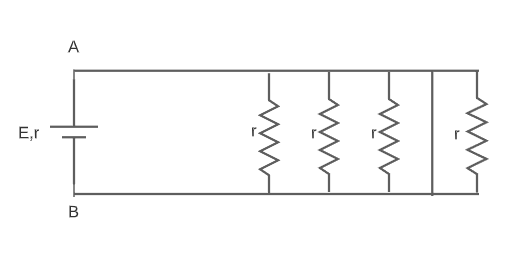
What is the potential difference between A and B?
Answer
 Verified
600.6k+ views
Hint: The potential difference is defined as the energy required to send the unit electricity from one point to other point. Internal resistance of the cell or the battery is defined as the opposition made in flow of current from the cell or battery.
Formula used:
The formula of the ohm’s law is given by,
$ \Rightarrow V = I \times R$
Where the potential difference of the cell or battery is V, the current flowing from the circuit is I and the resistance on the circuit is R.
Complete step by step solution:
It is given in the problem that there is a circuit given and we need to find equivalent potential difference of the circuit.
First of all we need to find the equivalent resistance of the three resistances.
$ \Rightarrow \dfrac{1}{{{r_{eq.}}}} = \dfrac{1}{r} + \dfrac{1}{r} + \dfrac{1}{r}$
$ \Rightarrow \dfrac{1}{{{r_{eq.}}}} = \dfrac{3}{r}$
$ \Rightarrow {r_{eq.}} = \dfrac{r}{3}$
Now the two resistors are in parallel connection we get,
$ \Rightarrow \dfrac{1}{{{r_{eq.}}}} = \dfrac{3}{r} + \dfrac{1}{r}$
$ \Rightarrow \dfrac{1}{{{r_{eq.}}}} = \dfrac{4}{r}$
$ \Rightarrow {r_{eq.}} = \dfrac{r}{4}$.
Now the resistance of the equivalent external resistance and internal resistance are in series the equivalent resistance is equal to,
$ \Rightarrow R = r + \dfrac{r}{4}$
$ \Rightarrow R = \dfrac{{5r}}{4}\Omega $.
The formula of the ohm’s law is given by,
$ \Rightarrow V = I \times R$
Where the potential difference of the cell or battery is V, the current flowing from the circuit is I and the resistance on the circuit is R.
The ohm’s law is given by,
$ \Rightarrow V = I \times R$
$ \Rightarrow V = I \times \dfrac{{5r}}{4}$.
The potential difference between the points A and B is equal to $V = I \times \dfrac{{5r}}{4}$.
Note: The internal resistance also creates hurdles on the flow of the current and is also considered while solving the problem. The problem consists of resistors which are all connected in parallel to each other and equivalent resistance is connected to the internal resistor of the cell in series.
Formula used:
The formula of the ohm’s law is given by,
$ \Rightarrow V = I \times R$
Where the potential difference of the cell or battery is V, the current flowing from the circuit is I and the resistance on the circuit is R.
Complete step by step solution:
It is given in the problem that there is a circuit given and we need to find equivalent potential difference of the circuit.
First of all we need to find the equivalent resistance of the three resistances.
$ \Rightarrow \dfrac{1}{{{r_{eq.}}}} = \dfrac{1}{r} + \dfrac{1}{r} + \dfrac{1}{r}$
$ \Rightarrow \dfrac{1}{{{r_{eq.}}}} = \dfrac{3}{r}$
$ \Rightarrow {r_{eq.}} = \dfrac{r}{3}$
Now the two resistors are in parallel connection we get,
$ \Rightarrow \dfrac{1}{{{r_{eq.}}}} = \dfrac{3}{r} + \dfrac{1}{r}$
$ \Rightarrow \dfrac{1}{{{r_{eq.}}}} = \dfrac{4}{r}$
$ \Rightarrow {r_{eq.}} = \dfrac{r}{4}$.
Now the resistance of the equivalent external resistance and internal resistance are in series the equivalent resistance is equal to,
$ \Rightarrow R = r + \dfrac{r}{4}$
$ \Rightarrow R = \dfrac{{5r}}{4}\Omega $.
The formula of the ohm’s law is given by,
$ \Rightarrow V = I \times R$
Where the potential difference of the cell or battery is V, the current flowing from the circuit is I and the resistance on the circuit is R.
The ohm’s law is given by,
$ \Rightarrow V = I \times R$
$ \Rightarrow V = I \times \dfrac{{5r}}{4}$.
The potential difference between the points A and B is equal to $V = I \times \dfrac{{5r}}{4}$.
Note: The internal resistance also creates hurdles on the flow of the current and is also considered while solving the problem. The problem consists of resistors which are all connected in parallel to each other and equivalent resistance is connected to the internal resistor of the cell in series.
Recently Updated Pages
Master Class 11 Social Science: Engaging Questions & Answers for Success

Master Class 11 English: Engaging Questions & Answers for Success
Master Class 11 Maths: Engaging Questions & Answers for Success
Master Class 11 Chemistry: Engaging Questions & Answers for Success
Master Class 11 Biology: Engaging Questions & Answers for Success
Master Class 11 Physics: Engaging Questions & Answers for Success
Trending doubts
One Metric ton is equal to kg A 10000 B 1000 C 100 class 11 physics CBSE
Difference Between Prokaryotic Cells and Eukaryotic Cells
How many of the following diseases can be studied with class 11 biology CBSE
Two of the body parts which do not appear in MRI are class 11 biology CBSE
Which of the following enzymes is used for carboxylation class 11 biology CBSE
Explain zero factorial class 11 maths CBSE