




Why do plants possess large-sized vacuole?
(a)Storage
(b)Dumping of cellular waste
(c)Maintaining turgidity in cell
(d)All of the above
Answer
 Verified
621.9k+ views
Hint: Vacuoles simply mean about a vacant space and are found in all the Eukaryotic cell types. In-plant cells, there is a single large central or sap vacuole, filled with cell sap, and is helpful for various purposes.
Complete answer:
Vacuoles of plants are like storage bubbles, which are found mostly in plant cells. They occupy most of the portion of the plant cells. The vacuoles perform the storage of food or water, removal of toxic metabolic by-products or end products of plant cells, and maintenance of osmotic pressure and turgidity due to the presence of cell sap. These are very vital processes of cell maintenance.
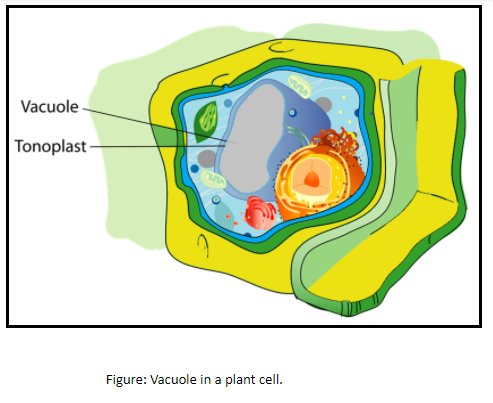
Additional Information: -A vacuole is formed of two parts:
1. Tonoplast: it is the outer, single-layered, unit membrane, and semipermeable.
2. Cell sap: It is the liquid present inside the central vacuole and is formed of water, minerals, sugars, amino acids, proteins, esters, anthocyanins, glucosides, alkaloids, organic acids, etc.
-Vacuoles help in the elongation of the cell.
-The maximum amount of water is stored in the vacuole.
-The vacuoles can be modified to perform different functions such as a food vacuole, contractile vacuole, or a gas vacuole.
So, the correct answer is, ’All of the above.’
Note: The toxic wastes are removed from the vacuole through the process of exocytosis. Exocytosis is a form of active transport (an energy-dependent process) and bulk transport in which a cell transports molecules (e.g., waste and proteins) out of the cell.
Complete answer:
Vacuoles of plants are like storage bubbles, which are found mostly in plant cells. They occupy most of the portion of the plant cells. The vacuoles perform the storage of food or water, removal of toxic metabolic by-products or end products of plant cells, and maintenance of osmotic pressure and turgidity due to the presence of cell sap. These are very vital processes of cell maintenance.
Additional Information: -A vacuole is formed of two parts:
1. Tonoplast: it is the outer, single-layered, unit membrane, and semipermeable.
2. Cell sap: It is the liquid present inside the central vacuole and is formed of water, minerals, sugars, amino acids, proteins, esters, anthocyanins, glucosides, alkaloids, organic acids, etc.
-Vacuoles help in the elongation of the cell.
-The maximum amount of water is stored in the vacuole.
-The vacuoles can be modified to perform different functions such as a food vacuole, contractile vacuole, or a gas vacuole.
So, the correct answer is, ’All of the above.’
Note: The toxic wastes are removed from the vacuole through the process of exocytosis. Exocytosis is a form of active transport (an energy-dependent process) and bulk transport in which a cell transports molecules (e.g., waste and proteins) out of the cell.
Recently Updated Pages
Master Class 11 Social Science: Engaging Questions & Answers for Success

Master Class 11 Chemistry: Engaging Questions & Answers for Success
Master Class 9 General Knowledge: Engaging Questions & Answers for Success
Master Class 9 Maths: Engaging Questions & Answers for Success
Master Class 9 Science: Engaging Questions & Answers for Success
Master Class 9 English: Engaging Questions & Answers for Success
Trending doubts
Explain zero factorial class 11 maths CBSE
Draw a diagram of a plant cell and label at least eight class 11 biology CBSE
What is the atomic mass of Sodium a 22 gmol b 23 gmol class 11 chemistry CBSE
Draw a diagram of nephron and explain its structur class 11 biology CBSE
How do I get the molar mass of urea class 11 chemistry CBSE
What organs are located on the left side of your body class 11 biology CBSE