




Pasteur’s experiments and similar ones that followed, convinced most people that spontaneous generation of life did not happen because
(a) Pasteur was extremely meticulous
(b) Pasteur used very fine mesh screens to cover his flasks.
(c) Pasteur did not boil his flasks for a long time
(d) Pasteur’s swan- necked flasks ruled out the objection that spoiled air could have contaminated his experiments.
Answer
 Verified
660.6k+ views
Hint: Louis Pasteur was an exemplary scientist of his time who invented the technique of pasteurization which is still used now to make pasteurized milk. His experiment to disprove spontaneous generation changed the perception of the origin of life.
Complete Step by Step Answer:
The theory of spontaneous generation states that living beings arose out of non- living things spontaneously.
This idea was proposed by Aristotle and was believed to be true for a long time because it supported the idea that God made humans from non- living things such as sand.
But this theory has been rejected ever since Pasteur’s swan neck experiment.
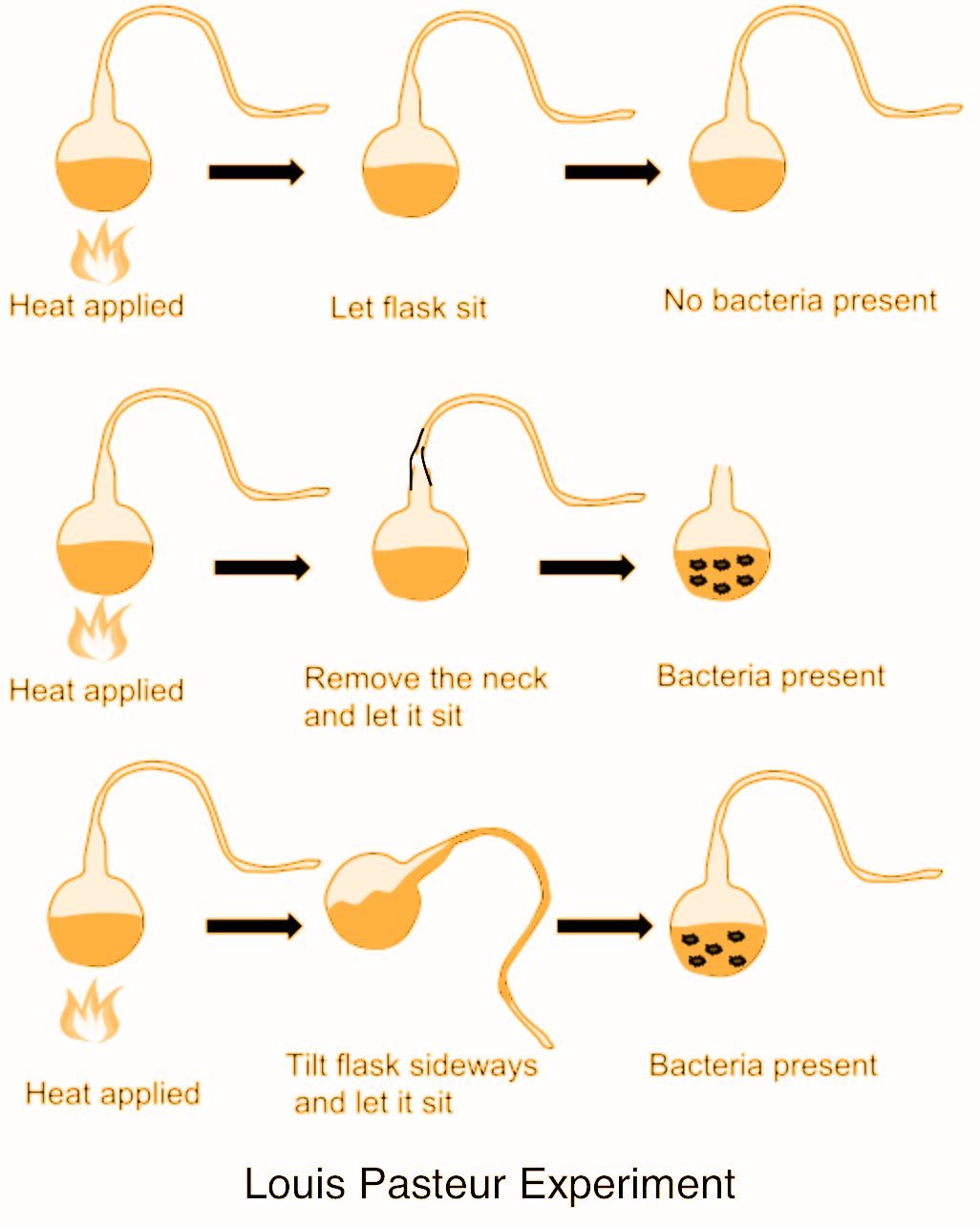
So, the correct option is 'Pasteur’s swan-necked flasks ruled out the objection that spoiled air could have contaminated his experiments'.
Additional information: Let us know the swan neck experiment in detail.
- Pasteur heated some soup and sterilized it and put it in a flask having a swan- shaped neck. The flask was also sterilized.
- The steam coming from the soup got deposited in the s- shaped neck of the flask and formed a plug there.
- This prevented contamination of the soup by the outside world.
- No matter how much time passed no living organisms were detected in the soup.
- Living organisms only appeared when the neck was broken i.e. contamination from outside.
Note: Louis Pasteur is a French scientist who is also known as the father of immunology.
The theory of spontaneous generation was also disproved by showing maggots didn't arise out from a dirty cloth unless there were maggot eggs present in it already. Now, the theory of abiogenesis which states living beings arose from non- living beings through slow evolutionary forces is accepted.
Complete Step by Step Answer:
The theory of spontaneous generation states that living beings arose out of non- living things spontaneously.
This idea was proposed by Aristotle and was believed to be true for a long time because it supported the idea that God made humans from non- living things such as sand.
But this theory has been rejected ever since Pasteur’s swan neck experiment.
So, the correct option is 'Pasteur’s swan-necked flasks ruled out the objection that spoiled air could have contaminated his experiments'.
Additional information: Let us know the swan neck experiment in detail.
- Pasteur heated some soup and sterilized it and put it in a flask having a swan- shaped neck. The flask was also sterilized.
- The steam coming from the soup got deposited in the s- shaped neck of the flask and formed a plug there.
- This prevented contamination of the soup by the outside world.
- No matter how much time passed no living organisms were detected in the soup.
- Living organisms only appeared when the neck was broken i.e. contamination from outside.
Note: Louis Pasteur is a French scientist who is also known as the father of immunology.
The theory of spontaneous generation was also disproved by showing maggots didn't arise out from a dirty cloth unless there were maggot eggs present in it already. Now, the theory of abiogenesis which states living beings arose from non- living beings through slow evolutionary forces is accepted.
Recently Updated Pages
Which will be the least stable resonating structure class 11 chemistry CBSE

How many 5 digit telephone numbers can be construc-class-11-maths-CBSE
How do you find the angle of the resultant vector class 11 physics CBSE
Draw labelled diagram of the following i Gram seed class 11 biology CBSE
1 Quintal is equal to a 110 kg b 10 kg c 100kg d 1000 class 11 physics CBSE
What is the need and importance of classification class 11 biology CBSE
Trending doubts
Find the value of the expression given below sin 30circ class 11 maths CBSE
One Metric ton is equal to kg A 10000 B 1000 C 100 class 11 physics CBSE
10 examples of friction in our daily life
Draw a diagram of a plant cell and label at least eight class 11 biology CBSE
Difference between physical and chemical change class 11 chemistry CBSE
Proton was discovered by A Thomson B Rutherford C Chadwick class 11 chemistry CBSE