



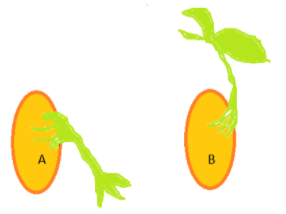
Observe the diagram.
a) Mention the type of movements shown in figure A and B.
b) How does this movement differ from the movement of mimosa?
Answer
 Verified
565.5k+ views
Hint: The plants show movement in response to stimuli. These movements help the plant to adapt with the environment and adverse conditions. This movement is called the tropic movement. These movements are important for growth and development of plants.
Complete answer:
To answer this question, we must know about different types of tropic movement. The tropic movement is a response to sunlight, nutrients, water etc for facilitating proper growth and development.
a) According to the question given in fig. A- The root developed from the seeds is moving down towards the earth. This movement is referred to as Geotropism. Geotropism is the growth of the plant in response to the gravity. The growth of plant shoots against gravity is called negative geotropism.
In fig. B. the shoot moves towards the sunlight. This type of movement of shot towards the sunlight is called phototropism.
b) Mimosa is called touch me not plant. It shows seismonastic (thigmonastic) movement which is also called touch induced movement. This type of movement is not a growth movement unlike in fig. A and B. It is a rapid plant movement. The mimosa plant undergoes a change in the morphology of the leaves in response to touch.
Note: The other type of movement exhibited by plants is the tactic movement. It is a type of locomotion movement which is caused by unidirectional stimuli. This movement differs from nastic movement as the movement of plants is in the direction of the induced stimuli.
Complete answer:
To answer this question, we must know about different types of tropic movement. The tropic movement is a response to sunlight, nutrients, water etc for facilitating proper growth and development.
a) According to the question given in fig. A- The root developed from the seeds is moving down towards the earth. This movement is referred to as Geotropism. Geotropism is the growth of the plant in response to the gravity. The growth of plant shoots against gravity is called negative geotropism.
In fig. B. the shoot moves towards the sunlight. This type of movement of shot towards the sunlight is called phototropism.
b) Mimosa is called touch me not plant. It shows seismonastic (thigmonastic) movement which is also called touch induced movement. This type of movement is not a growth movement unlike in fig. A and B. It is a rapid plant movement. The mimosa plant undergoes a change in the morphology of the leaves in response to touch.
Note: The other type of movement exhibited by plants is the tactic movement. It is a type of locomotion movement which is caused by unidirectional stimuli. This movement differs from nastic movement as the movement of plants is in the direction of the induced stimuli.
Recently Updated Pages
Master Class 11 Computer Science: Engaging Questions & Answers for Success

Master Class 11 Business Studies: Engaging Questions & Answers for Success
Master Class 11 Economics: Engaging Questions & Answers for Success
Master Class 11 English: Engaging Questions & Answers for Success
Master Class 11 Maths: Engaging Questions & Answers for Success
Master Class 11 Biology: Engaging Questions & Answers for Success
Trending doubts
One Metric ton is equal to kg A 10000 B 1000 C 100 class 11 physics CBSE
There are 720 permutations of the digits 1 2 3 4 5 class 11 maths CBSE
Discuss the various forms of bacteria class 11 biology CBSE
Draw a diagram of a plant cell and label at least eight class 11 biology CBSE
State the laws of reflection of light
Explain zero factorial class 11 maths CBSE