




Name the three main parts of the cathode ray tube.
Answer
 Verified
641.7k+ views
Hint: In this question we have been asked to name the three main parts of the cathode ray tube. Therefore, to answer this question, we shall first discuss the construction of cathode ray tubes. We shall then discuss the main parts of the cathode ray tube along with their working and the need in the tube. The television set in every household has a cathode ray tube that displays the images.
Complete step by step answer:
A cathode ray tube is a vacuum tube in which images are produced when an electron beam strikes a phosphorescent surface. A Cathode ray tube is made of the electron gun assembly, the phosphor viewing surface, and the glass envelope. A heated cathode surrounded by a metal anode makes the electron gun assembly.
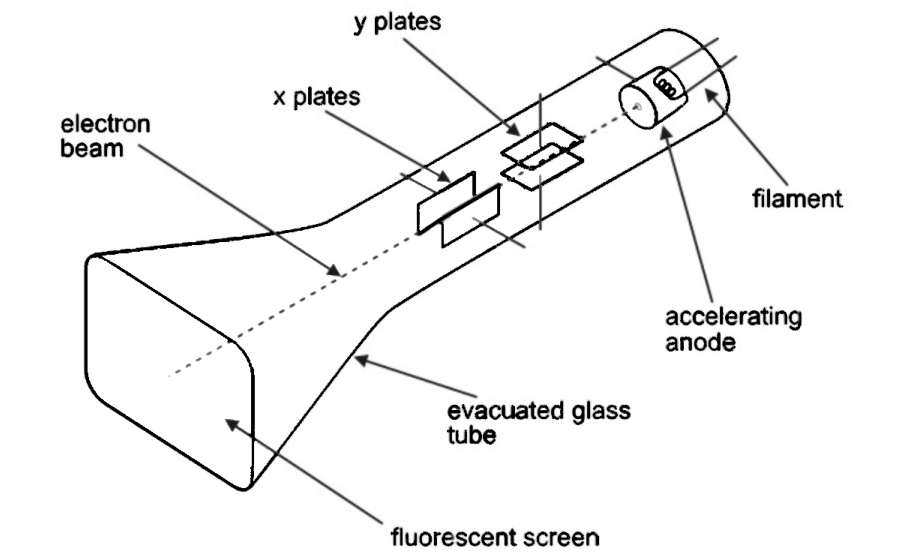
The first important part of the cathode ray tube is the heated metal cathode also known as the electron gun. The heat is supplied to the cathode which gets the electrons heated up. These electrons then start ejecting as a stream of negatively charged electrons which later accelerates towards the phosphor screen.
The second important part of the CRT is the phosphor screen. The function of this fluorescent screen is to convert electrical signals into visual patterns.
The third import part of the CRT is the deflecting system. The function of the deflector system is to deflect the electron beam horizontally or vertically. Therefore, it is also known as electron beam deflector.
Note:
J.J Thompson carried out an experiment with the cathode rays showing that all atoms contain tiny negatively charged particles. When the electron beam hits the phosphor screen, the phosphor sparks or emits light. In Thompson’s experiment, the cathode ray deflected away from the negatively charged electric plates and attracted towards the positively charged electric plates. This helped him prove that cathode rays were composed of tiny negatively charged particles.
Complete step by step answer:
A cathode ray tube is a vacuum tube in which images are produced when an electron beam strikes a phosphorescent surface. A Cathode ray tube is made of the electron gun assembly, the phosphor viewing surface, and the glass envelope. A heated cathode surrounded by a metal anode makes the electron gun assembly.
The first important part of the cathode ray tube is the heated metal cathode also known as the electron gun. The heat is supplied to the cathode which gets the electrons heated up. These electrons then start ejecting as a stream of negatively charged electrons which later accelerates towards the phosphor screen.
The second important part of the CRT is the phosphor screen. The function of this fluorescent screen is to convert electrical signals into visual patterns.
The third import part of the CRT is the deflecting system. The function of the deflector system is to deflect the electron beam horizontally or vertically. Therefore, it is also known as electron beam deflector.
Note:
J.J Thompson carried out an experiment with the cathode rays showing that all atoms contain tiny negatively charged particles. When the electron beam hits the phosphor screen, the phosphor sparks or emits light. In Thompson’s experiment, the cathode ray deflected away from the negatively charged electric plates and attracted towards the positively charged electric plates. This helped him prove that cathode rays were composed of tiny negatively charged particles.
Recently Updated Pages
Which of the following graphs shows the variation of class 12 physics CBSE

Draw a labelled diagram of the human male reproductive class 12 biology CBSE
Describe the experiment to compare the emf of two cells class 12 physics CBSE
What is standard hydrogen electrode
What is conventional current and electric current class 12 physics CBSE
2Bromopentane is treated with an alcoholic KOH solution class 12 chemistry CBSE
Trending doubts
Draw a labelled sketch of the human eye class 12 physics CBSE
Which are the Top 10 Largest Countries of the World?
Differentiate between homogeneous and heterogeneous class 12 chemistry CBSE
Draw ray diagrams each showing i myopic eye and ii class 12 physics CBSE
Which is the correct genotypic ratio of mendel dihybrid class 12 biology CBSE
What is the Full Form of PVC, PET, HDPE, LDPE, PP and PS ?