




Name the part of the brain that controls involuntary actions.
Answer
 Verified
639.9k+ views
Hint: The brain has three different parts which are further divided into certain regions depending on their location and functions. Each region plays a specific and important role in the brain.
Complete answer:
The medulla oblongata is the part of the brain which is responsible for controlling all the involuntary actions of the body. The medulla is that region of the hindbrain which is located below the midbrain and then continues to form the spinal cord which performs the functions of controlling and carrying out the reflex actions in the body.
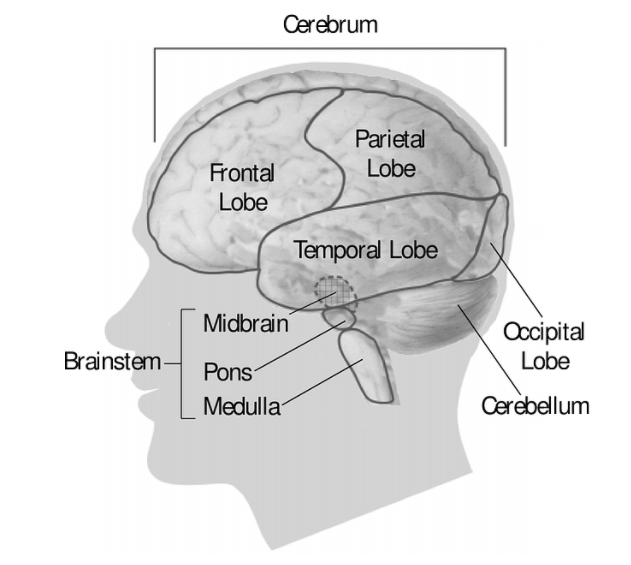
The human brain consists of three regions mainly forebrain, midbrain and hindbrain.
The forebrain is involved with the voluntary actions of the body and has specialized regions for the sense organs and is the main thinking part of the brain. The midbrain is the connecting link between forebrain and hindbrain and functions to control some involuntary actions of the body.The medulla controls the involuntary actions like salivation, blood pressure etc. The hindbrain is mainly divided into three regions: pons, medulla and cerebellum. The medulla controls involuntary actions and the cerebellum is associated with the precision of the decision and for maintaining the posture and balance of the body. The medulla controls the involuntary actions whereas forebrain is responsible for controlling the voluntary actions in the body.
Note: As the brain is the delicate organ and is the master of all the organs as it is known to control and coordinate the functions of all body organs thus protected in the bony case known as the skull or cranium.
Complete answer:
The medulla oblongata is the part of the brain which is responsible for controlling all the involuntary actions of the body. The medulla is that region of the hindbrain which is located below the midbrain and then continues to form the spinal cord which performs the functions of controlling and carrying out the reflex actions in the body.
The human brain consists of three regions mainly forebrain, midbrain and hindbrain.
The forebrain is involved with the voluntary actions of the body and has specialized regions for the sense organs and is the main thinking part of the brain. The midbrain is the connecting link between forebrain and hindbrain and functions to control some involuntary actions of the body.The medulla controls the involuntary actions like salivation, blood pressure etc. The hindbrain is mainly divided into three regions: pons, medulla and cerebellum. The medulla controls involuntary actions and the cerebellum is associated with the precision of the decision and for maintaining the posture and balance of the body. The medulla controls the involuntary actions whereas forebrain is responsible for controlling the voluntary actions in the body.
Note: As the brain is the delicate organ and is the master of all the organs as it is known to control and coordinate the functions of all body organs thus protected in the bony case known as the skull or cranium.
Recently Updated Pages
Master Class 11 English: Engaging Questions & Answers for Success

Master Class 11 Social Science: Engaging Questions & Answers for Success
Master Class 11 Maths: Engaging Questions & Answers for Success
Master Class 11 Biology: Engaging Questions & Answers for Success
Master Class 11 Physics: Engaging Questions & Answers for Success
Master Class 11 Chemistry: Engaging Questions & Answers for Success
Trending doubts
One Metric ton is equal to kg A 10000 B 1000 C 100 class 11 physics CBSE
Difference Between Prokaryotic Cells and Eukaryotic Cells
Two of the body parts which do not appear in MRI are class 11 biology CBSE
Find the value of the expression given below sin 30circ class 11 maths CBSE
Draw a diagram of a plant cell and label at least eight class 11 biology CBSE
10 examples of friction in our daily life