




What is the name of the kind of meniscus formed in the case of water?
A. concave
B. convex
C. both A and B
D. none
Answer
 Verified
618.3k+ views
Hint: In the case of a concave meniscus, the correct volume will be read at the bottom of the curve. And in the case of a convex meniscus, the opposite is true and the perfect reading will be at the top of the curve.
Complete step by step answer:
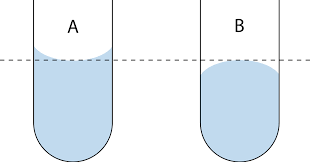
First of all let us discuss what actually a meniscus means. A meniscus is seen in the form of a curve in the surface of a molecular substance like water when it touches another surface. For example, we can think of water as when water sticks to the inside of a glass meniscus is formed there. A meniscus is developed because of surface tension in the liquid and must be read at eye level. The meniscus of a fluid in a test tube is because of the capillary force in the liquid, gas. Solid interface So long as the two fluids are not the similar kind, they will have change in properties even in small amounts and there will always develop a meniscus. Water is having a convex meniscus. This occurs with water and the glass container. A convex meniscus is developed when the molecules have a stronger attraction to each other than to the container. Therefore the correct answer is option B.
Note:
In the case of a concave meniscus, the volume of the liquid in the tube is read from the lower part of the curve. We can notice a 'line' of liquid at the top, creating the curve itself. The bottom of the curve is actually the lower side of this line.
Complete step by step answer:
First of all let us discuss what actually a meniscus means. A meniscus is seen in the form of a curve in the surface of a molecular substance like water when it touches another surface. For example, we can think of water as when water sticks to the inside of a glass meniscus is formed there. A meniscus is developed because of surface tension in the liquid and must be read at eye level. The meniscus of a fluid in a test tube is because of the capillary force in the liquid, gas. Solid interface So long as the two fluids are not the similar kind, they will have change in properties even in small amounts and there will always develop a meniscus. Water is having a convex meniscus. This occurs with water and the glass container. A convex meniscus is developed when the molecules have a stronger attraction to each other than to the container. Therefore the correct answer is option B.
Note:
In the case of a concave meniscus, the volume of the liquid in the tube is read from the lower part of the curve. We can notice a 'line' of liquid at the top, creating the curve itself. The bottom of the curve is actually the lower side of this line.
Recently Updated Pages
Master Class 11 Social Science: Engaging Questions & Answers for Success

Master Class 11 English: Engaging Questions & Answers for Success
Master Class 11 Maths: Engaging Questions & Answers for Success
Master Class 11 Chemistry: Engaging Questions & Answers for Success
Master Class 11 Biology: Engaging Questions & Answers for Success
Master Class 11 Physics: Engaging Questions & Answers for Success
Trending doubts
One Metric ton is equal to kg A 10000 B 1000 C 100 class 11 physics CBSE
Difference Between Prokaryotic Cells and Eukaryotic Cells
How many of the following diseases can be studied with class 11 biology CBSE
Draw a diagram of a plant cell and label at least eight class 11 biology CBSE
Two of the body parts which do not appear in MRI are class 11 biology CBSE
Which gas is abundant in air class 11 chemistry CBSE