




Name a material used for making permanent magnets. Describe how permanent magnets are made electrically.
Answer
 Verified
623.7k+ views
Hint: Permanent magnets are those objects which possess the unique magnetic effect without any external disturbances. We can make our own permanent magnets using proper metals or alloys. Some materials can attain the magnetic ability by exposing them to the suitable environment.
Complete answer:
Permanent magnets are mostly alloy or pure form of Iron, cobalt and nickel which are either man-made or naturally occurring. Some materials by virtue of their structure have a magnetic field present around them, from one end to the other end, existing as dipoles (with two poles – North and South). Such materials are called permanent magnets. They tend to retain their magnetic abilities for a long period of time if stored carefully at optimum temperatures.
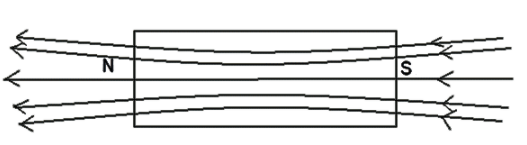
We can develop a permanent magnet by using a ferromagnetic material. Ferromagnetic materials are those which have a tendency to get strongly magnetised when exposed to an external field. The magnetic dipole moments of each domain (a group of molecules) of the material tend to align in one direction even after the external field is removed.
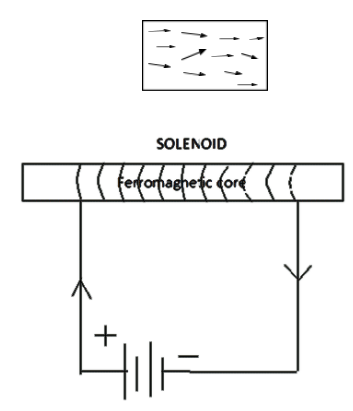
Let us see how to develop a permanent magnet. We need a solenoid, a ferromagnetic substance and an electrical power source for this process. The steps are given below:
1) Develop a circuit with the ferromagnetic material as the core of the solenoid connected to a DC source as shown in the figure.
2) Keep the circuit closed for sometimes.
3) Open the circuit and take the ferromagnetic material outside.
4) Check the magnetic ability of the material with some iron nails.
We can see that the before inactive ferromagnet now can attract iron nails, i.e., it has become a permanent magnet. Thus, we can develop a permanent magnet yourself.
Soft iron is widely used as a permanent magnet.
Note:
The materials which are used for permanent magnets include steel, alnico, ticonal and cobalt steel. They are cheaper and have the properties of high retentivity and high coercivity, which helps the material to retain its magnetic properties for a long time without losing strength.
Iron, nickel and cobalt are the naturally occurring ferromagnets.
Complete answer:
Permanent magnets are mostly alloy or pure form of Iron, cobalt and nickel which are either man-made or naturally occurring. Some materials by virtue of their structure have a magnetic field present around them, from one end to the other end, existing as dipoles (with two poles – North and South). Such materials are called permanent magnets. They tend to retain their magnetic abilities for a long period of time if stored carefully at optimum temperatures.
We can develop a permanent magnet by using a ferromagnetic material. Ferromagnetic materials are those which have a tendency to get strongly magnetised when exposed to an external field. The magnetic dipole moments of each domain (a group of molecules) of the material tend to align in one direction even after the external field is removed.
Let us see how to develop a permanent magnet. We need a solenoid, a ferromagnetic substance and an electrical power source for this process. The steps are given below:
1) Develop a circuit with the ferromagnetic material as the core of the solenoid connected to a DC source as shown in the figure.
2) Keep the circuit closed for sometimes.
3) Open the circuit and take the ferromagnetic material outside.
4) Check the magnetic ability of the material with some iron nails.
We can see that the before inactive ferromagnet now can attract iron nails, i.e., it has become a permanent magnet. Thus, we can develop a permanent magnet yourself.
Soft iron is widely used as a permanent magnet.
Note:
The materials which are used for permanent magnets include steel, alnico, ticonal and cobalt steel. They are cheaper and have the properties of high retentivity and high coercivity, which helps the material to retain its magnetic properties for a long time without losing strength.
Iron, nickel and cobalt are the naturally occurring ferromagnets.
Recently Updated Pages
Master Class 11 English: Engaging Questions & Answers for Success

Master Class 11 Social Science: Engaging Questions & Answers for Success
Master Class 11 Maths: Engaging Questions & Answers for Success
Master Class 11 Biology: Engaging Questions & Answers for Success
Master Class 11 Physics: Engaging Questions & Answers for Success
Master Class 11 Chemistry: Engaging Questions & Answers for Success
Trending doubts
One Metric ton is equal to kg A 10000 B 1000 C 100 class 11 physics CBSE
Difference Between Prokaryotic Cells and Eukaryotic Cells
Find the value of the expression given below sin 30circ class 11 maths CBSE
Difference between physical and chemical change class 11 chemistry CBSE
Two of the body parts which do not appear in MRI are class 11 biology CBSE
Draw a diagram of a plant cell and label at least eight class 11 biology CBSE