




Most thick walled and largest chamber of the heart is?
(a) Right auricle
(b) Right ventricle
(c) Left auricle
(d) Right auricle
Answer
 Verified
553.2k+ views
Hint: The heart is a muscular organ about the size of a fist. It is located just behind and slightly left of the breastbone. Under normal functioning, all four chambers of the heart work together in a continuous and coordinated effort to keep oxygen-rich blood circulating throughout the body.
Complete Answer:
The heart consists of four chambers in which the blood flows. Blood enters the right atrium and passes through the right ventricle which pumps the blood to the lungs where it becomes oxygenated. The pulmonary veins bring back the oxygenated blood to the left atrium from where the blood flows into the left ventricle. The left ventricle pumps the blood to the aorta which will distribute the oxygenated blood to the entire body.
The left ventricle is the strongest chamber because it has to pump blood out to the entire body. The left ventricle receives oxygenated blood from the left atrium via the mitral valve. The aortic valve paves the way for oxygen rich blood to pass from the left ventricle into the aorta, your body's largest artery, where it is delivered to the rest of the body. The left ventricular muscle relaxes and contracts quickly to increase or lower its pumping capacity under the control of the nervous system. In the diastolic phase, left ventricular muscles relax very quickly after each contraction so as to quickly fill itself with oxygenated blood flowing from the pulmonary veins. Likewise in the systolic phase, the left ventricle contracts rapidly and forcibly to pump this blood into the aorta, overcoming the much higher aortic pressure.
Note:
The heart weighs between 200 and 425 grams and is a little larger than the size of the fist. It has a volume capacity of 80-100mls. In a lifetime, a person’s heart must have beaten more than 3.5 billion times and each day the average heart beats about 100,000 times, pumping around 7500 litres of blood.
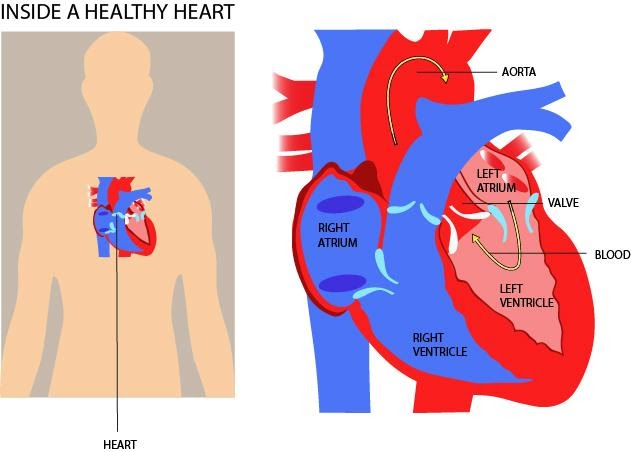
Figure: Chambers of heart
Complete Answer:
The heart consists of four chambers in which the blood flows. Blood enters the right atrium and passes through the right ventricle which pumps the blood to the lungs where it becomes oxygenated. The pulmonary veins bring back the oxygenated blood to the left atrium from where the blood flows into the left ventricle. The left ventricle pumps the blood to the aorta which will distribute the oxygenated blood to the entire body.
The left ventricle is the strongest chamber because it has to pump blood out to the entire body. The left ventricle receives oxygenated blood from the left atrium via the mitral valve. The aortic valve paves the way for oxygen rich blood to pass from the left ventricle into the aorta, your body's largest artery, where it is delivered to the rest of the body. The left ventricular muscle relaxes and contracts quickly to increase or lower its pumping capacity under the control of the nervous system. In the diastolic phase, left ventricular muscles relax very quickly after each contraction so as to quickly fill itself with oxygenated blood flowing from the pulmonary veins. Likewise in the systolic phase, the left ventricle contracts rapidly and forcibly to pump this blood into the aorta, overcoming the much higher aortic pressure.
Note:
The heart weighs between 200 and 425 grams and is a little larger than the size of the fist. It has a volume capacity of 80-100mls. In a lifetime, a person’s heart must have beaten more than 3.5 billion times and each day the average heart beats about 100,000 times, pumping around 7500 litres of blood.
Figure: Chambers of heart
Recently Updated Pages
Master Class 11 English: Engaging Questions & Answers for Success

Master Class 11 Social Science: Engaging Questions & Answers for Success
Master Class 11 Maths: Engaging Questions & Answers for Success
Master Class 11 Biology: Engaging Questions & Answers for Success
Master Class 11 Physics: Engaging Questions & Answers for Success
Master Class 11 Chemistry: Engaging Questions & Answers for Success
Trending doubts
One Metric ton is equal to kg A 10000 B 1000 C 100 class 11 physics CBSE
Difference Between Prokaryotic Cells and Eukaryotic Cells
Find the value of the expression given below sin 30circ class 11 maths CBSE
1 ton equals to A 100 kg B 1000 kg C 10 kg D 10000 class 11 physics CBSE
Two of the body parts which do not appear in MRI are class 11 biology CBSE
What are hard magnetic materials class 11 physics CBSE