




How do you know by looking at a graph that a system of linear equations has infinite solutions?
Answer
 Verified
603.9k+ views
Hint: For linear systems of equations we have three cases $ (1) $ No solutions $ (2) $ Finite solutions $ (3) $ Infinite solutions and we have a condition which has to be satisfied for each category of solution. For a system of linear equations to have an infinite number of solutions they have to intersect at an infinite number of points. From this point you definitely got the idea.
Complete step-by-step answer:
To tell just by looking at a graph that a system of linear equations has infinite solutions. First we have to be clear about the type of solutions to a system of linear equations.
$ (1) $ No solutions: A system of linear equations has no solutions if the lines formed by those linear equations are parallel in each other. It means that the system of linear equations has no solution. Here is an example:
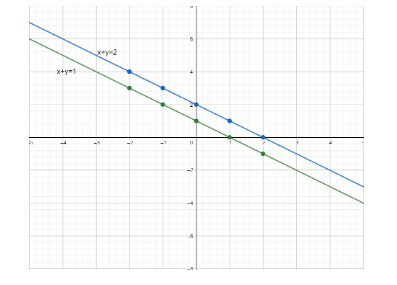
In the above graph both the lines are running parallel to each other infinitely. So they have no solution.
$ (2) $ Finite solutions: A system of linear equations has finitely many solutions if the lines formed by those linear equations are not parallel. It means that the system of linear equations has finite solutions. Here is an example:
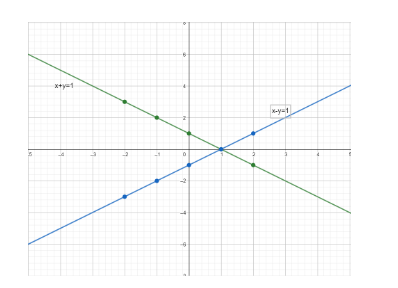
The point of intersection of both lines is the solution of the system of equations.
$ (3) $ Infinite solutions: A system of linear equations has infinitely many solutions if the lines formed by those linear equations are coincident on each other. It means that the system of linear equations has infinite solutions. Here is an example:
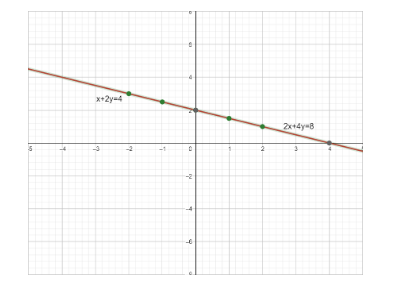
You can see two lines overlapping in this graph one is of green colour and the other is of red colour
Note: A mistake student does while telling a system of linear equations just by looking at graph has infinite solutions even they see two lines coincident of system of linear equations, but for a system of linear equations to have infinite solutions then all lines formed from system of linear equations has to be coincident.
Complete step-by-step answer:
To tell just by looking at a graph that a system of linear equations has infinite solutions. First we have to be clear about the type of solutions to a system of linear equations.
$ (1) $ No solutions: A system of linear equations has no solutions if the lines formed by those linear equations are parallel in each other. It means that the system of linear equations has no solution. Here is an example:
In the above graph both the lines are running parallel to each other infinitely. So they have no solution.
$ (2) $ Finite solutions: A system of linear equations has finitely many solutions if the lines formed by those linear equations are not parallel. It means that the system of linear equations has finite solutions. Here is an example:
The point of intersection of both lines is the solution of the system of equations.
$ (3) $ Infinite solutions: A system of linear equations has infinitely many solutions if the lines formed by those linear equations are coincident on each other. It means that the system of linear equations has infinite solutions. Here is an example:
You can see two lines overlapping in this graph one is of green colour and the other is of red colour
Note: A mistake student does while telling a system of linear equations just by looking at graph has infinite solutions even they see two lines coincident of system of linear equations, but for a system of linear equations to have infinite solutions then all lines formed from system of linear equations has to be coincident.

Recently Updated Pages
Master Class 12 Economics: Engaging Questions & Answers for Success

Master Class 12 Biology: Engaging Questions & Answers for Success
Master Class 11 English: Engaging Questions & Answers for Success
Master Class 11 Physics: Engaging Questions & Answers for Success
Master Class 11 Computer Science: Engaging Questions & Answers for Success
Master Class 11 Chemistry: Engaging Questions & Answers for Success
Trending doubts
What is BLO What is the full form of BLO class 8 social science CBSE
Citizens of India can vote at the age of A 18 years class 8 social science CBSE
One cusec is equal to how many liters class 8 maths CBSE
Give me the opposite gender of Duck class 8 english CBSE
Full form of STD, ISD and PCO
What are the methods of reducing friction. Explain