




IUPAC name of the formula $C{{H}_{2}}{{(COOH)}_{2}}$ is?
A. Butanoic acid
B. $\text{Propane}-1,3-\text{dioic acid}$
C. $\text{Propane}-1,2-\text{dioic acid}$
D. Malonic acid
Answer
 Verified
585.9k+ views
Hint: We should know that IUPAC name is determined by the number of carbon atoms present in the hydrocarbon chain. So, first count the atoms of carbon in the given formula and give the name according to the number of carbons. Then define the IUPAC name by what type of group is attached in the branch of the chain.
Complete answer:
IUPAC name is defined by the counting number of carbon atoms. There are different names given by the numbers of carbon atoms. If the molecule contains one carbon, then it is named as methen, if there are two carbons it is known as ethen.
So, here we can see it has three carbon atoms in the given formula $C{{H}_{2}}{{(COOH)}_{2}}$. So, it will be known by the name propane (as it has single covalent bonds attached to the side groups with the carbon atoms). And we can see there are two carboxylic acids. So, the suffix will be known by dioic. The carboxylic acids are present in the first and third carbon atom. So, the IUPAC name will be $\text{Propane}-1,3-\text{dioic acid}$ and its structure is shown as below,
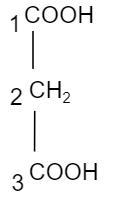
Hence, the correct option is B.
Note:
The possible mistake could be you can get confused with option D i.e. malonic acid. The given formula with IUPAC name $\text{Propane}-1,3-\text{dioic acid}$ is also known by the common name “malonic acid”. Remember, the common name and IUPAC nomenclature are two different entities. IUPAC nomenclature is a method which depends on the chain of carbon atoms and the group attached to it.
Complete answer:
IUPAC name is defined by the counting number of carbon atoms. There are different names given by the numbers of carbon atoms. If the molecule contains one carbon, then it is named as methen, if there are two carbons it is known as ethen.
So, here we can see it has three carbon atoms in the given formula $C{{H}_{2}}{{(COOH)}_{2}}$. So, it will be known by the name propane (as it has single covalent bonds attached to the side groups with the carbon atoms). And we can see there are two carboxylic acids. So, the suffix will be known by dioic. The carboxylic acids are present in the first and third carbon atom. So, the IUPAC name will be $\text{Propane}-1,3-\text{dioic acid}$ and its structure is shown as below,
Hence, the correct option is B.
Note:
The possible mistake could be you can get confused with option D i.e. malonic acid. The given formula with IUPAC name $\text{Propane}-1,3-\text{dioic acid}$ is also known by the common name “malonic acid”. Remember, the common name and IUPAC nomenclature are two different entities. IUPAC nomenclature is a method which depends on the chain of carbon atoms and the group attached to it.
Recently Updated Pages
Three beakers labelled as A B and C each containing 25 mL of water were taken A small amount of NaOH anhydrous CuSO4 and NaCl were added to the beakers A B and C respectively It was observed that there was an increase in the temperature of the solutions contained in beakers A and B whereas in case of beaker C the temperature of the solution falls Which one of the following statements isarecorrect i In beakers A and B exothermic process has occurred ii In beakers A and B endothermic process has occurred iii In beaker C exothermic process has occurred iv In beaker C endothermic process has occurred

Master Class 11 Social Science: Engaging Questions & Answers for Success
Master Class 11 Physics: Engaging Questions & Answers for Success
Master Class 11 Maths: Engaging Questions & Answers for Success
Master Class 11 Economics: Engaging Questions & Answers for Success
Master Class 11 Computer Science: Engaging Questions & Answers for Success
Three beakers labelled as A B and C each containing 25 mL of water were taken A small amount of NaOH anhydrous CuSO4 and NaCl were added to the beakers A B and C respectively It was observed that there was an increase in the temperature of the solutions contained in beakers A and B whereas in case of beaker C the temperature of the solution falls Which one of the following statements isarecorrect i In beakers A and B exothermic process has occurred ii In beakers A and B endothermic process has occurred iii In beaker C exothermic process has occurred iv In beaker C endothermic process has occurred
Master Class 11 Social Science: Engaging Questions & Answers for Success
Master Class 11 Physics: Engaging Questions & Answers for Success
Trending doubts
One Metric ton is equal to kg A 10000 B 1000 C 100 class 11 physics CBSE
There are 720 permutations of the digits 1 2 3 4 5 class 11 maths CBSE
State and prove Bernoullis theorem class 11 physics CBSE
Draw a diagram of a plant cell and label at least eight class 11 biology CBSE
Difference Between Prokaryotic Cells and Eukaryotic Cells
1 Quintal is equal to a 110 kg b 10 kg c 100kg d 1000 class 11 physics CBSE