



How many isomers of ${C_4}{H_8}C{l_2}$ are possible?
Answer
 Verified
623.1k+ views
Hint: Try to make different structures in your notebook firstly by putting all carbons in a straight line and swapping the positions of chlorine atoms count the number of isomers possible with it and then move one carbon atom to make a secondary position. This also places chlorine atoms in different arrangements.
Complete step-by-step answer:
For counting possible structural isomers there is formula available but drawing different structures helps a lot because using the drawing you can easily see the difference in two structures. Firstly, if I put all four carbon atoms in a straight line, then I can put both chlorine atoms with carbon no. $1$ or I can attach both with carbon number $2$ in these structure you get,
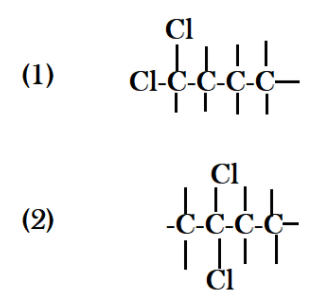
Now if we put both chlorines in different positions, I mean if I put one chlorine at carbon no. $1$ and other at carbon no.$2$, similarly if I take second chlorine from carbon no. $2$ and place it with carbon $3$ and $4$ I get three different structure.
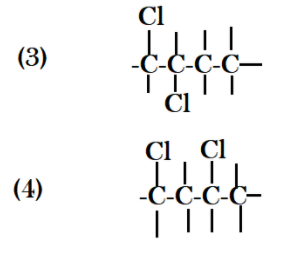
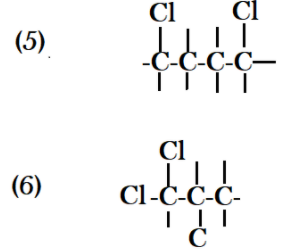
Now if I make a branched chain by connecting carbon no. $4$ with carbon no. $2$ then I also get a different structure. Let’s start placing two chlorine atoms with the same carbon and in different structures with two different carbon. When we place chlorine with two different carbons there are two possibilities that in first one, one chlorine gets attached to carbon no. $1$ and carbon no. $2$ and in second type chlorine atoms can get attached with carbon $1$ and carbon $3$ .
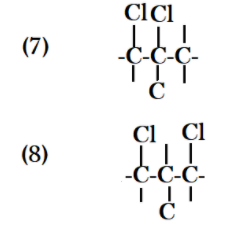
Count all the possible structures that you have drawn and you get an idea that you had made eight different types of structures with formula ${C_4}{H_8}C{l_2}$ .
Note: There are some cases in which you made diagrams which are exactly the same, it means it can happen that two diagrams become the same so cut them and count them one. All the valences that are leaved in the diagrams are the positions of all hydrogen atoms. Always count the number of atoms of chlorine, carbon and hydrogen to confirm that you are satisfying the structural possibilities of the formula given.
Complete step-by-step answer:
For counting possible structural isomers there is formula available but drawing different structures helps a lot because using the drawing you can easily see the difference in two structures. Firstly, if I put all four carbon atoms in a straight line, then I can put both chlorine atoms with carbon no. $1$ or I can attach both with carbon number $2$ in these structure you get,
Now if we put both chlorines in different positions, I mean if I put one chlorine at carbon no. $1$ and other at carbon no.$2$, similarly if I take second chlorine from carbon no. $2$ and place it with carbon $3$ and $4$ I get three different structure.
Now if I make a branched chain by connecting carbon no. $4$ with carbon no. $2$ then I also get a different structure. Let’s start placing two chlorine atoms with the same carbon and in different structures with two different carbon. When we place chlorine with two different carbons there are two possibilities that in first one, one chlorine gets attached to carbon no. $1$ and carbon no. $2$ and in second type chlorine atoms can get attached with carbon $1$ and carbon $3$ .
Count all the possible structures that you have drawn and you get an idea that you had made eight different types of structures with formula ${C_4}{H_8}C{l_2}$ .
Note: There are some cases in which you made diagrams which are exactly the same, it means it can happen that two diagrams become the same so cut them and count them one. All the valences that are leaved in the diagrams are the positions of all hydrogen atoms. Always count the number of atoms of chlorine, carbon and hydrogen to confirm that you are satisfying the structural possibilities of the formula given.
Recently Updated Pages
Which of the following graphs shows the variation of class 12 physics CBSE

Draw a labelled diagram of the human male reproductive class 12 biology CBSE
Describe the experiment to compare the emf of two cells class 12 physics CBSE
What is standard hydrogen electrode
What is conventional current and electric current class 12 physics CBSE
2Bromopentane is treated with an alcoholic KOH solution class 12 chemistry CBSE
Trending doubts
Draw a labelled sketch of the human eye class 12 physics CBSE
Which are the Top 10 Largest Countries of the World?
Differentiate between homogeneous and heterogeneous class 12 chemistry CBSE
Draw ray diagrams each showing i myopic eye and ii class 12 physics CBSE
Which is the correct genotypic ratio of mendel dihybrid class 12 biology CBSE
What is the Full Form of PVC, PET, HDPE, LDPE, PP and PS ?