




In which of the following circuits, will the bulb glow?
A)
B)
C)
D)
Answer
 Verified
562.5k+ views
Hint: If a bulb is connected in a circuit, it will glow only if the connection is complete and it is connected to the battery or supply voltage through wires. An open switch would mean an open circuit and hence no current passes through it whereas a closed switch acts as a normal conductor. For this question, we will analyze every circuit and check whether the switch is connected in series or in parallel with the bulb. A parallel connection would allow the bulb to glow since it provides an alternative path for the current to flow.
Complete answer:
A switch acts to regulate the flow of current in a circuit. An open switch would mean an open circuit and hence no current passes through it whereas a closed switch acts as a normal conductor.
Whether the current is obstructed or not depends on the position of the open switch with respect to other elements. If it is connected in series, then it will act as an open switch in the only path where the current can flow. Hence, the circuit breaks and no current flows in the circuit. However, when connected in parallel there is always an alternative path for the current to flow. Hence, the circuit does not break and the current easily flows through the other path.
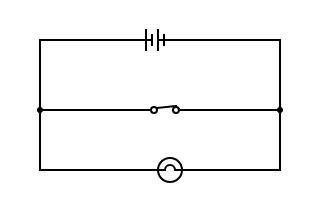
In circuit 1,
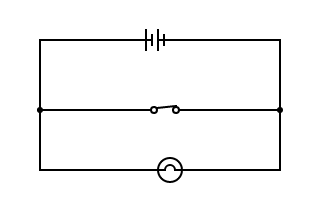
The switch is connected in parallel with the bulb and battery both. And it is a closed switch. So, it will only act as a conductor and allow the flow of current. Hence, this circuit is complete and the bulb will glow.
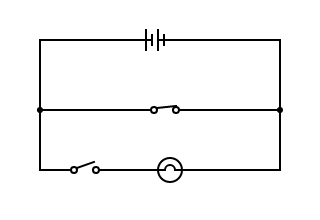
In circuit 2,
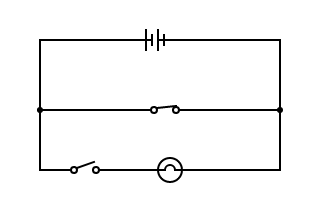
There are two switches-one open switch connected in series with the bulb and one closed switch connected in parallel. Now, the closed switch would act as a simple conductor but the open switch connected in series with the bulb would obstruct the flow of current. The circuit connecting the bulb with the battery would break and no current flows in it. So, the bulb will not glow.
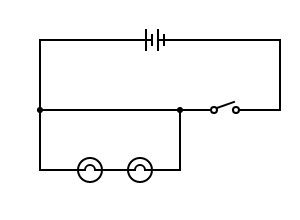
In circuit 3,
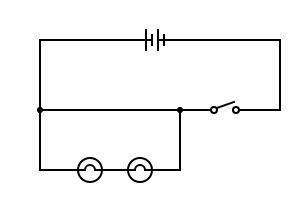
Two bulbs connected in series are connected with an open switch. This open switch is connected in series with the bulb. Hence, the circuit breaks and bulbs do not glow.
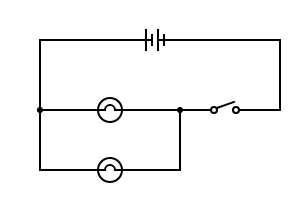
In circuit 4,
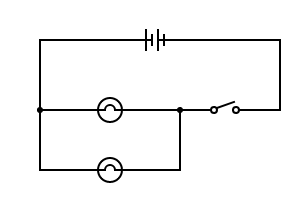
Two bulbs are connected in parallel with each other. The combination is connected in series with an open switch. Again, the circuit would break and no current would flow through it. Thus, the bulbs will not glow.
Hence, option (A) is the correct answer.
Note:
If in a parallel connection, there is an open switch in every arm of the parallel combination, it would mean that no arm is offering a path for the current to flow. Hence, in such a case also, the circuit shall break. A switch is simply a device which when turned off (open switch) offers infinite resistance to the current flow and when turned on (closed switch) offers zero resistance to the current flow.
Complete answer:
A switch acts to regulate the flow of current in a circuit. An open switch would mean an open circuit and hence no current passes through it whereas a closed switch acts as a normal conductor.
Whether the current is obstructed or not depends on the position of the open switch with respect to other elements. If it is connected in series, then it will act as an open switch in the only path where the current can flow. Hence, the circuit breaks and no current flows in the circuit. However, when connected in parallel there is always an alternative path for the current to flow. Hence, the circuit does not break and the current easily flows through the other path.
In circuit 1,
The switch is connected in parallel with the bulb and battery both. And it is a closed switch. So, it will only act as a conductor and allow the flow of current. Hence, this circuit is complete and the bulb will glow.
In circuit 2,
There are two switches-one open switch connected in series with the bulb and one closed switch connected in parallel. Now, the closed switch would act as a simple conductor but the open switch connected in series with the bulb would obstruct the flow of current. The circuit connecting the bulb with the battery would break and no current flows in it. So, the bulb will not glow.
In circuit 3,
Two bulbs connected in series are connected with an open switch. This open switch is connected in series with the bulb. Hence, the circuit breaks and bulbs do not glow.
In circuit 4,
Two bulbs are connected in parallel with each other. The combination is connected in series with an open switch. Again, the circuit would break and no current would flow through it. Thus, the bulbs will not glow.
Hence, option (A) is the correct answer.
Note:
If in a parallel connection, there is an open switch in every arm of the parallel combination, it would mean that no arm is offering a path for the current to flow. Hence, in such a case also, the circuit shall break. A switch is simply a device which when turned off (open switch) offers infinite resistance to the current flow and when turned on (closed switch) offers zero resistance to the current flow.
Recently Updated Pages
Which of the following graphs shows the variation of class 12 physics CBSE

Draw a labelled diagram of the human male reproductive class 12 biology CBSE
Describe the experiment to compare the emf of two cells class 12 physics CBSE
What is standard hydrogen electrode
What is conventional current and electric current class 12 physics CBSE
2Bromopentane is treated with an alcoholic KOH solution class 12 chemistry CBSE
Trending doubts
Draw a labelled sketch of the human eye class 12 physics CBSE
Which are the Top 10 Largest Countries of the World?
Differentiate between homogeneous and heterogeneous class 12 chemistry CBSE
Draw ray diagrams each showing i myopic eye and ii class 12 physics CBSE
Which is the correct genotypic ratio of mendel dihybrid class 12 biology CBSE
What is the Full Form of PVC, PET, HDPE, LDPE, PP and PS ?