




In the given figures sides $AB$ and $BC$ and median $AD$ of a $\Delta ABC$ are respectively proportional to sides $PQ,QR$ and median $PM$ of $\Delta PQR$ . show that triangle $\Delta ABC \sim \Delta PQR$.
Answer
 Verified
621.3k+ views
Hint: In order to solve this question, we have to apply similarity rules of triangles and in which side and angles helps us to show the similarities of these triangles.
Complete step-by-step answer:
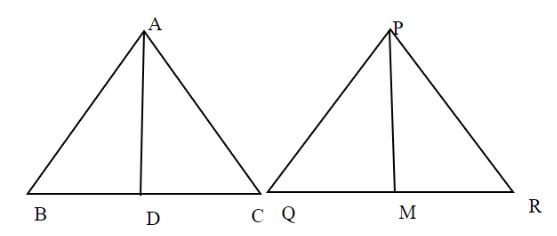
According to given question,
$\dfrac{{AB}}{{PQ}} = \dfrac{{BC}}{{QR}} = \dfrac{{AD}}{{PM}} - - - - - \left( 1 \right)$
In $\Delta ABC$, since $AD$ is the median,
$BD = CD = \dfrac{1}{2}BC$
Or $BC = 2BD - - - - - \left( 2 \right)$
Similarly, $PM$ is the median,
$QM = RM = \dfrac{1}{2}QR$
Or $QR = 2QM - - - - - \left( 3 \right)$
Substituting the value of $BC,QR$ in equation (1), we get
$\dfrac{{AB}}{{PQ}} = \dfrac{{2BD}}{{2QM}} = \dfrac{{AD}}{{PM}}$
$\dfrac{{AB}}{{PQ}} = \dfrac{{BD}}{{QM}} = \dfrac{{AD}}{{PM}} - - - - - \left( 4 \right)$
Since all three sides are proportional.
Therefore, by SSS similarity rule,
$\Delta ABD \sim \Delta PQM$
Hence,$\angle B = \angle Q - - - - - - \left( 5 \right)$,
corresponding angles of similar triangles are equal.
In $\Delta ABC\& \Delta PQR$
Using (5), we get
$\angle B = \angle Q$
Given, $\dfrac{{AB}}{{PQ}} = \dfrac{{BC}}{{QR}}$
Hence by SAS Similarity of triangle.
$\Delta ABC \sim \Delta PQR$
Note: Whenever we face these types of questions the key concept is that we have to take small triangles and by similarity rules show them similar by which we get two sides or one sides and one angle equality and we will easily get our desired answer.
Complete step-by-step answer:
According to given question,
$\dfrac{{AB}}{{PQ}} = \dfrac{{BC}}{{QR}} = \dfrac{{AD}}{{PM}} - - - - - \left( 1 \right)$
In $\Delta ABC$, since $AD$ is the median,
$BD = CD = \dfrac{1}{2}BC$
Or $BC = 2BD - - - - - \left( 2 \right)$
Similarly, $PM$ is the median,
$QM = RM = \dfrac{1}{2}QR$
Or $QR = 2QM - - - - - \left( 3 \right)$
Substituting the value of $BC,QR$ in equation (1), we get
$\dfrac{{AB}}{{PQ}} = \dfrac{{2BD}}{{2QM}} = \dfrac{{AD}}{{PM}}$
$\dfrac{{AB}}{{PQ}} = \dfrac{{BD}}{{QM}} = \dfrac{{AD}}{{PM}} - - - - - \left( 4 \right)$
Since all three sides are proportional.
Therefore, by SSS similarity rule,
$\Delta ABD \sim \Delta PQM$
Hence,$\angle B = \angle Q - - - - - - \left( 5 \right)$,
corresponding angles of similar triangles are equal.
In $\Delta ABC\& \Delta PQR$
Using (5), we get
$\angle B = \angle Q$
Given, $\dfrac{{AB}}{{PQ}} = \dfrac{{BC}}{{QR}}$
Hence by SAS Similarity of triangle.
$\Delta ABC \sim \Delta PQR$
Note: Whenever we face these types of questions the key concept is that we have to take small triangles and by similarity rules show them similar by which we get two sides or one sides and one angle equality and we will easily get our desired answer.
Recently Updated Pages
Master Class 11 Computer Science: Engaging Questions & Answers for Success

Master Class 11 Business Studies: Engaging Questions & Answers for Success
Master Class 11 Economics: Engaging Questions & Answers for Success
Master Class 11 English: Engaging Questions & Answers for Success
Master Class 11 Maths: Engaging Questions & Answers for Success
Master Class 11 Biology: Engaging Questions & Answers for Success
Trending doubts
One Metric ton is equal to kg A 10000 B 1000 C 100 class 11 physics CBSE
There are 720 permutations of the digits 1 2 3 4 5 class 11 maths CBSE
Discuss the various forms of bacteria class 11 biology CBSE
Draw a diagram of a plant cell and label at least eight class 11 biology CBSE
State the laws of reflection of light
Explain zero factorial class 11 maths CBSE