




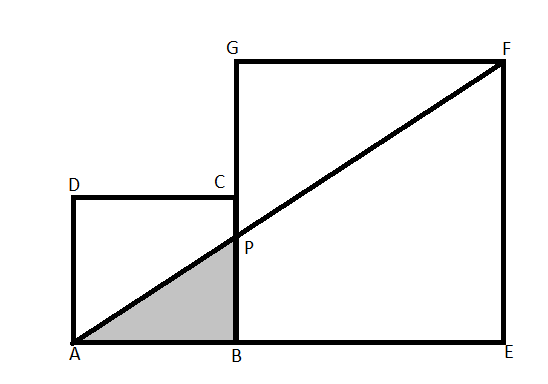
In the figure ABCD and BEFG are two squares with side lengths 4 cm and 10 cm respectively. Find the area of the shaded region (sq. cm).
Answer
 Verified
615.9k+ views
Hint: Length of AB is 4 cm and BC is 10 cm, as given in the question. The coordinate of F is (14,10) and the coordinate of A is (0, 0). Now, we consider A to be the origin of equation AF. By using this, we calculate the value of x and y which are the coordinates of P. Now we can easily calculate the area of triangle APB.
Complete step-by-step answer:
According to the problem statement, the length of AB = 4cm and the length of BC = 10cm.
By using the details of the side of the square, we evaluate the coordinates of F as x = 10+4 = 14 and y = 10 so it can be represented as (14,10).
Consider A to be the origin, the coordinate of A is (0,0).
Now, the equation of line AF:
So, the general equation of line when intercept is zero is: y = mx
Here m is defined as: \[m=\dfrac{{{y}_{2}}-{{y}_{1}}}{{{x}_{2}}-{{x}_{1}}}\]
Putting the values in slope formula: y2 = 14, y1 = 0, x2 =10 and x1 = 0
$\begin{align}
& m=\dfrac{14-0}{10-0} \\
& m=\dfrac{7}{5} \\
\end{align}$
Putting the value of m is $\dfrac{y}{x}$.
So,
$\begin{align}
& \dfrac{y}{x}=\dfrac{7}{5} \\
& y=\dfrac{7}{5}x \\
\end{align}$
Putting the value of x = 4 cm, we get y $=\dfrac{28}{5}$ cm. They are the coordinates of P.
$P\left( 4,\dfrac{28}{5} \right)$
Now, the area of $\Delta APB$.
Area$=\dfrac{1}{2}\times base\times height$.
Area$=\dfrac{1}{2}\times AB\times BP$.
Here, AB = 4cm, BP $=\dfrac{28}{5}$cm.
Area of $\Delta APB=\dfrac{1}{2}\times 4\times \dfrac{28}{5}$
Area of $\Delta APB=11.2c{{m}^{2}}$.
Hence, the area of the shaded region which is $\Delta APB=11.2c{{m}^{2}}$.
Note: This question can be alternatively solved by using the property of similar triangles. Since the triangle APB and AFE are similar, so the ratio of side PB and FE is proportional to the ratio of side AB and AE. As we know all the values other than PB, so it can be evaluated.
Complete step-by-step answer:
According to the problem statement, the length of AB = 4cm and the length of BC = 10cm.
By using the details of the side of the square, we evaluate the coordinates of F as x = 10+4 = 14 and y = 10 so it can be represented as (14,10).
Consider A to be the origin, the coordinate of A is (0,0).
Now, the equation of line AF:
So, the general equation of line when intercept is zero is: y = mx
Here m is defined as: \[m=\dfrac{{{y}_{2}}-{{y}_{1}}}{{{x}_{2}}-{{x}_{1}}}\]
Putting the values in slope formula: y2 = 14, y1 = 0, x2 =10 and x1 = 0
$\begin{align}
& m=\dfrac{14-0}{10-0} \\
& m=\dfrac{7}{5} \\
\end{align}$
Putting the value of m is $\dfrac{y}{x}$.
So,
$\begin{align}
& \dfrac{y}{x}=\dfrac{7}{5} \\
& y=\dfrac{7}{5}x \\
\end{align}$
Putting the value of x = 4 cm, we get y $=\dfrac{28}{5}$ cm. They are the coordinates of P.
$P\left( 4,\dfrac{28}{5} \right)$
Now, the area of $\Delta APB$.
Area$=\dfrac{1}{2}\times base\times height$.
Area$=\dfrac{1}{2}\times AB\times BP$.
Here, AB = 4cm, BP $=\dfrac{28}{5}$cm.
Area of $\Delta APB=\dfrac{1}{2}\times 4\times \dfrac{28}{5}$
Area of $\Delta APB=11.2c{{m}^{2}}$.
Hence, the area of the shaded region which is $\Delta APB=11.2c{{m}^{2}}$.
Note: This question can be alternatively solved by using the property of similar triangles. Since the triangle APB and AFE are similar, so the ratio of side PB and FE is proportional to the ratio of side AB and AE. As we know all the values other than PB, so it can be evaluated.
Recently Updated Pages
Master Class 12 Economics: Engaging Questions & Answers for Success

Master Class 12 Physics: Engaging Questions & Answers for Success
Master Class 12 English: Engaging Questions & Answers for Success
Master Class 12 Social Science: Engaging Questions & Answers for Success
Master Class 12 Maths: Engaging Questions & Answers for Success
Master Class 12 Business Studies: Engaging Questions & Answers for Success
Trending doubts
Which are the Top 10 Largest Countries of the World?
What are the major means of transport Explain each class 12 social science CBSE
Draw a labelled sketch of the human eye class 12 physics CBSE
Why cannot DNA pass through cell membranes class 12 biology CBSE
Differentiate between insitu conservation and exsitu class 12 biology CBSE
Draw a neat and well labeled diagram of TS of ovary class 12 biology CBSE