




In the female cone of Pinus
(a)There are two sessile ovules on the basis of each ovuliferous scale
(b)Each ovule is anatropous
(c)The nucleus is surrounded by two integuments
(d)All the megaspores produced by the division of the megaspore mother cell are
Answer
 Verified
635.7k+ views
Hint: It contains ovules which, when fertilized by pollen, become seeds. The structure of these shifts all the more notably between the distinctive conifer families and is frequently significant for the identification of numerous types of conifers. It has often been used by people in temperate climates to predict dry and wet weather, usually hanging a harvested from some string outside to measure the humidity of the air.
Complete step by step answer:
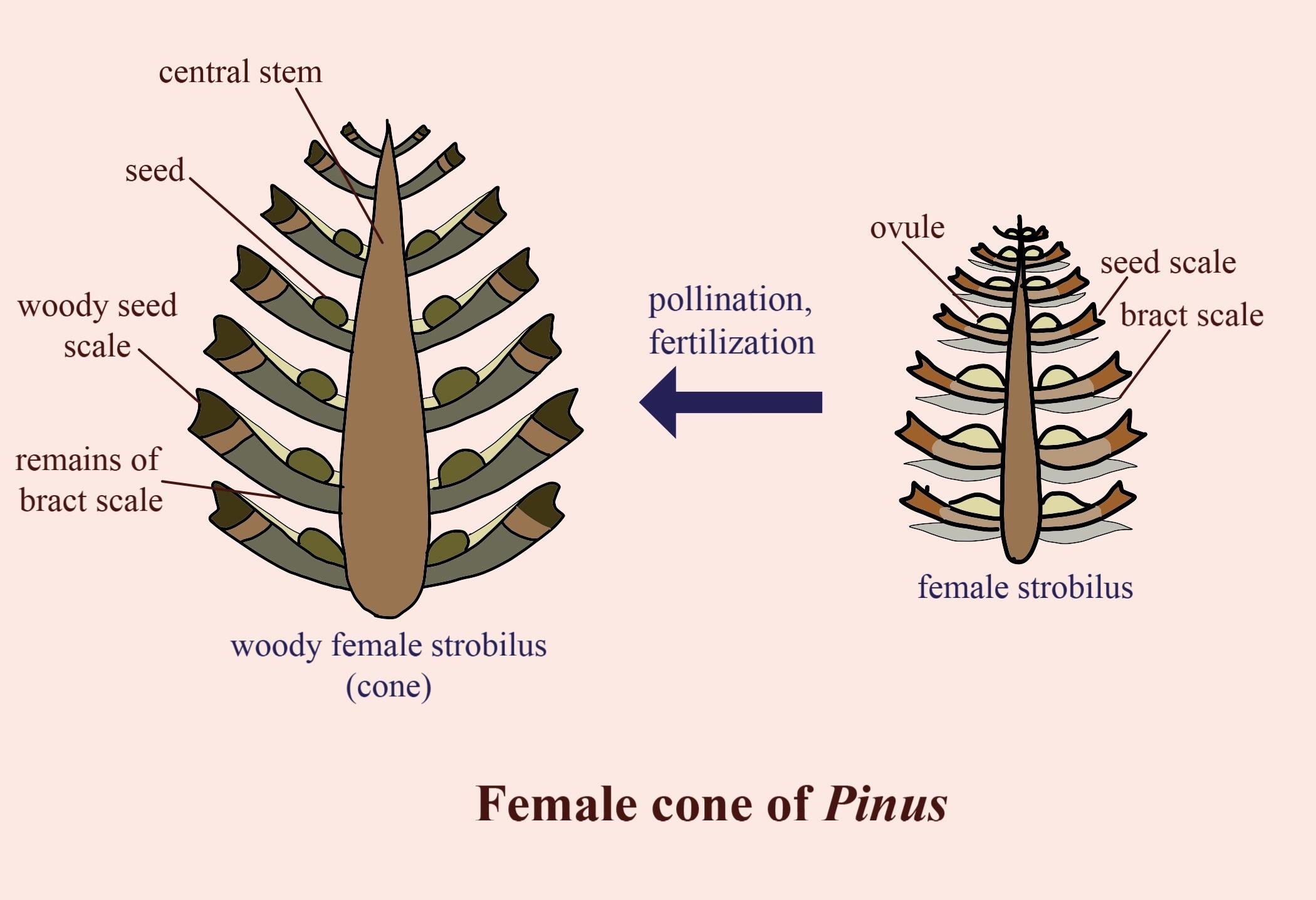
In the female cone of Pinus, bract scales and ovuliferous scales are available. The ovuliferous scale is woody and it has two sessile ovules on the upper part of each ovuliferous scale.
So the correct answer is ‘There are two sessile ovules on the basis of each ovuliferous scale’.
Additional information: The female cone has two kinds of scale: the bract scales, and subsequently the seed scales (or ovuliferous scales), one subtended by every bract scale, gotten from a profoundly adjusted branchlet. On the upper-side base of each seed, the scale is two ovules that develop into seeds after fertilization by pollen grains. The bract scales develop first, and are conspicuous at the time of pollination; the seed scales develop later to surround and protect the seeds, with the bract scales often not growing further. The scales open temporarily to receive gametophytes, then close during fertilization and maturation, then re-open again at maturity to permit the seed to flee. Development takes 6–8 months from pollination in most Pinaceae genera, yet a year in cedars and 18 two years (once in a while more) in many pines.
Note:
The opening of non-serotinous pine cones are identified with their dampness content, cones are open when dry and shut when wet in the wake of maturing. This assures that the tiny, wind disseminated seeds are going to be dispersed during relatively dry weather, and thus, the space traveled from the parent tree is going to be enhanced. This cycle happens with more seasoned cones while appended to branches and even after the more established cones have tumbled to the woodland floor.
Complete step by step answer:
In the female cone of Pinus, bract scales and ovuliferous scales are available. The ovuliferous scale is woody and it has two sessile ovules on the upper part of each ovuliferous scale.
So the correct answer is ‘There are two sessile ovules on the basis of each ovuliferous scale’.
Additional information: The female cone has two kinds of scale: the bract scales, and subsequently the seed scales (or ovuliferous scales), one subtended by every bract scale, gotten from a profoundly adjusted branchlet. On the upper-side base of each seed, the scale is two ovules that develop into seeds after fertilization by pollen grains. The bract scales develop first, and are conspicuous at the time of pollination; the seed scales develop later to surround and protect the seeds, with the bract scales often not growing further. The scales open temporarily to receive gametophytes, then close during fertilization and maturation, then re-open again at maturity to permit the seed to flee. Development takes 6–8 months from pollination in most Pinaceae genera, yet a year in cedars and 18 two years (once in a while more) in many pines.
Note:
The opening of non-serotinous pine cones are identified with their dampness content, cones are open when dry and shut when wet in the wake of maturing. This assures that the tiny, wind disseminated seeds are going to be dispersed during relatively dry weather, and thus, the space traveled from the parent tree is going to be enhanced. This cycle happens with more seasoned cones while appended to branches and even after the more established cones have tumbled to the woodland floor.
Recently Updated Pages
Which of the following graphs shows the variation of class 12 physics CBSE

Draw a labelled diagram of the human male reproductive class 12 biology CBSE
Describe the experiment to compare the emf of two cells class 12 physics CBSE
What is standard hydrogen electrode
What is conventional current and electric current class 12 physics CBSE
2Bromopentane is treated with an alcoholic KOH solution class 12 chemistry CBSE
Trending doubts
Draw a labelled sketch of the human eye class 12 physics CBSE
Which are the Top 10 Largest Countries of the World?
Differentiate between homogeneous and heterogeneous class 12 chemistry CBSE
Draw ray diagrams each showing i myopic eye and ii class 12 physics CBSE
Which is the correct genotypic ratio of mendel dihybrid class 12 biology CBSE
What is the Full Form of PVC, PET, HDPE, LDPE, PP and PS ?