




In the compound between A and H, what type of bond is formed?
(A) Ionic
(B) Covalent
(C) Coordinate
(D) No bond is formed
Answer
 Verified
643.5k+ views
Hint: By looking in the below table, we would get an idea about which element is A and which is H. Determining their nature we can easily say what type of bond is formed between them.
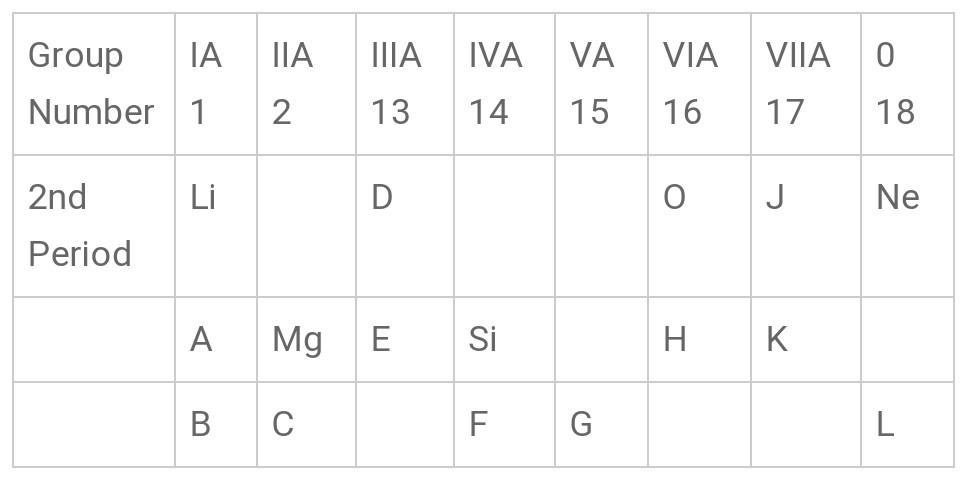
Complete step by step solution:
From the table given above, we can see that A belongs to Group IA and H belongs to Group VIA. Since A is below Lithium (Li-Atomic No.3) and next Neon (Atomic No. 10), it must surely be Sodium (Na- Atomic No. 11). H is placed in Group VIA, before the potassium (K- Atomic No. 17), so it must be Sulphur (S) with Atomic Number 16. As we know Na is a metal and S is a Nonmetal, the bond formed between them must be an ionic bond and the compound is called Ionic compound.
Definition: Ionic bond is the force of attraction between a positive and negative ion. This bond will be formed when the metallic atom gives its electrons to the nonmetallic atom.
During this time metal will give its electrons to the nonmetal, in order to obtain the nearest stable electronic configuration. Similarly, nonmetal will also accept those electrons from the metals in order to obtain the nearest stable electronic configuration.
$2Na+S\to N{{a}_{2}}S$
Sodium metal by giving its electron will attain [Ne] configuration and Sulphur will obtain two electrons (one from each Na metal) to attain [Ar] configuration.
Therefore, the correct answer is option (A) Ionic.
Additional Information:
There are various other bonds. They are
- Covalent bond
- Coordinate bond
- Hydrogen bond
Note: Covalent bonds will be formed only between two nonmetals. Ionic bonds are formed between a metal and a nonmetal. Strength of ionic bonds depends on the difference of electronegativity of the bonded atoms.
Complete step by step solution:
From the table given above, we can see that A belongs to Group IA and H belongs to Group VIA. Since A is below Lithium (Li-Atomic No.3) and next Neon (Atomic No. 10), it must surely be Sodium (Na- Atomic No. 11). H is placed in Group VIA, before the potassium (K- Atomic No. 17), so it must be Sulphur (S) with Atomic Number 16. As we know Na is a metal and S is a Nonmetal, the bond formed between them must be an ionic bond and the compound is called Ionic compound.
Definition: Ionic bond is the force of attraction between a positive and negative ion. This bond will be formed when the metallic atom gives its electrons to the nonmetallic atom.
During this time metal will give its electrons to the nonmetal, in order to obtain the nearest stable electronic configuration. Similarly, nonmetal will also accept those electrons from the metals in order to obtain the nearest stable electronic configuration.
$2Na+S\to N{{a}_{2}}S$
Sodium metal by giving its electron will attain [Ne] configuration and Sulphur will obtain two electrons (one from each Na metal) to attain [Ar] configuration.
Therefore, the correct answer is option (A) Ionic.
Additional Information:
There are various other bonds. They are
- Covalent bond
- Coordinate bond
- Hydrogen bond
Note: Covalent bonds will be formed only between two nonmetals. Ionic bonds are formed between a metal and a nonmetal. Strength of ionic bonds depends on the difference of electronegativity of the bonded atoms.
Recently Updated Pages
Write structures of the following compounds i 2 Chloro3methylpentane class 11 chemistry CBSE

What is BLO What is the full form of BLO class 8 social science CBSE
Explain the Treaty of Vienna of 1815 class 10 social science CBSE
A Paragraph on Pollution in about 100-150 Words
XIX+XXX A 49 B 51 C 55 D 44 class 5 maths CBSE
If x a + bt + ct2 where x is in meters and t is in class 11 physics CBSE
Trending doubts
One Metric ton is equal to kg A 10000 B 1000 C 100 class 11 physics CBSE
Draw a diagram of nephron and explain its structur class 11 biology CBSE
10 examples of friction in our daily life
Proton was discovered by A Thomson B Rutherford C Chadwick class 11 chemistry CBSE
Bond order ofO2 O2+ O2 and O22 is in order A O2 langle class 11 chemistry CBSE
Draw a labelled diagram of the neuron and describe class 11 biology CBSE