




In general in an alternating current circuit (one complete cycle) which of the following is possible:
A. the average value of current is zero.
B. The average value of the square of the current is zero.
C. Average power dissipation is zero.
D. The phase difference between voltage and current is zero.
Answer
 Verified
645.3k+ views
Hint: Firstly you could recall what exactly defines one complete cycle of an AC circuit. Then consider the possibility of each of the given options being true for such a situation. Since the question shows a possibility of more than one correct answer, you should check the possibility of every option being correct.
Complete step by step answer:
In the question we are discussing one complete cycle of alternating current circuits. We are given four conditions and are asked to find which among those conditions are true for one complete cycle of alternating current circuit.
For that we should understand what all things happen during one complete cycle of an AC circuit.
We could call a one cycle of an AC complete only when it completes one full pattern from its positive half to its negative half and back to its zero baseline again. So one full cycle contains both positive half cycles as well as negative half cycle.
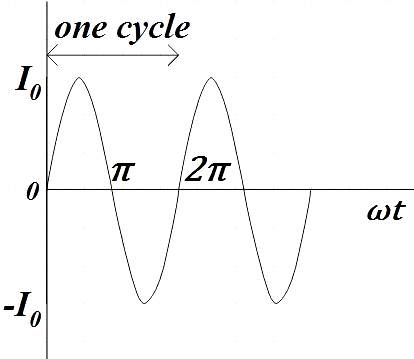
The waveform above clearly represents one full cycle for AC current and we see that one full cycle contains both negative and positive halves, so, the average value of current is obviously zero over one full cycle. That is for one full cycle of AC,
$\left\langle i \right\rangle =0$ …………………………….. (1)
But when the value of current is squared and then taken average over a full cycle, it cannot be zero because squaring makes the whole set of values positive.
$\left\langle {{i}^{2}} \right\rangle \ne 0$ ……………………………. (2)
We know that average power dissipated is given by,
$\left\langle p \right\rangle =\left\langle {{i}^{2}}R \right\rangle $
From (2), for a complete cycle of AC the average power dissipated $\left\langle p \right\rangle \ne 0$
Also, the phase difference between current and voltage remains the same throughout the cycle and is not zero after the completion of one full cycle.
So, the correct answer is “Option A”.
Note: Since the question shows a possibility of more than one option being correct, we must consider all other options even if we find the very first option correct. That is why we have discussed options B, C and D even when we know that option A is correct. Periodic time defines the time taken by the waveform to complete one full cycle.
Complete step by step answer:
In the question we are discussing one complete cycle of alternating current circuits. We are given four conditions and are asked to find which among those conditions are true for one complete cycle of alternating current circuit.
For that we should understand what all things happen during one complete cycle of an AC circuit.
We could call a one cycle of an AC complete only when it completes one full pattern from its positive half to its negative half and back to its zero baseline again. So one full cycle contains both positive half cycles as well as negative half cycle.
The waveform above clearly represents one full cycle for AC current and we see that one full cycle contains both negative and positive halves, so, the average value of current is obviously zero over one full cycle. That is for one full cycle of AC,
$\left\langle i \right\rangle =0$ …………………………….. (1)
But when the value of current is squared and then taken average over a full cycle, it cannot be zero because squaring makes the whole set of values positive.
$\left\langle {{i}^{2}} \right\rangle \ne 0$ ……………………………. (2)
We know that average power dissipated is given by,
$\left\langle p \right\rangle =\left\langle {{i}^{2}}R \right\rangle $
From (2), for a complete cycle of AC the average power dissipated $\left\langle p \right\rangle \ne 0$
Also, the phase difference between current and voltage remains the same throughout the cycle and is not zero after the completion of one full cycle.
So, the correct answer is “Option A”.
Note: Since the question shows a possibility of more than one option being correct, we must consider all other options even if we find the very first option correct. That is why we have discussed options B, C and D even when we know that option A is correct. Periodic time defines the time taken by the waveform to complete one full cycle.
Recently Updated Pages
Which of the following graphs shows the variation of class 12 physics CBSE

Draw a labelled diagram of the human male reproductive class 12 biology CBSE
Describe the experiment to compare the emf of two cells class 12 physics CBSE
What is standard hydrogen electrode
What is conventional current and electric current class 12 physics CBSE
2Bromopentane is treated with an alcoholic KOH solution class 12 chemistry CBSE
Trending doubts
Draw a labelled sketch of the human eye class 12 physics CBSE
Which are the Top 10 Largest Countries of the World?
Differentiate between homogeneous and heterogeneous class 12 chemistry CBSE
Draw ray diagrams each showing i myopic eye and ii class 12 physics CBSE
Which is the correct genotypic ratio of mendel dihybrid class 12 biology CBSE
What is the Full Form of PVC, PET, HDPE, LDPE, PP and PS ?