




In complete dominance ratio of red, pink. And white in Four o’ clock is
A) 1: 2: 1
B) 1: 1: 2
C) 1: 2: 2
D) 2: 2: 1
Answer
 Verified
559.5k+ views
Hint: Complete dominance is a form of dominance in heterozygous condition wherein the allele that is regarded as dominant completely masks the effect of the allele that is recessive.
Complete answer:
The true test of any theory of science is its ability to explain results that at first glance appear to be a clear exception to the theory. But, if the exception can be explained by the theory, then the theory is further validated. One such genetic example that challenged Mendel's first law was the relationship between two alleles that do not express a typical dominance/recessive relationship. That is, the F1 does not exhibit the genotype of one of the two pure line parents. This type of allelic relationship was termed dominance.
Let red plants be RR and the white plants be rr, then when a punnet is drawn, we get,
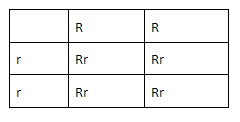
Therefore, the gametes in the first generation are Rr. In four o'clock plants (Mirabilis jalapa) we can gross a plant with red flower petals with another with white petals, the offspring have pink flower petals. If these pink flowered F1 plants are crossed, the F2 plants appear in a ratio of 1:2:1, having red, pink or white petals, respectively. In second generation, when the gametes (Rr) we get,
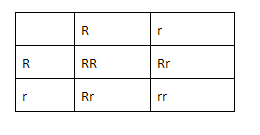
Here,
RR is red
Rr is pink, and
rr is white
Pattern of inheritance in which heterozygous offspring show a phenotype between the phenotypes of the parents (in the middle) 2. NEITHER allele is expressed fully 3.
Examples: a. Snapdragon flowers: i. Red flower + white flower = PINK flower b. Cow color: i. Red (brown) bull + white cow = Roan (Pink) cow 4. Punnett Square Example: a. Knowing that a certain flower shows a pattern of incomplete dominance, create a Punnett Square showing a cross of TWO PINK flowers.
Therefore from the above explanation, the correct option is (A)
Note: The term dominant was coined to describe the violet flowers because they completely covered up, or dominated, the white flowers. The white flowers were referred to as recessive because they were completely covered up by the violet flowers.
Complete answer:
The true test of any theory of science is its ability to explain results that at first glance appear to be a clear exception to the theory. But, if the exception can be explained by the theory, then the theory is further validated. One such genetic example that challenged Mendel's first law was the relationship between two alleles that do not express a typical dominance/recessive relationship. That is, the F1 does not exhibit the genotype of one of the two pure line parents. This type of allelic relationship was termed dominance.
Let red plants be RR and the white plants be rr, then when a punnet is drawn, we get,
Therefore, the gametes in the first generation are Rr. In four o'clock plants (Mirabilis jalapa) we can gross a plant with red flower petals with another with white petals, the offspring have pink flower petals. If these pink flowered F1 plants are crossed, the F2 plants appear in a ratio of 1:2:1, having red, pink or white petals, respectively. In second generation, when the gametes (Rr) we get,
Here,
RR is red
Rr is pink, and
rr is white
Pattern of inheritance in which heterozygous offspring show a phenotype between the phenotypes of the parents (in the middle) 2. NEITHER allele is expressed fully 3.
Examples: a. Snapdragon flowers: i. Red flower + white flower = PINK flower b. Cow color: i. Red (brown) bull + white cow = Roan (Pink) cow 4. Punnett Square Example: a. Knowing that a certain flower shows a pattern of incomplete dominance, create a Punnett Square showing a cross of TWO PINK flowers.
Therefore from the above explanation, the correct option is (A)
Note: The term dominant was coined to describe the violet flowers because they completely covered up, or dominated, the white flowers. The white flowers were referred to as recessive because they were completely covered up by the violet flowers.
Recently Updated Pages
Master Class 11 Business Studies: Engaging Questions & Answers for Success

Master Class 11 Computer Science: Engaging Questions & Answers for Success
Master Class 11 Economics: Engaging Questions & Answers for Success
Master Class 11 Social Science: Engaging Questions & Answers for Success
Master Class 11 English: Engaging Questions & Answers for Success
Master Class 11 Chemistry: Engaging Questions & Answers for Success
Trending doubts
Draw a diagram of nephron and explain its structur class 11 biology CBSE
Explain zero factorial class 11 maths CBSE
Chemical formula of Bleaching powder is A Ca2OCl2 B class 11 chemistry CBSE
Name the part of the brain responsible for the precision class 11 biology CBSE
The growth of tendril in pea plants is due to AEffect class 11 biology CBSE
One Metric ton is equal to kg A 10000 B 1000 C 100 class 11 physics CBSE