




In a meter bridge experiment, the null point is obtained at 20 cm from one end of the wire when resistance X is balanced against another resistance Y. If X is less than Y, then where will the new position of the null point be from the same end, if one decides to balance a resistance of 4X against Y?
A. 40 cm
B. 80 cm
C. 50 cm
D. 70 cm
Answer
 Verified
665.1k+ views
Hint: Find the relation between X and Y with the formula $\dfrac{X}{Y}=\dfrac{l}{100-l}$, where l is balanced from X. Then with this relation, find the new balanced length when the resistance X is replaced with 4X.
Formula used:
$\dfrac{X}{Y}=\dfrac{l}{100-l}$
Complete step-by-step answer:
Let us first understand the application of a meter bridge. A meter bridge is a device to find the relation between two unknown resistances or to find the value of an unknown resistance with help of a known resistance. It works on the principle of Wheatstone bridge. The device has a wire, one meter long with uniform resistance and to slots to attach the two resistances. It has a jockey with one end attached to the junction of the two resistances. The other end is used to balance the bridge.
A diagram of a meter bridge is given below.
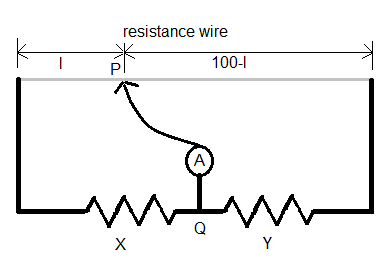
When the ammeter reads zero current, the bridge is balanced. We also call this a null point. Ats this point, the relation between the two resistances is given as:
$\dfrac{X}{Y}=\dfrac{l}{100-l}$, where X and Y are the values of the resistances.
Now, in the question, it is given that l=20cm.
Therefore, $\dfrac{X}{Y}=\dfrac{20}{100-20}=\dfrac{20}{80}=\dfrac{1}{4}$.
$\Rightarrow 4X=Y$.
The second case consists of resistances of 4X and Y. Let 4X=R and Y=S.
Hence, $\dfrac{R}{S}=\dfrac{l}{100-l}$
$\Rightarrow \dfrac{R}{S}=\dfrac{4X}{Y}=\dfrac{l}{100-l}$.
But we know that Y=4X.
Therefore,
$\dfrac{4X}{4X}=\dfrac{l}{100-l}$
$\Rightarrow 1=\dfrac{l}{100-l}$.
This implies that l=50 cm.
Therefore, when the resistance X is replaced with 4X, the new null point is obtained at a position of 50 cm from the end that has resistance 4X.
Hence, the correct option is C.
Note: The reason that we get a null point or zero current across P and Q is that the potential difference across P and Q is zero.
Please note that relation XY, then the position of the null point will also change. The smaller length is always in parallel with the resistance that has smaller value.
Formula used:
$\dfrac{X}{Y}=\dfrac{l}{100-l}$
Complete step-by-step answer:
Let us first understand the application of a meter bridge. A meter bridge is a device to find the relation between two unknown resistances or to find the value of an unknown resistance with help of a known resistance. It works on the principle of Wheatstone bridge. The device has a wire, one meter long with uniform resistance and to slots to attach the two resistances. It has a jockey with one end attached to the junction of the two resistances. The other end is used to balance the bridge.
A diagram of a meter bridge is given below.
When the ammeter reads zero current, the bridge is balanced. We also call this a null point. Ats this point, the relation between the two resistances is given as:
$\dfrac{X}{Y}=\dfrac{l}{100-l}$, where X and Y are the values of the resistances.
Now, in the question, it is given that l=20cm.
Therefore, $\dfrac{X}{Y}=\dfrac{20}{100-20}=\dfrac{20}{80}=\dfrac{1}{4}$.
$\Rightarrow 4X=Y$.
The second case consists of resistances of 4X and Y. Let 4X=R and Y=S.
Hence, $\dfrac{R}{S}=\dfrac{l}{100-l}$
$\Rightarrow \dfrac{R}{S}=\dfrac{4X}{Y}=\dfrac{l}{100-l}$.
But we know that Y=4X.
Therefore,
$\dfrac{4X}{4X}=\dfrac{l}{100-l}$
$\Rightarrow 1=\dfrac{l}{100-l}$.
This implies that l=50 cm.
Therefore, when the resistance X is replaced with 4X, the new null point is obtained at a position of 50 cm from the end that has resistance 4X.
Hence, the correct option is C.
Note: The reason that we get a null point or zero current across P and Q is that the potential difference across P and Q is zero.
Please note that relation X
Recently Updated Pages
Master Class 12 Physics: Engaging Questions & Answers for Success

Master Class 12 Social Science: Engaging Questions & Answers for Success
Master Class 12 English: Engaging Questions & Answers for Success
Master Class 12 Maths: Engaging Questions & Answers for Success
Master Class 12 Business Studies: Engaging Questions & Answers for Success
Master Class 12 Chemistry: Engaging Questions & Answers for Success
Trending doubts
Draw a labelled sketch of the human eye class 12 physics CBSE
Which are the Top 10 Largest Countries of the World?
Draw ray diagrams each showing i myopic eye and ii class 12 physics CBSE
Which is the correct genotypic ratio of mendel dihybrid class 12 biology CBSE
Give 10 examples of unisexual and bisexual flowers
What is the Full Form of PVC, PET, HDPE, LDPE, PP and PS ?