



In a class, 62 students speak assamese, 25 speak hindi and 1 student speak both the languages. How many speak at least one of these languages?
Answer
 Verified
592.2k+ views
Hint: We have to find the number of students who speak either Assamese or hindi or both. We will use formula $A \cup B = A + B - A \cap B$
Complete step-by-step answer:
First of all, let us see what is given to us.
Let n(h) be the number of students who speak hindi language, n(a) be the number of students who speak Assamese language. Therefore, the number of students who speak both Hindi and Assamese is represented by $n(a \cap h)$ which means the intersection of both the languages.
We can use the Venn diagram to represent the solution and concept.
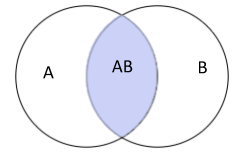
In the above diagram, A represents the n(a) and B represent the n(h). A $ \cap $B represent n(a$ \cap $b) and hence A $ \cup $B is given by
$
\Rightarrow A \cup B = A + B - A \cap B \\
\Rightarrow n(a \cup h) = n(a) + n(h) - n(a - h) \\
\Rightarrow n(a \cup b) = 25 + 62 - 1 \\
\Rightarrow n(a \cup b) = 86 \\
$
Here, n$(a \cup b)$represents the number of students who speak Assamese or students who speak Hindi or students who speak both the languages. So, 86 students speak at least one of these languages.
So, the total number of students who speak at least one of these languages is 86.
Note: Now if we solve this by mind, how we can calculate it directly. We will see how many students speak assamese language, there are 62 students speaking assamese and this also includes who speaks hindi and assamese both i.e. 1 student. So, the number of students who speak only Assamese is 61. After this, we will see how many students speak hindi language, there are 25 students speaking hindi and this also includes who speaks hindi and assamese both i.e. 1 student. So, the number of students who speak only hindi is 24. For finding the number of students who speak at least one of these languages is obtained by adding the number of students who speak hindi, assamese and both the languages i.e. \[61 + 24 + 1 = 86\]. Most common mistakes done by students are not considering the case of who speaks both the languages as they give at least one of these languages which is wrong.
Complete step-by-step answer:
First of all, let us see what is given to us.
Let n(h) be the number of students who speak hindi language, n(a) be the number of students who speak Assamese language. Therefore, the number of students who speak both Hindi and Assamese is represented by $n(a \cap h)$ which means the intersection of both the languages.
We can use the Venn diagram to represent the solution and concept.
In the above diagram, A represents the n(a) and B represent the n(h). A $ \cap $B represent n(a$ \cap $b) and hence A $ \cup $B is given by
$
\Rightarrow A \cup B = A + B - A \cap B \\
\Rightarrow n(a \cup h) = n(a) + n(h) - n(a - h) \\
\Rightarrow n(a \cup b) = 25 + 62 - 1 \\
\Rightarrow n(a \cup b) = 86 \\
$
Here, n$(a \cup b)$represents the number of students who speak Assamese or students who speak Hindi or students who speak both the languages. So, 86 students speak at least one of these languages.
So, the total number of students who speak at least one of these languages is 86.
Note: Now if we solve this by mind, how we can calculate it directly. We will see how many students speak assamese language, there are 62 students speaking assamese and this also includes who speaks hindi and assamese both i.e. 1 student. So, the number of students who speak only Assamese is 61. After this, we will see how many students speak hindi language, there are 25 students speaking hindi and this also includes who speaks hindi and assamese both i.e. 1 student. So, the number of students who speak only hindi is 24. For finding the number of students who speak at least one of these languages is obtained by adding the number of students who speak hindi, assamese and both the languages i.e. \[61 + 24 + 1 = 86\]. Most common mistakes done by students are not considering the case of who speaks both the languages as they give at least one of these languages which is wrong.
Recently Updated Pages
Master Class 11 Computer Science: Engaging Questions & Answers for Success

Master Class 11 Business Studies: Engaging Questions & Answers for Success
Master Class 11 Economics: Engaging Questions & Answers for Success
Master Class 11 English: Engaging Questions & Answers for Success
Master Class 11 Maths: Engaging Questions & Answers for Success
Master Class 11 Biology: Engaging Questions & Answers for Success
Trending doubts
One Metric ton is equal to kg A 10000 B 1000 C 100 class 11 physics CBSE
There are 720 permutations of the digits 1 2 3 4 5 class 11 maths CBSE
Discuss the various forms of bacteria class 11 biology CBSE
Draw a diagram of a plant cell and label at least eight class 11 biology CBSE
State the laws of reflection of light
Explain zero factorial class 11 maths CBSE