




If the maximum number of points in which 4 circles and 4 straight lines intersect is k, then write the value of k.
Answer
 Verified
665.4k+ views
Hint: In order to solve this question, we should know that for maximum intersection we will consider two figures crossing each other and not touching each other. Also, we have to remember that for choosing r out of n items irrespective of their orders, we can use the formula of combination, that is, $^{n}{{C}_{r}}=\dfrac{n!}{r!\left( n-r \right)!}$. By using these concepts we will solve this question.
Complete step-by-step answer:
In this question, we have been asked to find the value of k which is the maximum number of points of intersection of four straight lines and four circles. For that, we will consider the crossing of two figures and not the touching of two figures because touching any two figures will give less points than crossing of two figures.
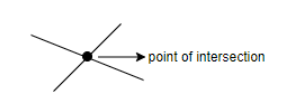
Now, we know that when two lines intersect, the maximum possible point of intersection will be one. So, for line-line intersection, we have to choose 2 out of 4 lines which we can do by using the formula of combination, which is used to choose r out of n items, that is $^{n}{{C}_{r}}=\dfrac{n!}{r!\left( n-r \right)!}$. So, for n = 4 and r = 2, we will get,
$\begin{align}
& ^{4}{{C}_{2}}=\dfrac{4!}{2!\left( 4-2 \right)!} \\
& ^{4}{{C}_{2}}=\dfrac{4!}{2!2!} \\
& ^{4}{{C}_{2}}=\dfrac{4\times 3\times 2!}{\left( 2\times 1 \right)2!}=\dfrac{4\times 3}{2}=6 \\
& {{\therefore }^{4}}{{C}_{2}}=10 \\
\end{align}$
Hence, the maximum number of points of intersection of 4 lines is 6 points.
Now, in the same way, we will calculate the points of intersection of 2 circles
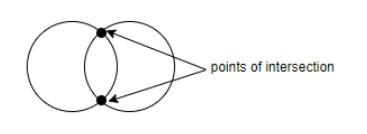
Now, we know that we get 2 points when 2 circles intersect each other and we have to choose 2 out of 4 circles. So, we can say that the maximum number of points of intersection of the circles can be given as,
$\begin{align}
& \Rightarrow 2{{\times }^{4}}{{C}_{2}} \\
& =2\times \dfrac{4!}{2!\left( 4-2 \right)!} \\
& =2\times \dfrac{4!}{2!2!} \\
& =2\times \dfrac{4\times 3\times 2!}{2!2!} \\
& =2\times \dfrac{4\times 3}{2} \\
& =2\times 6 \\
& =12 \\
\end{align}$
Now, we will consider the case of line-circle intersection.
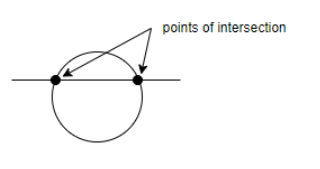
Now, from the figure, we can see that when a line intersects a circle, it gives 2 points of intersection and we have to choose 1 circle out of 4 circles and 1 line out of 4 lines. So, we can write the maximum points of line circle intersection as,
\[\begin{align}
& 2{{\times }^{4}}{{C}_{1}}{{\times }^{4}}{{C}_{1}} \\
& =2\times \dfrac{4!}{1!\left( 4-1 \right)!}\times \dfrac{4!}{1!\left( 4-1 \right)!} \\
& =2\times \dfrac{4!}{1!3!}\times \dfrac{4!}{1!3!} \\
& =2\times \dfrac{4\times 3!}{1\times 3!}\times \dfrac{4\times 3!}{1\times 3!} \\
& =2\times 4\times 4 \\
& =32 \\
\end{align}\]
Hence, we can find the value of k, which is the maximum points of intersection of 4 lines and 4 circles by adding the points of line-line intersection, circle-circle intersection and line-circle intersection. So, we get,
k = 6 + 12 + 32
k = 50 points
Therefore, the maximum points of intersection of 4 lines and 4 circles, k is 50 points.
Note: The possible mistake one can make in this question is by not including line-line intersection, circle-circle intersection or line-circle intersection. Also, one can think of solving this question by making a figure which includes all the conditions given in the question which will help us get the right answer, but the figure will get complicated so it is better to solve the conditions separately.
Complete step-by-step answer:
In this question, we have been asked to find the value of k which is the maximum number of points of intersection of four straight lines and four circles. For that, we will consider the crossing of two figures and not the touching of two figures because touching any two figures will give less points than crossing of two figures.
Now, we know that when two lines intersect, the maximum possible point of intersection will be one. So, for line-line intersection, we have to choose 2 out of 4 lines which we can do by using the formula of combination, which is used to choose r out of n items, that is $^{n}{{C}_{r}}=\dfrac{n!}{r!\left( n-r \right)!}$. So, for n = 4 and r = 2, we will get,
$\begin{align}
& ^{4}{{C}_{2}}=\dfrac{4!}{2!\left( 4-2 \right)!} \\
& ^{4}{{C}_{2}}=\dfrac{4!}{2!2!} \\
& ^{4}{{C}_{2}}=\dfrac{4\times 3\times 2!}{\left( 2\times 1 \right)2!}=\dfrac{4\times 3}{2}=6 \\
& {{\therefore }^{4}}{{C}_{2}}=10 \\
\end{align}$
Hence, the maximum number of points of intersection of 4 lines is 6 points.
Now, in the same way, we will calculate the points of intersection of 2 circles
Now, we know that we get 2 points when 2 circles intersect each other and we have to choose 2 out of 4 circles. So, we can say that the maximum number of points of intersection of the circles can be given as,
$\begin{align}
& \Rightarrow 2{{\times }^{4}}{{C}_{2}} \\
& =2\times \dfrac{4!}{2!\left( 4-2 \right)!} \\
& =2\times \dfrac{4!}{2!2!} \\
& =2\times \dfrac{4\times 3\times 2!}{2!2!} \\
& =2\times \dfrac{4\times 3}{2} \\
& =2\times 6 \\
& =12 \\
\end{align}$
Now, we will consider the case of line-circle intersection.
Now, from the figure, we can see that when a line intersects a circle, it gives 2 points of intersection and we have to choose 1 circle out of 4 circles and 1 line out of 4 lines. So, we can write the maximum points of line circle intersection as,
\[\begin{align}
& 2{{\times }^{4}}{{C}_{1}}{{\times }^{4}}{{C}_{1}} \\
& =2\times \dfrac{4!}{1!\left( 4-1 \right)!}\times \dfrac{4!}{1!\left( 4-1 \right)!} \\
& =2\times \dfrac{4!}{1!3!}\times \dfrac{4!}{1!3!} \\
& =2\times \dfrac{4\times 3!}{1\times 3!}\times \dfrac{4\times 3!}{1\times 3!} \\
& =2\times 4\times 4 \\
& =32 \\
\end{align}\]
Hence, we can find the value of k, which is the maximum points of intersection of 4 lines and 4 circles by adding the points of line-line intersection, circle-circle intersection and line-circle intersection. So, we get,
k = 6 + 12 + 32
k = 50 points
Therefore, the maximum points of intersection of 4 lines and 4 circles, k is 50 points.
Note: The possible mistake one can make in this question is by not including line-line intersection, circle-circle intersection or line-circle intersection. Also, one can think of solving this question by making a figure which includes all the conditions given in the question which will help us get the right answer, but the figure will get complicated so it is better to solve the conditions separately.
Recently Updated Pages
Which of the following graphs shows the variation of class 12 physics CBSE

Draw a labelled diagram of the human male reproductive class 12 biology CBSE
Describe the experiment to compare the emf of two cells class 12 physics CBSE
What is standard hydrogen electrode
What is conventional current and electric current class 12 physics CBSE
2Bromopentane is treated with an alcoholic KOH solution class 12 chemistry CBSE
Trending doubts
Draw a labelled sketch of the human eye class 12 physics CBSE
Which are the Top 10 Largest Countries of the World?
Differentiate between homogeneous and heterogeneous class 12 chemistry CBSE
Draw ray diagrams each showing i myopic eye and ii class 12 physics CBSE
Which is the correct genotypic ratio of mendel dihybrid class 12 biology CBSE
What is the Full Form of PVC, PET, HDPE, LDPE, PP and PS ?