




If primary root continues to grow type of root system will be known as
A. Secondary root
B. Fibrous root
C. Tap root
D. Stilt root
Answer
 Verified
605.4k+ views
Hint: Root is the underground part of the plant. Roots originate by the elongation of the radicle of the embryo. There are different types of root found in plants like tap, fibrous, adventitious roots.
Complete step by step answer:
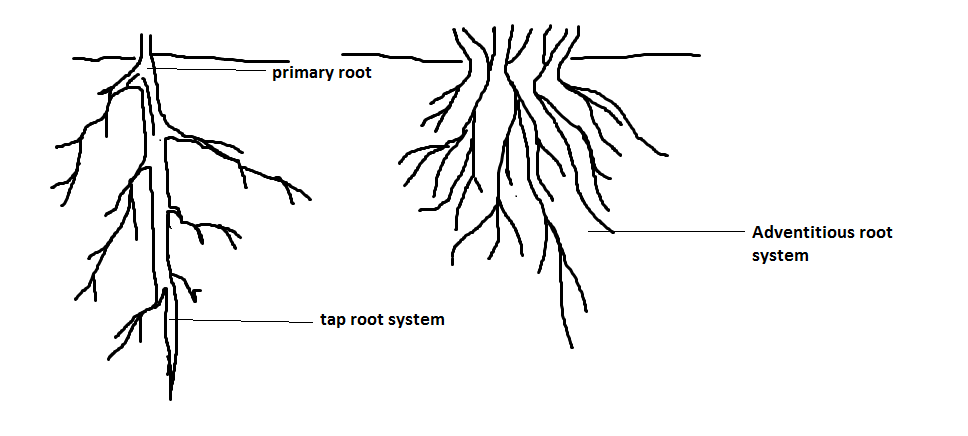
Roots originate by the elongation of the radicle of the embryo. Root gives support to the aerial part of the plant that is the stem. Also, the root absorbs minerals and water from the soil. Along with these functions root also performs various functions and modifies according to this. Roots are of different types in different plants. In monocot plants, the fibrous root is found and in dicot plants root is called tap root. The tap root is found in dicot angiosperms. At the time of embryonic development, the radicle elongates and forms the primary root. This primary root grows continuously downward and also gives rise to many branches during growth. These branches are secondary and tertiary roots. All secondary and tertiary branches are called lateral roots. This type of root is called a tap root system.
Fibrous roots are found in monocots. These are also called adventitious roots. The primary root that is developed from radicle destruction and new roots are developed from any other part of the plant-like basal part of the stem. This root has thick fibers and is called the fibrous root.
Stilt roots are modified adventitious roots that are found in mangrove plants.
Hence option C is correct.
Note: The lateral roots and adventitious roots are endogenous in nature. In epiphytes and climbers, aerial roots are found. Plants that live in a saline water area called mangroves. These have pneumatophore roots. Sometimes root modifies food. For example- carrot, radish, beets, etc.
Complete step by step answer:
Roots originate by the elongation of the radicle of the embryo. Root gives support to the aerial part of the plant that is the stem. Also, the root absorbs minerals and water from the soil. Along with these functions root also performs various functions and modifies according to this. Roots are of different types in different plants. In monocot plants, the fibrous root is found and in dicot plants root is called tap root. The tap root is found in dicot angiosperms. At the time of embryonic development, the radicle elongates and forms the primary root. This primary root grows continuously downward and also gives rise to many branches during growth. These branches are secondary and tertiary roots. All secondary and tertiary branches are called lateral roots. This type of root is called a tap root system.
Fibrous roots are found in monocots. These are also called adventitious roots. The primary root that is developed from radicle destruction and new roots are developed from any other part of the plant-like basal part of the stem. This root has thick fibers and is called the fibrous root.
Stilt roots are modified adventitious roots that are found in mangrove plants.
Hence option C is correct.
Note: The lateral roots and adventitious roots are endogenous in nature. In epiphytes and climbers, aerial roots are found. Plants that live in a saline water area called mangroves. These have pneumatophore roots. Sometimes root modifies food. For example- carrot, radish, beets, etc.
Recently Updated Pages
Master Class 11 Economics: Engaging Questions & Answers for Success

Master Class 11 English: Engaging Questions & Answers for Success
Master Class 11 Maths: Engaging Questions & Answers for Success
Class 11 Question and Answer - Your Ultimate Solutions Guide
Master Class 11 Social Science: Engaging Questions & Answers for Success
Master Class 11 Business Studies: Engaging Questions & Answers for Success
Trending doubts
Differentiate between an exothermic and an endothermic class 11 chemistry CBSE
One Metric ton is equal to kg A 10000 B 1000 C 100 class 11 physics CBSE
There are 720 permutations of the digits 1 2 3 4 5 class 11 maths CBSE
In what year Guru Nanak Dev ji was born A15 April 1469 class 11 social science CBSE
Difference Between Prokaryotic Cells and Eukaryotic Cells
Draw a diagram of a plant cell and label at least eight class 11 biology CBSE