




If one of the diagonals of a rhombus is equal to one of its sides, then find the greater angle of the rhombus?
(a) 60
(b) 120
(c) 90
(d) 150
Answer
 Verified
622.2k+ views
Hint: We start solving the problem by drawing the given rhombus and the diagonal. We use the fact that all sides of the rhombus are equal and angles opposite to equal sides in a triangle are equal to get the angle of the triangles which were formed due to the diagonal. We find all the angles in a rhombus and we check which is the greatest angle.
Complete step by step answer:
Given that we had a rhombus which had a length of the diagonal equal to one of its sides. We need to find the greatest of the rhombus.
Let us draw the rhombus ABCD and diagonal equal to its sides to get a better view.
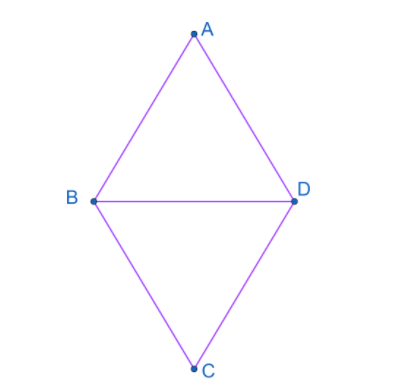
We know that the lengths of the sides of rhombus are equal. Let us assume that the length of the diagonal BD is equal to the sides of the rhombus.
Let us take the triangle BDC and we can see that the length of all the sides of the triangle are equal. We know that angles opposite to the equal sides in a triangle are equal.
So, we have $\angle BCD=\angle CDB=\angle DBC$. We know that the sum of angles in a triangle is ${{180}^{o}}$.
$\Rightarrow \angle BCD+\angle CDB+\angle DBC={{180}^{o}}$.
$\Rightarrow \angle BCD+\angle BCD+\angle BCD={{180}^{o}}$.
$\Rightarrow 3\angle BCD={{180}^{o}}$.
$\Rightarrow \angle BCD=\dfrac{{{180}^{o}}}{3}$.
$\Rightarrow \angle BCD={{60}^{o}}$.
So, we get $\angle BCD=\angle CDB=\angle DBC={{60}^{o}}$ ---(1).
Let us take the triangle ABD and we can see that the length of all the sides of the triangle are equal. We know that angles opposite to the equal sides in a triangle are equal.
So, we have $\angle BAD=\angle ADB=\angle DBA$. We know that the sum of angles in a triangle is ${{180}^{o}}$.
$\Rightarrow \angle BAD+\angle ADB+\angle DBA={{180}^{o}}$.
$\Rightarrow \angle BAD+\angle BAD+\angle BAD={{180}^{o}}$.
$\Rightarrow 3\angle BAD={{180}^{o}}$.
$\Rightarrow \angle BAD=\dfrac{{{180}^{o}}}{3}$.
$\Rightarrow \angle BAD={{60}^{o}}$.
So, we get $\angle BAD=\angle ADB=\angle DBA={{60}^{o}}$ ---(2).
From the figure, we can see that $\angle B=\angle DBA+\angle CBD$.
$\Rightarrow \angle B={{60}^{o}}+{{60}^{o}}$.
$\Rightarrow \angle B={{120}^{o}}$.
Similarly, we can find $\angle D={{120}^{o}}$.
We have found the largest angle as ${{120}^{o}}$.
∴ The largest angle in the given rhombus is ${{120}^{o}}$.
So, the correct answer is “Option B”.
Note: We must remember that all sides in rhombus are equal but we should know that all angles are not equal. If all the angles and sides are equal in a figure, it becomes square which makes all the diagonals equal. The diagonals of the rhombus are not equal. Similarly, we can expect problems to find the length of other diagonals after finding the angles of rhombus.
Complete step by step answer:
Given that we had a rhombus which had a length of the diagonal equal to one of its sides. We need to find the greatest of the rhombus.
Let us draw the rhombus ABCD and diagonal equal to its sides to get a better view.
We know that the lengths of the sides of rhombus are equal. Let us assume that the length of the diagonal BD is equal to the sides of the rhombus.
Let us take the triangle BDC and we can see that the length of all the sides of the triangle are equal. We know that angles opposite to the equal sides in a triangle are equal.
So, we have $\angle BCD=\angle CDB=\angle DBC$. We know that the sum of angles in a triangle is ${{180}^{o}}$.
$\Rightarrow \angle BCD+\angle CDB+\angle DBC={{180}^{o}}$.
$\Rightarrow \angle BCD+\angle BCD+\angle BCD={{180}^{o}}$.
$\Rightarrow 3\angle BCD={{180}^{o}}$.
$\Rightarrow \angle BCD=\dfrac{{{180}^{o}}}{3}$.
$\Rightarrow \angle BCD={{60}^{o}}$.
So, we get $\angle BCD=\angle CDB=\angle DBC={{60}^{o}}$ ---(1).
Let us take the triangle ABD and we can see that the length of all the sides of the triangle are equal. We know that angles opposite to the equal sides in a triangle are equal.
So, we have $\angle BAD=\angle ADB=\angle DBA$. We know that the sum of angles in a triangle is ${{180}^{o}}$.
$\Rightarrow \angle BAD+\angle ADB+\angle DBA={{180}^{o}}$.
$\Rightarrow \angle BAD+\angle BAD+\angle BAD={{180}^{o}}$.
$\Rightarrow 3\angle BAD={{180}^{o}}$.
$\Rightarrow \angle BAD=\dfrac{{{180}^{o}}}{3}$.
$\Rightarrow \angle BAD={{60}^{o}}$.
So, we get $\angle BAD=\angle ADB=\angle DBA={{60}^{o}}$ ---(2).
From the figure, we can see that $\angle B=\angle DBA+\angle CBD$.
$\Rightarrow \angle B={{60}^{o}}+{{60}^{o}}$.
$\Rightarrow \angle B={{120}^{o}}$.
Similarly, we can find $\angle D={{120}^{o}}$.
We have found the largest angle as ${{120}^{o}}$.
∴ The largest angle in the given rhombus is ${{120}^{o}}$.
So, the correct answer is “Option B”.
Note: We must remember that all sides in rhombus are equal but we should know that all angles are not equal. If all the angles and sides are equal in a figure, it becomes square which makes all the diagonals equal. The diagonals of the rhombus are not equal. Similarly, we can expect problems to find the length of other diagonals after finding the angles of rhombus.
Recently Updated Pages
Master Class 12 Economics: Engaging Questions & Answers for Success

Master Class 12 English: Engaging Questions & Answers for Success
Master Class 12 Social Science: Engaging Questions & Answers for Success
Master Class 12 Maths: Engaging Questions & Answers for Success
Master Class 12 Physics: Engaging Questions & Answers for Success
Master Class 9 General Knowledge: Engaging Questions & Answers for Success
Trending doubts
Explain the Treaty of Vienna of 1815 class 10 social science CBSE
Who Won 36 Oscar Awards? Record Holder Revealed
Why is it 530 pm in india when it is 1200 afternoon class 10 social science CBSE
Make a sketch of the human nerve cell What function class 10 biology CBSE
What is the full form of POSCO class 10 social science CBSE
Define Potential, Developed, Stock and Reserved resources