




If a point $P$ has co-ordinates (0, -2) and $Q$ is any point on the circle${{x}^{2}}+{{y}^{2}}-5x-y+5=0$, then find out the maximum value of ${{\left( PQ \right)}^{2}}$.\[\]
A.$8+5\sqrt{3}$\[\]
B.$\dfrac{25+\sqrt{6}}{2}$\[\]
C. $14+5\sqrt{3}$\[\]
D. $\dfrac{47+10\sqrt{6}}{2}$\[\]
Answer
 Verified
667.2k+ views
Hint: Check whether the point $P$ lies inside or outside the circle. Accordingly, draw a diagram to deduce that the maximum distance between $P$ and $Q$ is possible when$P$, $Q$ and the center of the circle lies in the same line. Use that to find out the answer.
Complete step-by-step solution:
The given equation of circle is ${{x}^{2}}+{{y}^{2}}-5x-y+5=0$. We know from the standard equation of circle on a plane ${{x}^{2}}+{{y}^{2}}+2gx+2fy+c=0$ that the centres is $\left( -g,-f \right)=\left( \dfrac{5}{2},\dfrac{1}{2} \right)$ and the radius is \[r=\sqrt{{{g}^{2}}+{{f}^{2}}-c}=\sqrt{\left( \dfrac{5}{2} \right)^{2}+\left( \dfrac{5}{2} \right)^{2} -5}=\dfrac{\sqrt{6}}{2}\] .
Any point $\left( {{x}_{1}},{{y}_{1}} \right)$ lies inside the circle if ${{x}_{1}}^{2}+{{y}_{1}}^{2}+2g{{x}_{1}}+2f{{y}_{1}}+c<0$ and outside the circle if ${{x}_{1}}^{2}+{{y}_{1}}^{2}+2g{{x}_{1}}+2f{{y}_{1}}+c>0$. Checking whether $P$ lies inside or outside the circle,
\[{{0}^{2}}+{{\left( -2 \right)}^{2}}+5.0-\left( -2 \right)+5=7>0\]
We draw a diagram with $P$ outside the circle and $Q$ on the circle. We denote $O\left( \dfrac{5}{2},\dfrac{1}{2} \right)$ as the centre of the circle. So the radius of the circle $r=OQ=\dfrac{6}{\sqrt{2}}$.\[\]
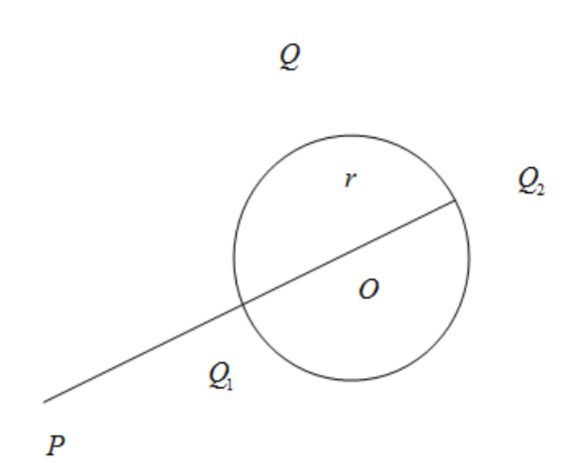
If we move $Q$ everywhere on the circle there can be a minimum of one and a maximum two points of intersection possible for the circle and the line segment$PQ$. Let us denote the first point of intersection as ${{Q}_{1}}$ and the second point of intersection as ${{Q}_{2}}$.
We can observe that $PQ$ is minimum when $Q={{Q}_{1}}$ and maximum when $Q={{Q}_{2}}$ that is the center $O$ and both points $Q$ and $P$are co-linear. . So $PQ$ is maximum when $PQ=P{{Q}_{2}}=PO+O{{Q}_{2}}=PO+r$ that is the sum of the distance from the point to the center and distance and the radius. We use the distance formula between two points to find out the long distance from the point $P$ to the center.
\[OP=\sqrt{{{\left( \dfrac{5}{2}-0 \right)}^{2}}+{{\left( \dfrac{1}{2}-\left( -2 \right) \right)}^{2}}}=\sqrt{\dfrac{50}{4}}=\dfrac{5\sqrt{2}}{2}\]
So the maximum value of $PQ=OP+r=\dfrac{5\sqrt{2}}{2}+\dfrac{\sqrt{6}}{2}$. As given in the question we need to find out maximum value of ${{\left( PQ \right)}^{2}}$
\[{{\left( PQ \right)}^{2}}={{\left( \dfrac{5\sqrt{2}}{2}+\dfrac{\sqrt{6}}{2} \right)}^{2}}=\dfrac{50+6+20\sqrt{3}}{4}=14+5\sqrt{3}\]
So the correct option is C.
Note:The question tests your knowledge of the general equation of circle and distance formula in two dimensions. Careful drawing of the figure and usage of formula will lead us to arrive at the correct result. The problem can also be re-framed to ask the minimum value with a circle or ellipse.
Complete step-by-step solution:
The given equation of circle is ${{x}^{2}}+{{y}^{2}}-5x-y+5=0$. We know from the standard equation of circle on a plane ${{x}^{2}}+{{y}^{2}}+2gx+2fy+c=0$ that the centres is $\left( -g,-f \right)=\left( \dfrac{5}{2},\dfrac{1}{2} \right)$ and the radius is \[r=\sqrt{{{g}^{2}}+{{f}^{2}}-c}=\sqrt{\left( \dfrac{5}{2} \right)^{2}+\left( \dfrac{5}{2} \right)^{2} -5}=\dfrac{\sqrt{6}}{2}\] .
Any point $\left( {{x}_{1}},{{y}_{1}} \right)$ lies inside the circle if ${{x}_{1}}^{2}+{{y}_{1}}^{2}+2g{{x}_{1}}+2f{{y}_{1}}+c<0$ and outside the circle if ${{x}_{1}}^{2}+{{y}_{1}}^{2}+2g{{x}_{1}}+2f{{y}_{1}}+c>0$. Checking whether $P$ lies inside or outside the circle,
\[{{0}^{2}}+{{\left( -2 \right)}^{2}}+5.0-\left( -2 \right)+5=7>0\]
We draw a diagram with $P$ outside the circle and $Q$ on the circle. We denote $O\left( \dfrac{5}{2},\dfrac{1}{2} \right)$ as the centre of the circle. So the radius of the circle $r=OQ=\dfrac{6}{\sqrt{2}}$.\[\]
If we move $Q$ everywhere on the circle there can be a minimum of one and a maximum two points of intersection possible for the circle and the line segment$PQ$. Let us denote the first point of intersection as ${{Q}_{1}}$ and the second point of intersection as ${{Q}_{2}}$.
We can observe that $PQ$ is minimum when $Q={{Q}_{1}}$ and maximum when $Q={{Q}_{2}}$ that is the center $O$ and both points $Q$ and $P$are co-linear. . So $PQ$ is maximum when $PQ=P{{Q}_{2}}=PO+O{{Q}_{2}}=PO+r$ that is the sum of the distance from the point to the center and distance and the radius. We use the distance formula between two points to find out the long distance from the point $P$ to the center.
\[OP=\sqrt{{{\left( \dfrac{5}{2}-0 \right)}^{2}}+{{\left( \dfrac{1}{2}-\left( -2 \right) \right)}^{2}}}=\sqrt{\dfrac{50}{4}}=\dfrac{5\sqrt{2}}{2}\]
So the maximum value of $PQ=OP+r=\dfrac{5\sqrt{2}}{2}+\dfrac{\sqrt{6}}{2}$. As given in the question we need to find out maximum value of ${{\left( PQ \right)}^{2}}$
\[{{\left( PQ \right)}^{2}}={{\left( \dfrac{5\sqrt{2}}{2}+\dfrac{\sqrt{6}}{2} \right)}^{2}}=\dfrac{50+6+20\sqrt{3}}{4}=14+5\sqrt{3}\]
So the correct option is C.
Note:The question tests your knowledge of the general equation of circle and distance formula in two dimensions. Careful drawing of the figure and usage of formula will lead us to arrive at the correct result. The problem can also be re-framed to ask the minimum value with a circle or ellipse.
Recently Updated Pages
Master Class 10 Computer Science: Engaging Questions & Answers for Success

Differentiate between voluntary action and reflex class 10 biology CBSE
The uses of bleaching powder are A It is used bleaching class 10 chemistry CBSE
Fill in the blanks with abstract nouns of the words class 10 english CBSE
How many threedigit numbers are there class 10 maths CBSE
What is a reflex arc class 10 biology CBSE
Trending doubts
Explain the Treaty of Vienna of 1815 class 10 social science CBSE
In basketball, how many quarters are played in an NBA game?
10 examples of evaporation in daily life with explanations
Which country is known as "The land of Fire and Ice"?
What is the full form of POSCO class 10 social science CBSE
In which year voting age was reduced from 21 to 18?